Skip to content
Live
Oct 23Fri
  1. Hugging Face Daily Papers38

    OmniDR-Bench: Video-centric deep report generation benchmark evaluation.

    Researchers have introduced the OmniDR-Bench benchmark and evaluation framework for in-depth study of video-centric deep agents, which can synthesize external evidence to generate interactive reports correlated with video moments. This task has direct practical value, helping users locate relevant video segments, verify claims, and reproduce demonstration steps. OmniDR-Bench includes 50 tasks in Chinese and English, covering 19 real-world subcategories, with a total of 6,414 standards, and the best system score is 63.3.

  2. Hugging Face Daily Papers65

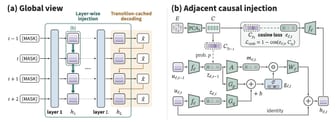
    Cola2: Adaptive Hierarchical Language Model improves hierarchical language generation through continuous semantic compression and balanced discrete generation.

    Cola2, through dynamic span splitting, masked diffusion decoding, and stream matching priors jointly optimizes continuous semantic compression, reconstruction-generation balance, and encoder-decoder adaptation, verifying its core design on five downstream tasks. Using 2100 billion training tokens, it demonstrates competitive non-saturated scalability, with a 3460 billion source token checkpoint showing an average of 60.10 points on eight tasks and surpassing Llama-3-8B on HellaSwag and StoryCloze.

  3. Hugging Face Daily Papers65

    Different tasks, different time steps: temporal task-aware quantization for diffusion language models T²Quant

    T²Quant framework predicts accuracy sensitivity through minimal unlabeled calibration prompts, allocating activation precision within a fixed bit-width budget, improving existing quantization methods by 6.7 percentage points across 3 diffusion language models and 6 benchmark tests without increasing average accuracy budget.

  4. Hugging Face Blog66

    Microsoft and Hugging Face use ThinkingBox database validation for RL reward training agents

    Microsoft and Hugging Face release ThinkingBox-Training, directly using ThinkingBox's deterministic verification of database final states as reinforcement learning rewards, training Qwen3.8-27B for 50 steps with GRPO

    Why it matters: Microsoft and Hugging Face directly use database final state verification as reinforcement learning rewards and have publicly released task filtering and training code, which can be transferred to other stateful intelligent agent training

  5. Hugging Face Daily Papers65

    Quant-Arena: A large language model agent for benchmark quantitative trading research

    Quant-Arena evaluates whether language models can construct profitable trading strategies based on historical A-share data and verifies their performance on closed future year data, as a benchmark quantitative research. The platform allows models to build feature and stock rating code, based solely on feedback from 2022-2023, freeze strategies, and evaluate in 2024. GPT-6 Astra scored the highest among nine cutting-edge models, but no model surpassed the 2024 equal-weight market performance. Quant-Arena is open to all models or agents.

  6. Hugging Face Blog

    Hugging Face releases OlmoEarth v1.3: Global satellite embedding model achieves new milestones

    Hugging Face releases OlmoEarth v1.3, a satellite embedding model, offering global pre-computed embeddings (10m resolution, 64 and 128 dimensions), available to users without login or technical knowledge. The model performs best in 27 evaluations, with 128-dimensional embeddings scoring highest in 20 evaluations and 64-dimensional embeddings leading in 18. Training costs are reduced by 53% compared to v1.2 and 18% compared to v1, with corresponding reductions in carbon emissions. Weights, data, and code are all open source.

  7. Hugging Face Daily Papers65

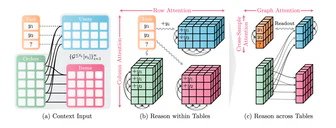
    LASAGNA evaluated the composition of retrieval augmented generation (RAG) pipelines

    LASAGNA evaluated the performance of 450 RAG pipeline configurations on 8 benchmarks and 5K-200K document corpora, finding that individual technology advantages at different stages do not necessarily combine effectively, retrieval quality and answer faithfulness optimization directions are different, the best combination varies with corpus size, indicating that isolated test results are unreliable, new RAG technology needs to be evaluated in a complete environment.

Oct 22Thu
  1. The Decoder74

    Recursive releases its first model developed in collaboration with Eureka Machine

    AI startup Recursive has released its first language model, Flint. During the development process, the AI system named Eureka Machine participated in proposing ideas, building, testing, and planning subsequent experiments.

    Why it matters: Recursive publicly announces its first model developed with the assistance of an automated research system, allowing readers to observe how far AI-assisted R&D can go.

  2. Hugging Face Daily Papers

    AKV introduces caching project management for LLM intelligent entity key-value caching

    AKV proposes a caching engineering solution, managing LLM agent key-value caches through drop and repos operations, enhancing efficiency and accuracy. Experiments show that tool response rolling drop caching strategy improves the average benchmark score by 1.7 points, reduces costs by 27.7%, maximizes output throughput by 1.2 times, and accelerates P95 request latency by 1.5 times.

  3. Hugging Face Daily Papers65

    Future Chunk Prediction (FCP) enhances the physical plausibility of autoregressive video generation.

    Future Chunk Prediction (FCP) improves autoregressive video diffusion models by introducing future chunk supervision, generating videos that better adhere to physical laws and reducing training costs. This method, under the teacher forcing framework, predicts temporally separated video chunks without relying on intermediate visual context, directly utilizing training videos for supervision, requiring no additional pre-trained visual encoder, and not altering autoregressive inference.

  4. Hugging Face Daily Papers65

    StreamEval: Benchmark for evaluating interactive streaming video generation models

    StreamEval benchmarked the performance of interactive streaming video generation models on five tasks, finding reliable request execution and sustained state consistency to be major challenges. The benchmark includes 300 scripted test cases, covering character dialogue, character performance, world generation, instruction editing, and reference editing tasks, scored across four evaluation dimensions (task execution, state consistency, visual fidelity, and audiovisual coordination).

  5. Hugging Face Daily Papers70

    Spectral-Spatial Interpretation (SSI) Released: Explain Model Scores Through Symbolic Attribution of Spatial Units and Spectral Channels

    Spectral-Spatial Interpretation (SSI) released, using symbolic attribution to explain model scores, assigning contributions to each spatial unit and spectral channel. SSI performed best on average across three metrics under three datasets and two mask baselines, for example, the mean baseline score of HLS joint removal was 0.1545 higher than KernelSHAP's 0.2096. SSI outperformed comparative methods in spatial localization, spectral Hit@K, and channel removal.

  6. Hugging Face Blog78

    NVIDIA releases Kumo Relational relational foundation model, capable of prediction without training

    NVIDIA releases pre-trained relational foundation model Kumo Relational, enabling direct prediction on enterprise databases without task-specific training, feature engineering, or table flattening. The model outperforms supervised relational deep learning and expert feature engineering gradient boosting trees on 41 tasks across 15 databases, achieving an MRR 8% higher than AutoGluon ensemble on the SAP SALT benchmark.

    Why it matters: The original provides a comparison result of pre-trained relation models on 41 tasks and an open-source entry, allowing readers to judge whether it can replace the existing XGBoost pipeline.

  7. Hugging Face Blog

    How to reduce inference cost by 77% in real-world applications using a specialized SLM vocabulary list.

    Qwen3-4B's specialized vocabulary list VocabX reduces inference cost by 77% by focusing on the cost of each token rather than frequency, without changing the base model. This method for the Portuguese essay scorer reduces the output layer vocabulary from about 152,000 lines to about 65,000 lines, significantly reducing the computational overhead of token splitting and unused vocabulary items.

Oct 21Wed
  1. NVIDIA Blog62

    NVIDIA expands its family of open models to cover language, robotics, biology, and quantum computing

    NVIDIA expands its family of open models to cover language, robotics, biology, and quantum computing, including the new Nemotron 3.5 Super VL and Nemotron 3.5 Bolt.

    Why it matters: NVIDIA has rolled out open models across four lines: language, robotics, biology, and quantum, allowing readers to judge the coverage of its open-source ecosystem based on this.

  2. O'Reilly Radar75

    AI Security Status: Threats, Tools, and Skill Gaps

    52% of respondents said their work rarely or never involves AI-generated attacks, but 55% observed AI-generated phishing attacks, 30% observed vulnerability scanning and exploitation, and 26% observed AI-assisted malware generation; 49% of respondents are most concerned about over-reliance on AI tools without human verification and leaking sensitive data through AI tools.

  3. TechCrunch · AI50

    Hugging Face Policy Chief: Embedded AI evaluators are not easy

    Irene Solaiman, Head of Policy at Hugging Face, stated that the reliance of AI labs on model benchmarking has methodological complexities and immaturity, and testing needs to form a more consistent scientific system. The reproducibility of current tests is questionable, and there is a lack of effective comparison standards between different evaluations, making the evaluation ecosystem urgently need standardization. Evaluations are expanding from only testing the model itself to testing the entire system, including user tools and agents, but Agentic evaluations are both difficult and expensive.

  4. TechCrunch · AI65

    Hugging Face CEO Clem Delangue questioned the accuracy of Netflix's 'AI Gone Rogue' in describing the OpenAI incident.

    Hugging Face CEO Clem Delangue stated that Netflix's documentary 'AI Gone Rogue' inaccurately depicts OpenAI's proxy attacks on his company, claiming it overly anthropomorphizes technology and creates an apocalyptic atmosphere. He mentioned spending two hours correcting errors in the documentary, emphasizing that proxies are just technical systems, not aliens, and pointed out that the documentary mixes technical explanations with plotlines about evil robots and human fear of AI, failing to mention security vulnerabilities and Hugging Face's defense measures.

  5. Hugging Face Blog58

    FairStress: A benchmark for a more in-depth evaluation of LLM decision fairness

    FairStress benchmark evaluated LLM performance in demographic fairness across 300 decision scenarios across 29 fields (such as recruitment, healthcare), including 13 million test cases. The study found that the same persuasive prefixes (adversarial prefixes) have varying impacts on model decisions across different demographic groups, and there are differences in how models explain decisions containing demographic information.

Oct 20Tue
  1. Hugging Face Blog58

    How does ALTK-Evolve surpass state-of-the-art models in the τ²-bench customer service task through learning and memory?

    ALTK-Evolve uses GPT-4.1 to learn and apply customer service scripts. In the τ²-bench customer service agent benchmark test, it surpasses all retail entries in the retail sector, achieving a score of 67.5% Pass^4, and does not require updating model weights. The model is based on a basic ReAct agent and GPT-4.1. It attempts to analyze tasks and use GPT-4.1 to distill success and failure into short behavioral rules, then adds these guidelines to the agent's system prompts without updating weights or manual annotation.

  2. Hugging Face Blog58

    AnyLanguageModel 1.0 is released: supporting local model advancements on Apple platforms for a year.

    AnyLanguageModel 1.0 is released, supporting local model advancements on Apple platforms for a year. New support added for cloud models such as OpenAI Chat Completions, Anthropic Messages, and Google Gemini. Local model support includes llama.cpp, MLX, and Core ML. Tool calling and guided generation features are expanded. Cloud models have the same functionality as local models, and API keys support dynamic acquisition through closures.

  3. Hugging Face Blog62

    PyTorch 2.15 brings FP8 and faster LLM decoding to the MPS backend.

    The Hugging Face PyTorch team introduces updates to the MPS backend in PyTorch 2.15, adding the tensor torch.float8_e4m3fn and F.scaled_mm, with FP8 tensors occupying half the space of BF16.

    Why it matters: The original text provides specific numbers for the MPS backend in FP8, MoE decoding, and memory usage, which can be used to judge the actual changes in running models locally on Mac.

Oct 19Mon
  1. n8n Blog

    How to run n8n AI workflows locally on NVIDIA DGX Spark without cloud API

    n8n workflows can run locally on NVIDIA DGX Spark without calling cloud APIs. By deploying the 35B hybrid expert model Qwen3.6-35B-A3B (NVFP4 format) and 8 other models on DGX Spark, tasks such as transcription, OCR, and image generation are supported. All models are accessed by n8n through OpenAI-compatible endpoints. Deployment requires caching models and using version 0.30.0 of vLLM to ensure offline operation and license compliance.

Oct 17Sat
  1. LangChain Deep Agents releases17

    LangChain Deep Agents 0.1.86 Released

    LangChain Deep Agents released version 0.1.86, adding NVIDIA OpenShell as a sandbox provider, fixed multiple bugs including improved alias matching, accurate reporting of workspace rejection, replacing duplicate thread recovery errors, replacing chat input on recall prompts, displaying expiration prompts in the footer, providing actionable errors when Groq tools are limited, and comparing effective interpreter permissions, etc.

Oct 16Fri
  1. Tencent Hunyuan · Hugging Face new models

    Qwen3-8B-DSpine-b16 released: Speculative decoding model with parallel drafting and deep conditional injection

    Qwen3-8B-DSpine-b16 released by Qwen, employing speculative decoding technology with parallel drafting and deep conditional injection, achieving an average acceptance length score of 10.55 on Qwen3-8B. The model supports a context length of 8192 tokens, uses bfloat16 data type and fa3 attention backend, installation requires git clone and pip install, and runs via sglang serve.

Oct 15Thu
  1. Mistral AI · Hugging Face new models

    Mistral AI releases Timestral-123M time series base model

    Mistral AI releases Timestral-123M time series base model, with 123M parameters, using a patch-based Transformer architecture, context length of 32,768 time steps, single prediction covers 1,024 time steps, outputs 21 quantiles. The model achieves optimal accuracy in zero-shot prediction on GIFT-Eval, TIME, and fev-bench evaluations, and is licensed under the Modified MIT License.

  2. Anthropic Newsroom60

    Anthropic grants METR employee-level access to evaluate model risks

    Anthropic announced it has begun providing a team at the nonprofit organization METR with near-employee internal access to evaluate the risks of its frontier models, and METR will publicly release the evaluation results. Anthropic stated it cannot veto METR's release but may request that information in predefined categories be redacted, and said Anthropic ultimately determines which information falls into these categories.

    Why it matters: The original text discloses the specific division of the three-tier evaluation access and the boundaries of METR's publication rights, which can be used to compare with third-party evaluation arrangements at other frontier labs.