Skip to content
Live
Nov 13Fri
  1. Hugging Face Daily Papers65

    Ropedia Xperience 2: A gold standard for extending physical AI environments and behaviors

    Ropedia Xperience 2 includes 1,589 published metric 3D scans and 4,230 viewpoint center records for 74 tasks (131 hours), each capture can be reused for robot learning, scene converted to physical interaction simulation environment, human motion redirected to full-body robot trajectories, additional robot behaviors obtained through virtual remote operation and automatic long-term trajectory generation, this joint capture proposed as the gold standard for physical AI data collection.


  2. Hugging Face Daily Papers65

    PhysLoop: Utilizing the physical perception capabilities of large language models to achieve self-improvement of video generation models

    PhysLoop utilizes large language models to guide video generation, selection, and correction, achieving physically consistent self-improvement and controllable data construction. The framework drives recursive self-improvement (RSI) of video generation models with limited human intervention by identifying and correcting physical errors in generated videos, and releases a diverse dataset containing 100K videos along with generation tools.

  3. Hugging Face Daily Papers

    Duo: A Reciprocal World Model for Full-Duplex Interaction

    Duo v1 introduces the Reciprocal World Model (RWM), which jointly models intentions and reality through autoregressive reasoning, synchronized attention, and dual inference distillation, achieving real-time full-duplex audio-video interaction. The model continuously perceives audio-video input while responding to users in real time, treating intelligence and physical reality as equal foundational components of the world, supporting interactions such as dialogue, sharing objects, and reshaping virtual scenes. The first batch of models has been open-sourced.

Nov 12Thu
Nov 11Wed
  1. Databricks Blog66

    Databricks has announced that Genie Ontology is now officially available.

    Databricks announces the official availability of Genie Ontology, where agents continuously learn business context from dashboards, SQL queries, notebooks, and semantic models, and key definitions are managed by humans through Unity Catalog.

    Why it matters: The original text provides pass rates, time consumption, and token comparisons for benchmarks co-built with Turing, allowing judgment on the impact of the enterprise context layer on the accuracy of agents.

Nov 10Tue
  1. Berkeley AI Research22

    BAIR at CoRL 2026

    BAIR team presented multiple research achievements at the Robot Learning Conference (CoRL) held from November 9 to 12, 2026, in Austin, Texas, including 33 main conference papers, 4 breakthrough posters, 10 oral presentations, and 7 thematic speeches, among which Professor Negar Mehr will deliver an early career keynote speech. The conference covers topics such as robotic vision-language-action models, embodied agents, fine-grained manipulation alignment, and hindsight reward editing.

Nov 9Mon
Nov 7Sat
  1. Baseten Labs65

    Research shows that on-policy self-distillation (OPSD) is biased and has limited effectiveness

    Research indicates that on-policy self-distillation (OPSD) may still be valuable in specific scenarios, but more research resources should not be invested. OPSD trains through the outputs generated by the student model itself with context prompts, but research shows that this intensive supervision may introduce bias, especially for trained models, making it less effective.

Nov 6Fri
  1. Apple Machine Learning Research

    Apple's Amortizing Maximum Inner Product Search accelerates retrieval

    Apple's Amortizing Maximum Inner Product Search, presented at ICML 2026, learns support functions by training small neural networks to understand typical query matching patterns at a fixed cost, achieving faster precise retrieval during inference. This method utilizes ICNN to learn support functions, and KeyNet directly outputs the best matching key vector, both trained on supervised datasets constructed based on actual query distributions, significantly improving retrieval efficiency in RAG scenarios.

  2. Microsoft Research

    PDD Kit officially validated full-stack web applications written by AI intelligent agents

    The PDD Kit translates user intent into formal specifications and verifies whether the code written by the agent for each input conforms to these specifications, supplemented by testing. The team officially validated the Rust-written Pet Store login logic using the Chopin environment on GitHub Next with the PDD Kit, and the Verus tool discovered and fixed existing bugs, proving no login bugs under the specification.

Nov 5Thu
  1. MarkTechPost

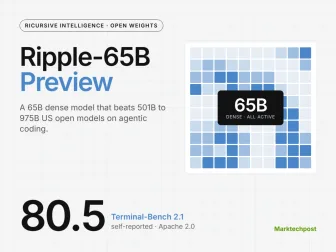
    Ricursive AI has released Ripple-65B Preview: a 65B dense open-source model that scored 80.5 on Terminal-Bench 2.1.

    Ricursive AI has released Ripple-65B Preview, a 65B dense open-source model, scoring 80.5 on Terminal-Bench 2.1, becoming the highest-scoring open-source model in the United States. Its parameter size is 65B (active parameters), pre-training used 12T tokens, with a maximum context length of 1M, and is released under the Apache 2.0 license.

  2. Epoch AI65

    Epoch Capabilities Index update adopts Bayesian model methodology

    Epoch Capabilities Index (ECI) update adopts Bayesian model methodology, providing more reliable estimates of model capability uncertainty and the probability of comparing capabilities between models. The new method is based on four-parameter logistic (4PL) item response theory (IRT), using Claude 3.5 Sonnet (ECI 130) and GPT-5 (ECI 150) as anchor models, and achieves cross-temporal consistency through linear transformations to fix parameter location and scale.

Nov 3Tue
  1. MIT Technology Review · AI

    "Reverse game theory" how it constrains AI agents

    Reversed game theory controls powerful AI models by designing systems that incentivize agents to follow rules, such as rewarding cross-validation or competitive dynamics between model answers, or having the model take turns being a 'problem solver' and an 'auditor' to simulate social constraints. Models like Claude already have moral guidelines, but reversed game theory incentivizes agent behavior through mechanism design (such as cake-cutting strategies, bidding auctions) rather than relying on understanding their internal workings, addressing the issue that current security research primarily focuses on internal understanding or value training but achieves poor results.

Oct 29Thu
  1. Hugging Face Daily Papers65

    Sensorimotor Alignment: A Successful Embodied Agent Metric Based on Sensorimotor Alignment

    The Sensorimotor Alignment (S²) metric finds that the alignment degree between vision and motor representations of embodied agents is positively correlated with task success rates, verifying the applicability of the Platonic representation hypothesis in the robotics field. In simulation and real robot tests, models with high S² (such as Vision-Language-Action and World Action Models) perform better and can explain the phenomenon where the VLA model ignores instructions and relies on visual features, serving as a low-cost offline proxy metric.

  2. Hugging Face Daily Papers

    EmbeddingGemma 2: A Unified and Efficient Cross-Modal Representation Model

    EmbeddingGemma 2 is an open-source multimodal embedding model that unifies text, image, audio, and video representations in an efficient and resource-flexible design, and performs excellently in benchmark tests. It has established a new Pareto frontier in embedding benchmark tests for all modalities, outperforming professional models and other models that are two to twelve times larger in scale. The model supports selective modality encoder loading, adjustable visual token budgets, truncatable embedding dimensions, and quantized weights to adapt to resource-constrained environments.

Oct 28Wed
  1. Hugging Face Daily Papers

    The Trinity framework: Capability-driven recursive self-improving multi-modal agents

    The Trinity framework improves multi-modal agent performance by organizing tasks into capability trees, generating simulated training worlds, routing professional Harness modules, and recursively refining multi-modal agents, achieving a mean performance improvement of 34 and 26 points on 28 training benchmarks and 18 unseen benchmarks, including two real-world embodied tasks.

Oct 27Tue
  1. Hugging Face Daily Papers65

    FORK Reward Mechanism: Alleviating Reward Hacking in Standard-Based Reinforcement Learning through Precise Targets

    The FORK reward mechanism enhances response quality and reduces redundancy by combining necessity credit driven by scoring with factual scoring, while optimizing recall and precision. Compared to traditional rewards based solely on recall, FORK significantly improves precision and shortens response length while maintaining similar scoring coverage, increasing win rates from 10.6% to 68.0% on RubricHub-Medical and from 22.1% to 74.1% on HealthBench.

  2. LangChain Deep Agents releases

    LangChain Deep Agents deepagents-code==0.2.2 release: Security and performance improvements

    The deepagents-code==0.2.2 version of LangChain Deep Agents has been released, including security and performance improvements. New features include GPT-6.1 Terra support, Chinese text input to chat, plugin update detection, etc.; bug fixes include project .env file trust value settings, terminal UI link limits, Git option limits, etc.; performance has been improved by reusing parent process context, optimizing server startup processes, and streamlining transcription rendering, etc. It is recommended to upgrade as soon as possible.

Oct 23Fri
  1. Hugging Face Daily Papers38

    OmniDR-Bench: Video-centric deep report generation benchmark evaluation.

    Researchers have introduced the OmniDR-Bench benchmark and evaluation framework for in-depth study of video-centric deep agents, which can synthesize external evidence to generate interactive reports correlated with video moments. This task has direct practical value, helping users locate relevant video segments, verify claims, and reproduce demonstration steps. OmniDR-Bench includes 50 tasks in Chinese and English, covering 19 real-world subcategories, with a total of 6,414 standards, and the best system score is 63.3.

  2. Hugging Face Daily Papers65

    LASAGNA evaluated the composition of retrieval augmented generation (RAG) pipelines

    LASAGNA evaluated the performance of 450 RAG pipeline configurations on 8 benchmarks and 5K-200K document corpora, finding that individual technology advantages at different stages do not necessarily combine effectively, retrieval quality and answer faithfulness optimization directions are different, the best combination varies with corpus size, indicating that isolated test results are unreliable, new RAG technology needs to be evaluated in a complete environment.

Oct 22Thu
  1. Hugging Face Daily Papers65

    Future Chunk Prediction (FCP) enhances the physical plausibility of autoregressive video generation.

    Future Chunk Prediction (FCP) improves autoregressive video diffusion models by introducing future chunk supervision, generating videos that better adhere to physical laws and reducing training costs. This method, under the teacher forcing framework, predicts temporally separated video chunks without relying on intermediate visual context, directly utilizing training videos for supervision, requiring no additional pre-trained visual encoder, and not altering autoregressive inference.

Oct 21Wed
Oct 19Mon
Oct 14Wed
  1. Google DeepMind

    Gemini 4 Argon brings breakthrough progress to robotics technology

    Gemini 4 Argon has achieved major breakthroughs in physical understanding, code generation, and visual semantic reasoning, achieving a pure reasoning score of 87% on the Embodied Reasoning (ERQA) benchmark test, surpassing all leading models. Argon can be applied to all stages of the robot's lifecycle, including mobile manipulation practice using MuJoCo, zero-shot robot control, and closed-loop steering of video world models.

Oct 13Tue
Oct 12Mon
  1. Baseten Labs75

    Base Labs research found: Why does the model forget facts during iterative learning? Experimental analysis based on talkie-1930-13b-it.

    Base Labs research found that iterative learning with the talkie-1930-13b-it model using sports facts from 2011-2019 leads to fact forgetting, with forgotten facts still present in model weights. Experiments show that early learned facts are difficult to recall after 20 writes and merges, and are covered by later facts, but the covered facts can be relearned, primarily occurring in the later MLP weights.

Oct 5Mon
  1. MIT Technology Review · AI65

    Enterprise AI Agent Knowledge Capability Report: Data and Knowledge Deficiencies Hinder Deployment

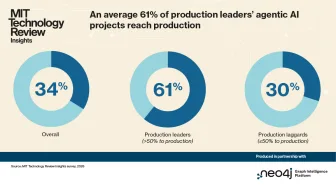
    Enterprise AI Agent Projects Average Only 34% Deployment, Knowledge Deficiency as Main Bottleneck. Knowledge-capable production leaders (61% projects passed pilot) show significant advantages in semantic understanding, but data fragmentation (55% consider it the primary challenge) and traditional system limitations remain key obstacles. Enterprises will prioritize strengthening the structural connection between data and agents through knowledge graphs, RAG technology, and AI evaluation agents.

Oct 1Thu
  1. Amazon Science

    Graph Center Agent: How to Utilize Graph Structures for Agent Reasoning

    Amazon Science has released Graph Center Agent technology, which combines a continuous synchronized graph (digital twin) representing the network with device attributes and connections, with cascade graph algorithms (decomposition, aggregation, tracing) and agent orchestration to achieve minute-level root cause analysis of complex network failures, achieving 95% accuracy in a demonstration at NTT DOCOMO's MWC.

Aug 24Mon
  1. Import AI75

    Import AI 470: Machines without rights; SPADE automated environment generation; Hawkeye building better GPU kernels

    Research shows that AI accelerates the discovery of network vulnerabilities but has a minimal impact on mathematical research, and AI research itself has not shown significant acceleration. The SPADE project generates training data in synthetic environments through self-play, with the Qwen3-30B model achieving the best results, significantly improving performance in both game and tool environment tasks. The Hawkeye tool is used to optimize GPU kernel construction.

May 8Fri
  1. Berkeley AI Research

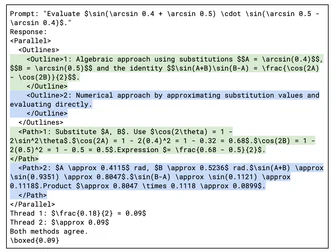
    Adapting to parallel reasoning: the next paradigm for efficient reasoning extension

    Adapting to parallel reasoning allows models to decide on their own when to decompose and parallelize independent subtasks, how many threads to start, and how to coordinate. Existing methods such as fixed parallelism, heuristic structured search, and Monte Carlo tree search determine the parallel structure externally. Recent advancements like ParaThinker and GroupThink attempt to let models adaptively select parallel strategies, but decisions are still constrained externally.

Jan 6Tue
Oct 30Thu
  1. Dify Blog

    Dify Integrates TiDB Vector: Enhancing Knowledge Pipelines with Distributed Vector Storage

    Dify Knowledge Pipeline has officially integrated TiDB Vector, allowing developers to seamlessly reuse processes like parsing tables, extracting entities, and embedding text for knowledge construction in downstream AI applications. TiDB Vector supports hybrid SQL + vector search, filtering structured metadata via SQL syntax before performing semantic retrieval to ensure precise, context-aware responses, and leverages TiDB's distributed architecture for enterprise-grade scalability and stability.

Oct 27Mon
  1. Prime Intellect Blog75

    Prime Intellect is expanding the scale of its open-source environment project to become a global open evaluation and reinforcement learning environment center.

    Prime Intellect is expanding its open-source environment project into a global open evaluation and reinforcement learning environment center, committing millions of dollars in prizes and seeking partners to accelerate the development of open superintelligence. Over the past two months, more than 400 cutting-edge reinforcement learning environments and evaluations have been collected through bounty programs and reinforcement learning residencies. A new large-scale bounty program will expand to thousands of open-source environments, divided into open access and task-only categories, with prize amounts ranging from 100 to 5000 dollars.

Oct 17Fri
  1. Dify Blog65

    Dify platform integrates Tavily API to achieve real-time web data knowledge pipeline construction

    Dify platform now supports Tavily Real-time Web Search API, allowing users to directly embed web data into knowledge pipelines to enhance accuracy and timeliness; Tavily can be used as a data source plugin in Dify Marketplace, paired with Dify knowledge pipelines, which support modular components from upload and parsing to chunk embedding; users can install the plugin, obtain an API key, and configure LLM nodes to use Tavily search results for generating Q&A pairs and storing them in a knowledge base.