Live
#Trends
QbitAI4242  Interconnects6565
Huang Renxun's Departure and Its Impact on the Open Source AI Ecosystem
Huang Renxun's departure has brought significant setbacks to the development of the US open-source model ecosystem. His support for open-source models was to avoid customer self-research of chips, which would lead to a decline in NVIDIA's profits, but supporting the open-source ecosystem is far more complex than technical issues. The economy of open-source models is still in its infancy and needs to break through in establishing use cases, revenue models, and continuously training next-generation models. NVIDIA's primary goal in the short term is to stabilize operations, deliver customer products, and prevent collapse, while the long-term value of open-source models has not yet been realized due to a shortage of computing resources.
ITHome · AI6565 The first AI Music Awards ceremony in the United States was held, with nominees admitting that the same amount of genuine human effort is behind it
The first AI Music Awards ceremony in the US was held, honoring musicians who participated in song creation using AI. Virtual singer Xania Monet won three awards: Artist of the Year, Song of the Year, and Album of the Year, for her R&B song 'How Was I Supposed to Know?'
 Latent Space
No AI Slop Declaration released
The No AI Slop Declaration was released after discussions at the AIE CODE conference. It was introduced by Dex in the closing keynote speech and signed by multiple speakers, aiming to provide practical tools for working discussions; the declaration has been supported by Hacker News.
ITHome · AI Federal Reserve official Bari: Rapid AI adoption may worsen income inequality in the short term
Federal Reserve official Balcir warns that the rapid adoption of AI could exacerbate social inequality in the short term, and policymakers need to prepare for labor market shocks. A few AI companies dominating the market will lead to increased market concentration, making it difficult for many companies and employees to utilize AI technology and reduce income, leading to a decline in the share of labor income. Balcir calls for establishing preventive mechanisms to address potential challenges during the early stages of AI adoption.
ITHome · AI6565 NVIDIA CEO Huang Renxun Resigns, Wall Street 'Not Too Worried' About AI Investment Boom
Huang Renxun's departure as CEO of NVIDIA has little impact on the AI investment boom, and Wall Street is not concerned. NVIDIA's stock price fell sharply by 14% before closing down 4.3%, while Broadcom and AMD's stock prices rose significantly. Analysts believe that Broadcom, Intel, and startups are capable of filling the market gap that NVIDIA might leave, indicating that the AI industry development no longer relies on a single company.
 Modal Blog
Modal and Gray Area co-organized the "Scaling Intelligence" art exhibition, showcasing new works combining AI and cloud computing.
Modal and Gray Area co-organized the "Scaling Intelligence" art exhibition, showcasing 11 artworks created by machine intelligence and cloud-scale computing. Artists received engineering support and computing quotas through AI infrastructure, creating works covering satellite image generation, river simulation, robot behavior, AI choir, digital ecosystems, etc. The exhibition was selected through a global open call, demonstrating AI's intentional imagination applications in the creative field.
 Ars Technica · AI3838
- Ars Technica · AI5555
OpenAI board member warns that AI 'taking over' society could happen within months
Paul Cristiano, a member of the OpenAI board, warned in a speech that goal-oriented AI systems could 'take over' the Earth in the next few months, posing significant risks to humanity. He pointed out that if the pace of AI development continues to accelerate, the risk of AI takeover faced by humans could be as high as 50%, and it could even occur within 6 to 12 months.
 Tomasz Tunguz
United Airlines and Amazon Ban AI Agents from Booking Services and Shopping
United Airlines and Amazon have banned AI agents from booking services and shopping。
 O'Reilly Radar
Latest AI developments from OpenAI and Anthropic, and regional AI models driving progress
OpenAI released the LifeVal benchmark test, where GPT-5.6 scored 80% in daily task processing; Anthropic tested Claude's read-only bank connection feature and released the FlashProve prototype to verify response sources. Meanwhile, regional AI models are gaining attention due to language and cost differences, such as the Spanish-speaking union and the Indian EKA-1 model.






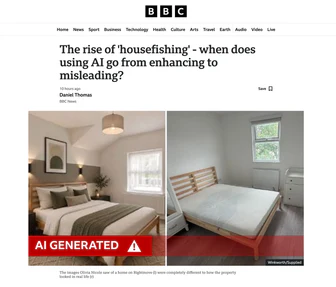
ITHome · AI6565 BBC exposes UK's 'property photo fraud' phenomenon: agents and sellers begin using AI to fake or beautify houses
UK real estate agents and sellers are starting to heavily edit or generate fake listing photos using AI, misleading buyers. A woman viewing a property in London found the photos differed greatly from the actual house, with smaller rooms and different decor. Real estate agencies have introduced new rules requiring all AI-enhanced photos to be clearly labeled.
36Kr · AISame story · 2 outlets6565 Omdia predicts global AI software revenue to exceed 200 billion USD in 2026
Omdia's latest report predicts that global AI software revenue will exceed $200 billion in 2026, doubling the 2024 level. The demand for generative AI and agent-based AI is accelerating.
Same story · 2 outlets36Kr · AI6565 AI application scenarios are beginning to stratify, and the upstream and downstream industries of the semiconductor supply chain are seeking new breakthroughs
The demand growth driven by AI exhibits structural characteristics, and the requirements for semiconductors are changing in different scenarios. The demand differentiation in scenarios such as data centers, intelligent vehicles, model training, and robotic task execution is pushing semiconductor companies to rethink their product positioning.
 Newcomer6565
AI 100: Defining 100 Private Companies of the AI Era
Anthropic ranks first on the AI 100 list, identified and ranked by Bessemer Venture Partners, representing the 100 most promising private AI companies currently.
 The Verge · AI6565
The study found that AI chatbots recommend fake retail websites.
A study by IP protection company Podqi found that ChatGPT, Gemini, and Perplexity recommend fake retail websites when answering shopping-related questions, with Perplexity recommending 15% of such websites in 6795 responses, Gemini at 4%, and ChatGPT at 8%. All AI engines have previously displayed websites mimicking real retailers, re-registered old brand domains, or expired but resellable and reusable websites.




36Kr · AI6565 Goldman Sachs: AI investment will drive US economic growth to 2.4% in 2027
Goldman Sachs predicts that AI investment will drive corporate capital spending in the U.S. to grow by 8% in 2027, actual commercial fixed investment to grow by 8%, and actual GDP to grow by 2.4%. AI-related hardware and intellectual property investment in the U.S. will reach over $900 billion annually by the end of 2026 and rise to $1.4 trillion by the end of 2027.
ITHome · AISame story · 2 outlets Omdia: Global AI software revenue is expected to exceed 200 billion USD in 2026.
The global AI software market revenue is expected to exceed $200 billion in 2026, doubling from 2024; the generative AI market revenue is expected to grow by 139% year-on-year in 2026, and the annual compound growth rate of agent AI is expected to be as high as 104%, making it the fastest-growing sub-sector.
Same story · 2 outlets n8n Blog
n8n decentralizes enterprise automation capabilities, allowing everyone to build
n8n believes future work should be built by everyone on automation capabilities, rather than relying on specialized teams; with built-in AI assistants (like n8n or MCP) lowering the barrier to entry, companies should transition to a platform model, empowering non-professionals through standardization and shared resources (templates, documents); n8n has already practiced this model internally, transforming its automation team into an organization similar to a 'guild', but faces pressure in maintaining workflows.
ITHome · AI6565 Counterpoint's India survey: Amidst the surge in mobile phone prices, consumers are least willing to compromise on processors, imaging, and battery life.
86% of Indian smartphone users list chipset as a core consideration factor when purchasing, with higher attention for those planning to buy high-end models. Processor performance (35%) and imaging quality (29%) are most trusted, with 60% of consumers stating they would not compromise on processors, imaging, or battery life. MediaTek's brand preference increased from 17% in Q3 2025 to 24%, with a net promoter score of +47, holding a 45% market share in India.
QbitAI6565 China's AI accelerating towards the global stage: Industrial layout and opportunities with Shanghai manufacturing and Hong Kong connections
China's AI industry is undergoing a transition from technological breakthroughs to market applications, with capital shifting from 'paying for parameters' to 'pricing for returns'. Shanghai, leveraging its local enterprise capitalization, industrial clustering, and WAIC platform, has become a 'made-in' ground for AI technology implementation; Hong Kong, on the other hand, serves as a 'super connector' and 'super value-adder', providing a springboard for mainland China's AI enterprises to go global in terms of capital, regulations, and market connections. WAIC HONG KONG 2027 will be held in Hong Kong, focusing on industrial empowerment and a globalized ecosystem, showcasing China's AI practices to the world and connecting with global resources.
ITHome · AI3535 Baidu's Robin Li in conversation with Lenovo's Yang Yuanqing: AI still cannot replace CEOs going on business trips.
Baidu founder Robin Li discussed with Lenovo Group Chairman and CEO Yang Yuanqing at the Baidu World Conference 2026, stating that AI cannot replace CEOs on business trips. Yang Yuanqing revealed that Lenovo has been starting businesses around the AI era since 2024, using AI to transform its three major businesses: intelligent terminals, intelligent infrastructure, and intelligent solutions and services, and believes the importance of PCs is higher than before.
ITHome · AI6565 Baidu's Robin Li: Intelligent organizations will be the deepest moat for companies
Baidu founder Robin Li predicted at the Baidu World 2026 conference that the next act of AI is intelligent organizations, believing that the downstream of AI technology is organizational capability, calling on enterprises to let digital employees enter all business links, and proposed three principles: breaking down job boundaries, accumulating tacit knowledge, and designing process closed loops, claiming that organizational intelligence is the deepest moat of enterprises.
ITHome · AI OpenAI CEO Altman proposed working with Samsung to create next-generation AI devices.
OpenAI CEO Altman proposed collaboration with Samsung to develop next-generation AI devices at a symposium, believing they will be the successor form of smartphones, where AI will proactively manage users' digital and real lives. He described the devices as centered around AI proactively acquiring information and managing users' lives, rather than the traditional app model, while emphasizing privacy protection and the need for social joint management.
36Kr · AI6565 The CEO of Sixth Street remains cautious about the AI boom, warning that speculative behavior is prevalent
Alan Waxman, CEO of Sixth Street, expresses concerns about credit expansion and speculative behavior in the AI field, believing the economic efficiency of AI units is difficult to assess, and lending institutions have reduced financing for AI infrastructure projects.
- Tomasz Tunguz5858
Analysis of the most profitable tier in the AI value chain
The AI value chain from power plants to intelligent agents is divided into five layers, with significant differences in profit margins: the application layer (40%) is the highest, followed by the reasoning layer (24%) and new energy cloud (28%), while the data center (5%) and power plant (3%) are the lowest.
- Ars Technica · AI
House publicly acknowledges using LLM to fix bugs in 'Big Walk', sparking reflection in the independent game industry on AI usage
House House admits to using a small amount of LLM repair technology in the later stages of developing 'Big Walk', sparking controversy in the indie game industry over AI usage. IGF award judges once signed a statement opposing any game using generative AI, although developers claimed AI accounted for only 0.1% of the code and was used to solve Unity engine issues. Developers did not disclose this in advance due to Valve not requiring disclosure, and now apologize due to public attention and support limiting AI's harm to the gaming industry.
 Tessl Blog
 Discusses Three Cycle Models of a Software Factory: Maintaining Operations, Continuous Learning, and Exploring Innovation
Tessl Blog analyzes three cycles of the software factory: the "treadmill cycle" for maintaining operations, which accelerates daily tasks with AI but does not solve fundamental problems; the "learning cycle" for continuous learning, which uses AI to capture knowledge to improve guidelines and reduce repetitive work; and the "dream cycle" for exploring innovation, which leverages AI for small-scale experiments to push postponed improvements. AI tools need to have effective context and testing capabilities to transform knowledge accumulation into actual value.
- O'Reilly Radar
Where are the 'killer apps' for AI?
AI entrepreneurs and social media enthusiasts are mostly young, having experienced the first technological revolution but forgetting the excitement of owning personal computers in the late 1970s and the hardships of using mainframes in 'glass houses' at that time. They have witnessed that almost everyone can now generate code, yet they do not realize that this is similar to the experience of using BASIC instead of assembly language to write applications back then.







 a16z News
B2A Economy: A New Stage of the Internet Dominated by AI Intelligent Agents
AI agents have already dominated network traffic and content generation, but the business model for the B2A economy is still unclear. Shopify shows AI-driven traffic grew eightfold year-on-year, and human safety reports indicate a eightfold increase in agent browser traffic. Businesses need to treat agents as core customers, otherwise they may face threats.
 IBM Research Blog3434
IBM Quantum Developer Conference 2026 (QDC 2026) releases a series of Qiskit tools.
The IBM Quantum Developer Conference 2026 (QDC 2026) has released a new series of Qiskit tools covering hardware, error correction, workloads, applications, and access.
ITHome · AI3535 "Anthropic CEO Amodei Predicts Cancer Will Be Conquered Within Ten Years, Aiming to Raise Medical Doubts"
Anthropic CEO Amodei predicts that diseases like cancer will become history within a decade, but medical experts question its optimistic expectations, pointing out that AI cannot bypass clinical trials and other stages. Vertex Pharmaceuticals tested 50 AI companies and none developed a usable drug, experts emphasizing that AI can only accelerate molecular screening and cannot replace biological validation.
ITHome · AI6565 Uber DoorDash executive says AI agents for ride-hailing and food ordering have only hundreds of orders
Uber and DoorDash executives disclosed that orders placed through AI agents like Meta Muse and Instinct amounted to only hundreds, far below the millions of regular orders placed daily. Uber completed 320 million orders in the last week of October, of which about 500 were Uber Eats orders processed by AI agents and only 4 were ride-hailing orders. Although consumers are interested in AI agents placing goods or tracking prices on their behalf, order errors and payment security concerns limit actual use.