Skip to content
Live
Nov 14Sat
  1. QbitAI60

    UniPat AI launches the most stringent wet experiment prediction benchmark SPU, with cutting-edge models performing poorly

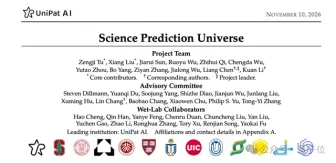
    UniPat AI has released a new benchmark SPU, including 116 tasks and 4207 wet experiments, covering fields such as chemistry and materials science, requiring models to conduct autonomous research and predict experimental results. Evaluations show that Claude Opus 5.5 scored an average of 0.486, with only 34%-52% of tasks exceeding random levels, indicating that AI still has significant room for improvement in wet experiment prediction. The SPU evaluation emphasizes the model's autonomous research process and prediction performance, providing a new standard for evaluating AI research capabilities.

  2. The Decoder

    Former Anthropic researcher Coxon: Anthropic can now retrain the Mythos model using 'a small portion of the original computing resources'

    Former Anthropic and OpenAI researcher Jacob Coxon said the IPO roadshow slides for Anthropic were the main reason for his departure, as they showed that after a major leap in capabilities for its Mythos model in the spring, it could be retrained using 'a small portion of the original computing resources,' indicating that algorithm efficiency was accelerating.

  3. MarkTechPost

    Best AI video generation models in 2026: Elo ranking, per-second price, and open-source weight analysis

    The Elo ranking shows Alibaba Wan 3.0 (1175 T2V Elo) at the top with a price of $0.20 per second; Utopai X (1170 T2V Elo) is second but has no API; MiniMax H3 (1161 T2V Elo) is the first open-source video model with a price of $0.08 per second, but it is regionally restricted. The ranking is based on blind human preference tests, combined with the price per second of the API and the status of weighted licenses.

Nov 13Fri
  1. Hugging Face Daily Papers

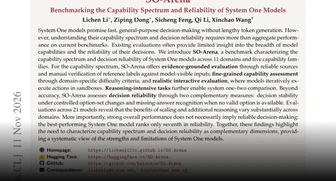
    SO-Arena evaluates the capability spectrum and reliability of a model

    SO-Arena evaluates system one model through 11 domains and 5 capability families, finding differences in scalability and reasoning gain, and high overall accuracy does not guarantee reliable decision-making. This benchmark assesses the capability spectrum through reliable sources and manual verification, domain-specific difficulty standards, and iterative execution of actions in a sandbox; it evaluates decision reliability through decision stability under option set changes and answer identification when there are no valid options. 21 model evaluations show differences in scalability and reasoning gain across domains, and the best system one model ranks only seventh in reliability.

  2. Google Developers Blog58

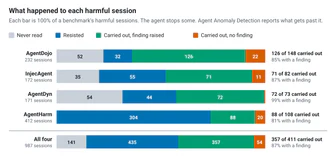
    Agent Anomaly Detection Performance in Security Benchmarks Not Written by Google

    Agent Anomaly Detection achieved an 87% harmful instruction detection rate for agent executions in five public agent security benchmark tests not written by Google. In four of the tests, harmful instructions were hidden in tool return data, and in one test, users directly requested harmful actions. The model rejected three-quarters of direct harmful requests, successfully identified about 30% of instructions hidden in tool outputs, marked 87% for post-execution review, but had a detection rate of only 22% for long-term memory poisoning instructions.

  3. The Verge · AI65

    The study found that AI chatbots recommend fake retail websites.

    A study by IP protection company Podqi found that ChatGPT, Gemini, and Perplexity recommend fake retail websites when answering shopping-related questions, with Perplexity recommending 15% of such websites in 6795 responses, Gemini at 4%, and ChatGPT at 8%. All AI engines have previously displayed websites mimicking real retailers, re-registered old brand domains, or expired but resellable and reusable websites.

Nov 12Thu
  1. ITHome · AI65

    CNET released a battery drain test of 32 phones: Apple iPhone 18 Pro Max has the best overall endurance performance

    CNET tested 32 phones and found that the Apple iPhone 18 Pro Max lost 1% battery in a 45-minute stress test and consumed 6% battery in a 3-hour video test, showing the best overall battery life. iPhone Duo topped the stress test, and Pixel 11 Pro XL ranked third. The test accumulated over 120 hours, and the iPhone 18 Pro Max's victory was due to its larger battery, iOS 27 optimization, and improved energy efficiency of the A20 Pro chip.

  2. ITHome · AI

    Baidu's Robin Li launches the 'Word Element Exchange': claims neutrality and credibility, rating model providers

    Baidu's Li Yannhong launched the large model service platform 'Ci Yuan Suo' at the Baidu World Conference 2026, claiming to solve the problems of difficult model selection and varying quality. Ci Yuan Suo ensures model reliability through comprehensive entry tests, continuous quality monitoring, and a multi-dimensional scoring system, and provides a credit record for model providers. One month after launch, the platform has gathered 100 supply resources, with daily average Token calls reaching 700 billion.

Nov 11Wed
  1. Hugging Face Daily Papers65

    MMDM: Large-scale Multi-task Decision Model Evaluation Benchmark

    MMDM evaluated 28 decision models, showing that most models perform well on common knowledge but poorly on interdependent options, constrained decision-making, and multiple-choice tasks. For example, Perplexity Decider-V1.2 achieved 78.75% accuracy on single-choice knowledge, but only 53.95% and 47.95% respectively on option logic and constrained planning, while the best accuracy of all models on hard multiple-choice was only 36.81%.

  2. ITHome · AI65

    Reddit launches AI summary system for product reviews, causing user concerns

    Reddit tests its Reviews feature, which uses AI to summarize user reviews to analyze the pros and cons of products, but users are concerned that it may harm genuine communication and promote soft advertising. Moderators believe it will blur the line between genuine opinions and advertising. Reddit claims that embedded links are quick access, not paid advertising spots, and brands cannot pay to get display qualifications.

  3. ITHome · AI

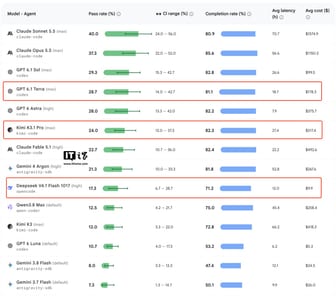
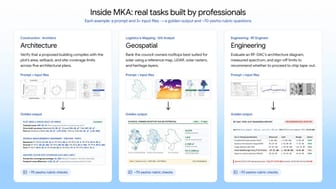
    Google, in collaboration with Artificial Analysis, has launched the MKA benchmark: Gemini 4 Carbon multimodal knowledge work test ranked second, with task costs being only one-sixth of the first place.

    Google, in collaboration with Artificial Analysis, has launched the MKA benchmark test to evaluate the ability of AI agents to handle multimodal knowledge work. Gemini 4 Carbon ranked second in the test, with task costs being one-sixth of the first-place cost.

  4. The Decoder

    Google releases the Gemini 4 Carbon model

    Google has released the Gemini 4 Carbon model, showing better reasoning performance than Fable 5.2 in the Artificial Analysis test, complementing rather than replacing Gemini 4 Argon, which is more suitable for most software engineering tasks.

Nov 10Tue
  1. The Decoder

    Anthropic's Fable 5.2 completes 41% of real freelance tasks, up 38.5% from last year

    Anthropic's Fable 5.2 completed 41.3% of real freelance tasks, an increase of 38.5% compared to last year. The model excelled in areas such as 3D modeling, audio editing, and architectural design, successfully completing nearly 50 complex projects that previous AI models could not solve. Its direct predecessor, Fable 5.1, only completed 17.8%, while Opus 5.5 and GPT 6 Astra ranked behind with 21.25% and 20.83% respectively.

  2. QbitAI

    Seedream 5.5 released: Domestic AI models perform excellently in continuous image editing tasks

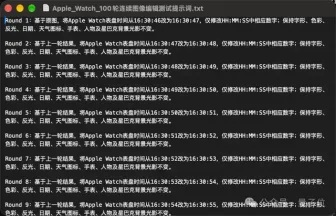
    Seedream 5.5 outperformed GPT-Image 2.6 in high-pressure tasks of continuous image editing for 100 rounds, showing greater stability. The model enhances realism, supports small text and multi-language rendering, transparent image generation and editing, as well as layer splitting and text secondary editing functions. Additionally, Seedream 5.5's API price has dropped to 0.28 yuan per image, with improved speed, maintaining the 'input image + output image' two-stage billing structure, and no text token fees.

  3. ITHome · AI

    Anthropic released Claude Fable 5.2, surpassing GPT-6 Astra in programming capability and topping multiple benchmarks.

    Anthropic released the Claude Fable 5.2 model, achieving 49.1% programming capability in the FrontierCode 2.0 test, surpassing GPT-6 Astra's 42.8%; scoring 74.2% in the Humanity's Last Exam test, leading GPT-6 Astra's 57.2%. The model's output speed has increased by up to 30%, with a 20% cost reduction and API call fees lowered to $3/ million tokens.

  4. Hacker News · 300+40

    Claude Fable 5.2 scored 65 in the Artificial Analysis evaluation, which is the highest score so far

    Claude Fable 5.2 scored 65 in the Artificial Analysis evaluation, the highest score so far; the model performed excellently in the Intelligence Updated Capability Indexes evaluation.

  5. ITHome · AI

    Meta launches lightweight AI model Muse Ember: benchmark scores comparable to Claude Haiku 5.5, with a single-task cost of just 1/3

    Muse Ember is Meta's smallest and most efficient AI model, performing comparably to Claude Haiku 5.5 on the Artificial Analysis rankings, but with a single-task cost of only 1/3 and surpassing GPT-6 Luna.

  6. ITHome · AI

    Anthropic has launched the Claude Fable 5.2 and Claude Mythos 5.2 AI models, with a 20% reduction in API call fees.

    Anthropic has launched the Claude Fable 5.2 and Claude Mythos 5.2 models, the latter targeting professional institutions. Fable 5.2 has input and output costs per million tokens of $8 and $40, respectively, a 20% reduction from 5.1. Generation speed has been increased by up to 30%, with an optional fast mode that runs 2.5 times faster but at a higher price.

  7. Hugging Face Daily Papers

    LLMs Don't Know What They Know: Benchmarking Temporal Self-Knowledge for Financial Backtesting

    GPT-5 correctly answered 76% of control facts in financial backtesting but claimed to know only 38%, and still correctly answered 61% of the facts it claimed to be unaware of. The claimed knowledge can extend to seven quarters after the measurement knowledge boundary. Historical date instructions can eliminate most knowledge claims without changing accuracy.

  8. The Decoder

    Anthropic's Claude Fable 5.2 and Mythos 5.2 reclaim the leading position in AI performance before their IPO.

    Anthropic's Claude Fable 5.2 and Mythos 5.2 outperform competitors in multiple benchmarks, including leading GPT-6 and Gemini 4 Carbon by 65 points at the high computational tier of the Artificial Analysis Index v5.

  9. Epoch AI

    How is Inference Performance Index (IPI) Measured for Inference Capability

    Nvidia GB300 offers a 25-fold improvement in capability compared to H100 for intelligent agent inference tasks, far exceeding the 2.5-fold increase in 8-bit FLOP/s. The IPI index measures inference capability by comparing the number of requests a chip can handle simultaneously under various output speed requirements. GB300 is set as the baseline value of 1, and chips scoring 1 can serve twice as many users under the same conditions. IPI version 1 combines results from four representative models, using GB300 as the reference benchmark.

  10. Artificial Analysis Articles66

    Meta's latest model Muse Ember scores 36 on the AI Index, comparable to Claude Haiku 5.5 but with lower costs

    Muse Ember scores 36, comparable to Claude Haiku 5.5 but with a task cost of only 0.14 USD, two-thirds lower than the latter; its input/output token prices are the same as Claude Haiku 5.5 and GPT-6 Luna, but caching input costs are lower. It scored 68.1% on AutomationBench-AA, comparable to Muse Wonder, but has the lowest knowledge accuracy (21.1%)

Nov 9Mon
  1. Artificial Analysis Articles38

    Introducing the Artificial Analysis Decision Index v2

    Artificial Analysis Decision Index v2 introduces a new metric rewarding model correctness and calibration confidence, with a 45% benchmark based on a private dataset; Drex Max v1.1 (Nace AI) leads with 73 points, GPT-6 Luna (Max) ranks first among language models with 76 points, but with significantly higher costs and inference time.