Skip to content
Live
Nov 3Tue
  1. Hugging Face Daily Papers65

    When Latent Prediction Error Supports Physical Anomaly Claims - Research on Video World Models

    Research shows that the latent prediction error in video world models reflects appearance and motion rather than reliable measurements of physical anomalies. Comparisons of latent prediction, masked pixel reconstruction, and simple visual statistics on the IntPhys2 benchmark show that appearance is easy to decode, and V-JEPA2 only slightly reveals whether an event is possible.


  2. Hugging Face Daily Papers65

    Hugging Face Daily Papers: Advances in Proxy Computer Graphics

    Hugging Face Daily Papers has released a report on proxy computer graphics driven by large language models, proposing a unified classification method and literature system, analyzing trends and challenges in human-machine collaboration and long-term planning. The report introduces a unified classification method for representing agent systems in different computer graphics tasks and develops an agent literature system to assist researchers in large-scale analysis of existing and new published papers.

  3. Hugging Face Blog

    Transformers Model Integration Contracts Released: Hugging Face Launches Model Integration Contracts Standard

    Transformers supports over 750 model types, its test suite includes 88,000+ CPU tests and 200,000+ GPU tests. Hugging Face releases Model Integration Contracts (MIC) standard, including compressed models (such as a 66 MB weight UMT5 fix), runnable examples (such as SmolLM text generation), and human review baselines.

  4. Hugging Face Daily Papers65

    CEPO: A general prompt optimization framework for multi-agent systems

    CEPO enhances prompt optimization for multi-agent systems by separating shared coordination from agent-specific execution, continuously improving the performance of four existing prompt optimization methods across 11 cross-domain benchmark tests. The framework uses shared coordinator prompts and agent-specific execution prompts, guiding them to update based on their respective roles, allowing shared coordination rules to be consistently optimized across all agents while maintaining independent adjustment of execution instructions. Experiments show that CEPO improves optimization budget efficiency and scales performance as the number of agents increases.

Nov 2Mon
  1. Hugging Face Daily Papers65

    HiFOR: A hierarchical predictive framework for visual language action models

    HiFOR guides action generation by hierarchically predicting future states and retrieving relevant future information, enhancing robotic manipulation capabilities. The framework jointly predicts short-term state evolution, semantic milestones, and final goal states through hierarchical dependency masks (HDM), establishing cross-temporal dependency relationships; structured perception latent world modeling organizes future potential representations along temporal, perspective, and spatial dimensions, promoting fine-grained retrieval; action-guided decomposition world retrieval adaptively retrieves relevant future information based on action representations during the denoising process, providing targeted guidance for action generation.

  2. ITHome · AI65

    Researchers test AI agent clusters in Minecraft: Collaboration is prone to bureaucracy, higher win rate against GPT in battles

    Researchers used 50 GPT-6.1 Sol agents to build a civilization community in Minecraft, but failed to develop due to bureaucratic tendencies; in a wake-up war test with 10 GPT-6.1 Sol against 10 Claude Opus 5.5, GPT agents adopted a more aggressive strategy, completing problem diagnosis and sharing solutions; in seven Mindustry battles, GPT agents won six and lost one, demonstrating the advantage of swarm mode.

  3. Hugging Face Daily Papers58

    Wizard: Real-time control of any world through agent control

    Wizard decouples character animation, scene control, and game logic from visual generation, allowing intelligent agents to control joint skeletons and scene geometry through structured visual agents, achieving real-time interaction at 24 FPS, zero-shot generalization to unseen scenes, characters, and actions. The team built 50.3 hours of aligned agent-video pairs, including 750 scenes and 178 characters, supporting character adaptive masking, causal adaptation, and few-step distillation techniques.

  4. Moonshot AI · Hugging Face new models

    Kimi K3.1 Pro Released: Open-Weight Multimodal AI Model

    Kimi K3.1 Pro is an open-source multimodal AI model by Moonshot AI, with 2.8T parameters, 104B activation parameters, and a context window of 1M tokens, demonstrating excellent performance in areas such as coding, 3D creation, and financial research. Compared to Kimi K3, it adopts Gated DSA layers to improve long text processing efficiency and has outperformed competitors like Claude Fable 5.1 and GPT-6 Astra in benchmarks such as Terminal-Bench 4.0.

Oct 31Sat
  1. Hugging Face Daily Papers45

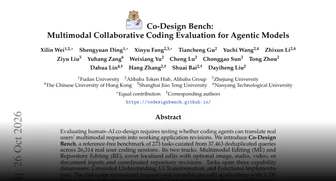
    Co-Design Bench: Multimodal Collaborative Coding Evaluation Benchmark for Agent Models

    The Co-Design Bench benchmark includes 273 tasks and 2,331 acceptance criteria written by experts, derived from 26,314 real user coding sessions. On 10 model endpoints, gpt-6-astra averages 69.9% passing the criteria for each task, but only 26.4% of tasks are fully satisfied; Qwen3.8-27B has an overall strict completion rate of 64.4% and ranks second in the repository editing subset.

Oct 30Fri
  1. Hugging Face Daily Papers60

    Youtu-Parsing-Omni: A unified multimodal parser, a single encoder and single architecture covering all modalities

    Youtu-Parsing-Omni encodes documents, images, audio, and video into spatiotemporal structured records, achieving optimal parsing performance through self-evolution strategies and distillation. Single-modal encoders share weights and integrate cross-modal information, a single architecture unifies outputs for ten parsing tasks. The 5B parameter version achieved top scores of 96.96 and 75.08 on OmniDocBench v1.6 and OmniParsingBench, with code and weights open-sourced.

  2. Hugging Face Daily Papers31

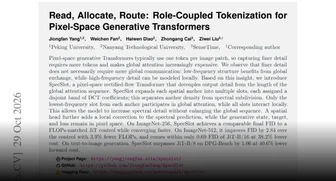
    SpecSlot: A role-coupled tokenization method for generating Transformers in pixel space

    SpecSlot improves pixel space generation Transformer by using local spectral slots and limiting global attention without increasing computational cost, enhancing image details. SpecSlot expands each spatial anchor to multiple slots, assigning each slot a different DCT coefficient band, which separates anchor density and spectral refinement; only the low-frequency slots of each anchor participate in global attention, while all slots perform local interactions.

  3. QbitAI75

    The domestically developed open-source OXR tops three document parsing benchmarks with 1.3B parameters.

    The SoMark team has open-sourced the 1.3B document parsing model OXR, ranking first on three benchmarks: OmniDocBench (97.18), olmOCR-Bench (87.84), and DocParsingBench (87.76).

    Why it matters: 1.3B model trained with RSI ranks first in three document parsing rankings, and provides engineering trade-offs between plug-in architecture and free API.

  4. Hugging Face Daily Papers65

    Hugging Face Daily Papers: Formal benchmark evaluation through difficulty measures identifies measurement mismatches and coverage gaps

    Research formalizes benchmark evaluation through difficulty measures to identify measurement mismatches and coverage gaps, proposing diagnostic metrics and rewrite algorithms to improve benchmark coverage; analyzing 25 popular benchmarks across 7 fields reveals that most implicitly overestimate specific difficulty areas or fail to cover most of the difficulty axis, limiting model improvement monitoring capabilities; introduces BenchFill algorithm to effectively reduce local coverage gaps.

  5. Hugging Face Daily Papers52

    WeVisCut: An integrated smart editing agent from narration to long videos

    WeVisCut coordinates video editing tools, recovers from failures, and reduces token usage through a compact strategy trained on 9B parameters, while maintaining output quality. The system employs a four-stage data pipeline, combining editing inversion and validation replay, to generate over 130K training examples from 3,750 finished videos for training a single strategy.

  6. TechCrunch · AI78

    Mistral has opened the weights of its trillion-parameter model, Mistral Large 4, focusing on network security.

    Mistral has released the weights of its trillion-parameter open-source model, Mistral Large 4 (ML4, nickname Le Chonk), which businesses and governments can obtain and deploy on their own via Hugging Face and API.

    Same story — showing the featured version《Mistral releases open-source model Mistral Large 4 (Le Chonk) with trillion parameters》

Oct 29Thu
  1. Hugging Face Blog

    Project ProtoStar project release: Promoting the AI compatibility of publicly funded scientific research

    Project ProtoStar is announced, aiming to unlock the potential of publicly funded scientific research by making datasets, models, and code more accessible and reusable. The project brings together universities, research institutions, industry, and the open science community, supporting the release of scientific achievements in AI-compatible, machine-actionable formats, and demonstrating its value through a series of public challenges. The first challenge, hosted by Carnegie Mellon University, will launch on November 2.

  2. The Decoder

    U.S. antitrust regulators are reviewing NVIDIA's acquisition of Hugging Face and its sales practices

    The U.S. Department of Justice is investigating NVIDIA's planned acquisition of the open-source platform Hugging Face, with officials questioning whether the acquisition would allow NVIDIA to control a critical hub for AI distribution and harm competitors, with a transaction value of $12.93 billion and expected to be completed in the first half of 2027.

  3. Hugging Face Blog85

    Mistral Large 4 (Le Chonk) released on Hugging Face

    Mistral releases multimodal MoE model Mistral Large 4 (Le Chonk), with approximately 1T total parameters, 49B activation parameters, a context window of 1M tokens, offering two official versions FP8 and NVFP4, as well as GGUF made by Unsloth and llama.cpp teams.

    Why it matters: The original text provides specific scores for the 1T total parameter, 49B activation multimodal MoE model on cybersecurity and coding benchmarks, along with measured throughput for local and endpoint deployment.

  4. Hugging Face Blog

    Hugging Face Granite Switch 4.1.1 released: software-based model update

    Hugging Face releases Granite Switch 4.1.1, an incremental update based on 4.1, maintaining full backward compatibility. New features include multilingual speech-to-text models (supporting 10 languages with native punctuation) and a decision adapter for improved performance on the Jev decision index test set. The team achieves rapid deployment by updating only the adapter without recalculating the base model, and future support for third-party custom adapters is planned.

  5. Hugging Face Daily Papers

    Prox model achieves channel selection for expert mixture decoding without calibration data

    The Prox model accelerates expert mixture inference through top-k channel selection and weighted reader, while maintaining accuracy without calibration data. Under 13% and 18% budgets, the top-k version of Prox outperformed or matched the threshold version in 40 out of 43 comparisons, including all 23 generation tasks, and avoided the repetitive loop crashes caused by calibration thresholds on Gemma 4.

  6. ITHome · AI78

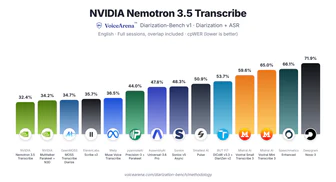
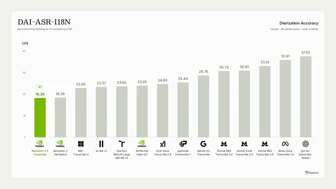
    NVIDIA open-sourced the speech transcription model Nemotron 3.5 Transcribe, supporting 40 languages and 8 speaker separation.

    NVIDIA launched the open-weight speech transcription model Nemotron 3.5 Transcribe on October 28, integrating transcription, speaker attribution, translation, and audio Q&A, using the MoE architecture, with total parameters of about 34 billion and activation parameters of about 4.3 billion, capable of processing the longest recording of 1 hour, supporting transcription of 40 languages, and distinguishing up to 8 speakers.

    Why it matters: NVIDIA open-sourced the speech transcription model, disclosing parameter scale, multilingual and speaker separation capabilities, and benchmark results, allowing comparison with existing open-source ASR solutions.

  7. Hugging Face Daily Papers

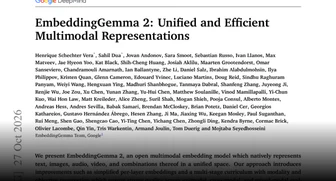
    EmbeddingGemma 2: A Unified and Efficient Cross-Modal Representation Model

    EmbeddingGemma 2 is an open-source multimodal embedding model that unifies text, image, audio, and video representations in an efficient and resource-flexible design, and performs excellently in benchmark tests. It has established a new Pareto frontier in embedding benchmark tests for all modalities, outperforming professional models and other models that are two to twelve times larger in scale. The model supports selective modality encoder loading, adjustable visual token budgets, truncatable embedding dimensions, and quantized weights to adapt to resource-constrained environments.

  8. Hugging Face Daily Papers

    Falcon audio-visual target speaker extraction model released

    Falcon is a causal audio-visual target speaker extraction model that extracts the voice of the target speaker from the mouth video of the target speaker in noisy overlapping speech, combined with a single multi-scale time-frequency separator and an encoder spatial speaker contrast loss, reducing interference speaker leakage without increasing inference cost.

  9. 36Kr · AI

    U.S. Department of Justice investigates NVIDIA's acquisition of Hugging Face

    The U.S. Department of Justice is conducting inquiries into how the acquisition of the open-source platform Hugging Face by NVIDIA will affect competition in the artificial intelligence field, asking whether this acquisition will allow NVIDIA to control a fundamental distribution channel in the AI field. DOJ officials also inquired about NVIDIA's acquisition, investment, and sales activities, as well as whether the company has ever pressured customers.

  10. Hugging Face Daily Papers

    EvidenceConnect framework and Zooming without Zooming v2 model released

    The EvidenceConnect framework generates comparative, aggregated, or chained visual evidence queries by synthesizing image region thumbnails, enhancing the evidence connection capability of VLMs. The ZwZ2 model is trained based on this framework, without targeting any downstream benchmarks but improving fine-grained and spatial perception, and achieving progress in embodied spatial reasoning, multimodal long-context understanding, multimodal agent tasks, and general visual reasoning

Oct 28Wed
  1. Hugging Face Blog78

    NVIDIA has released Nemotron 3.5 Transcribe and the Granary v2 data pipeline.

    NVIDIA has released the open-source weight model Nemotron 3.5 Transcribe, integrating transcription, speaker separation, translation, and audio Q&A into a single checkpoint, supporting transcription in 40 languages, translation between 31 languages and English, and speaker annotation in 13 languages, capable of processing the longest 1-hour recordings and annotating up to 8 speakers.

    Why it matters: The original text provides a unified weighting model for multilingual transcription, speaker separation, and translation, along with an open data pipeline and fine-tuning recipes, which can be used to determine the adaptation path for voice scenarios.

  2. Hugging Face Daily Papers

    Decomposition Vector Quantization Technology Enhances Discrete Visual Token Quality

    Decomposition Vector Quantization Technology enhances discrete visual token quality by using parallel codebooks on complementary feature views, enabling it to match continuous representations in multimodal understanding. Models trained on industrial-grade multimodal data outperform UniAR and Emu3-Chat by 22.8% and 59.2% on average across nine metrics, making it the first discrete representation model capable of competing with strong continuous representation models like Qwen3-VL.

  3. Hugging Face Daily Papers65

    Memory Tax: Analyzing the net value of intelligent agent memory

    Large-scale evaluations show that dedicated memory systems are often weaker than simple retrieval-enhanced generation. The Memory Benefit and Memory Tax framework is introduced to evaluate the net value. Memory is becoming increasingly common in long-term intelligent agents, but the net value of building memory compared to directly retrieving from raw history remains unclear.

  4. Hugging Face Daily Papers

    The Trinity framework: Capability-driven recursive self-improving multi-modal agents

    The Trinity framework improves multi-modal agent performance by organizing tasks into capability trees, generating simulated training worlds, routing professional Harness modules, and recursively refining multi-modal agents, achieving a mean performance improvement of 34 and 26 points on 28 training benchmarks and 18 unseen benchmarks, including two real-world embodied tasks.