Advances in Agentic Computer Graphics
Advances in Agentic Computer Graphics
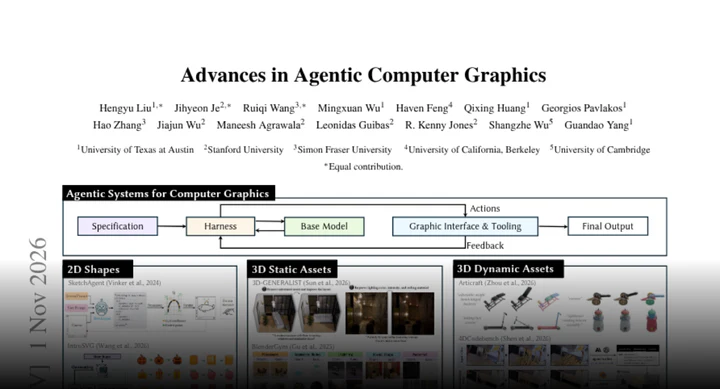
Hugging Face Daily Papers has released a report on proxy computer graphics driven by large language models, proposing a unified classification method and literature system, analyzing trends and challenges in human-machine collaboration and long-term planning. The report introduces a unified classification method for representing agent systems in different computer graphics tasks and develops an agent literature system to assist researchers in large-scale analysis of existing and new published papers.
Published on Nov 1
Authors:
,
,
,
,
,
,
,
,
,
,
,
,
Abstract
This report proposes a unified taxonomy and literature system for agentic computer graphics driven by large language models, analyzing trends and open challenges in human-agent collaboration and long-horizon planning.
Computer graphics is built on code. Large language model (LLM) agents can now generate graphics code and iteratively refine it through various feedback. This capability opens the door to a potentially new paradigm of computer graphics, with graphics algorithms increasingly built around agentic systems to automate progressively complex tasks. Over the past years, research on agentic graphics has expanded rapidly across a diverse range of tasks. This rapid growth makes it increasingly difficult for manual literature reviews to keep pace with new developments. At the same time, similar ideas are often described using different terminology across these tasks, further complicating efforts to develop a systematic understanding of the field. In this report, we address these challenges through two contributions. First, we introduce a unified taxonomy for characterizing agentic systems across diverse computer graphics tasks. Second, we develop an agentic literature system that can assist human researchers in analyzing existing and newly published papers at scale. Building on these contributions, we analyze emerging research trends and discuss open challenges in coordinating agents and tools across graphics tasks, designing interfaces and representations for human-agent collaboration, sustaining long-horizon planning and refinement, and reliably evaluating interactive graphics systems.
View arXiv page View PDF Add to collection
Get this paper in your agent:
hf papers read 2611.01860
Don't have the latest CLI?
curl -LsSf https://hf.co/cli/install.sh | bash
Models citing this paper 0
No model linking this paper
Cite arxiv.org/abs/2611.01860 in a model README.md to link it from this page.
Datasets citing this paper 0
No dataset linking this paper
Cite arxiv.org/abs/2611.01860 in a dataset README.md to link it from this page.
Spaces citing this paper 0
No Space linking this paper
Cite arxiv.org/abs/2611.01860 in a Space README.md to link it from this page.
Collections including this paper 0
No Collection including this paper
Add this paper to a collection to link it from this page.
Source: Hugging Face Daily Papers · huggingface.co