Read, Allocate, Route: Role-Coupled Tokenization for Pixel-Space Generative Transformers
Read, Allocate, Route: Role-Coupled Tokenization for Pixel-Space Generative Transformers
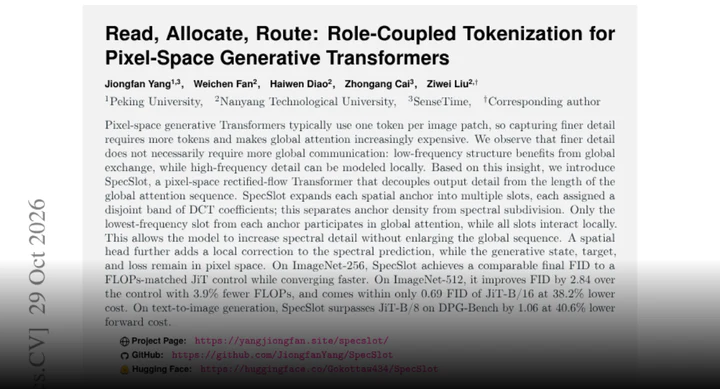
SpecSlot improves pixel space generation Transformer by using local spectral slots and limiting global attention without increasing computational cost, enhancing image details. SpecSlot expands each spatial anchor to multiple slots, assigning each slot a different DCT coefficient band, which separates anchor density and spectral refinement; only the low-frequency slots of each anchor participate in global attention, while all slots perform local interactions.
Published on Oct 29
Authors:
,
,
,
Abstract
SpecSlot improves pixel-space generative Transformers by using localized spectral slots and restricted global attention to increase image detail without raising computational cost.
Pixel-space generative Transformers typically use one token per image patch, so capturing finer detail requires more tokens and makes global attention increasingly expensive. We observe that finer detail does not necessarily require more global communication: low-frequency structure benefits from global exchange, while high-frequency detail can be modeled locally. Based on this insight, we introduce SpecSlot, a pixel-space rectified-flow Transformer that decouples output detail from the length of the global attention sequence. SpecSlot expands each spatial anchor into multiple slots, each assigned a disjoint band of DCT coefficients; this separates anchor density from spectral subdivision. Only the lowest-frequency slot from each anchor participates in global attention, while all slots interact locally. This allows the model to increase spectral detail without enlarging the global sequence. A spatial head further adds a local correction to the spectral prediction, while the generative state, target, and loss remain in pixel space. On ImageNet-256, SpecSlot achieves a comparable final FID to a FLOPs-matched JiT control while converging faster. On ImageNet-512, it improves FID by 2.84 over the control with 3.9% fewer FLOPs, and comes within only 0.69 FID of JiT-B/16 at 38.2% lower cost. On text-to-image generation, SpecSlot surpasses JiT-B/8 on DPG-Bench by 1.06 at 40.6% lower forward cost.
View arXiv page View PDF Project page GitHub 10 Add to collection
Get this paper in your agent:
hf papers read 2610.40647
Don't have the latest CLI?
curl -LsSf https://hf.co/cli/install.sh | bash
Models citing this paper 0
No model linking this paper
Cite arxiv.org/abs/2610.40647 in a model README.md to link it from this page.
Datasets citing this paper 0
No dataset linking this paper
Cite arxiv.org/abs/2610.40647 in a dataset README.md to link it from this page.
Spaces citing this paper 0
No Space linking this paper
Cite arxiv.org/abs/2610.40647 in a Space README.md to link it from this page.
Collections including this paper 0
No Collection including this paper
Add this paper to a collection to link it from this page.
Source: Hugging Face Daily Papers · huggingface.co