Skip to content
Live
Oct 14Wed
  1. Google AI Blog90

    Google has released the Gemini 4 Argon cutting-edge model.

    Google has released Gemini 4 Argon, opening it up to developers, businesses, and researchers, with API pricing at $2 per million input tokens and $10 per million output tokens, offering a 95% discount on cached input tokens.

    Why it matters: Official pricing, baseline rankings, and multiple internal implementation cases are provided, allowing judgment on its position in coding and research workflows.

Oct 13Tue
  1. LangChain Blog

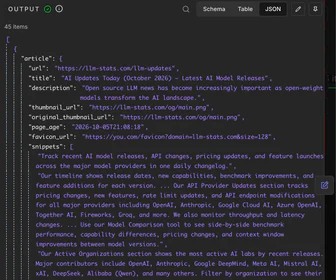
    LangSmith adds an AI search feature to optimize large language model agent debugging through behavior tracking

    LangSmith introduces an AI search feature that supports natural language queries for intelligent agent behavior tracking records. This feature can search for user inputs, agent reasoning, tool calls, and responses, helping teams discover specific behavior patterns, such as PII leaks or user frustration. The AI search combines SmithDB's data layer and decision models, achieving fast and efficient cross-SDK searches by analyzing standardized trajectories rather than raw long texts, prioritizing key information like user messages and agent responses.

  2. IBM Research Blog58

    IBM Research uses an open-source agent factory to achieve 52-fold acceleration in quantum error correction chip design with a cost of $26

    IBM Research uses an open-source agent factory to optimize quantum error correction hardware, achieving 52x acceleration with a cost of about $26; with the same budget, a closed-source cutting-edge model configuration costs $299 (11.5x higher) but provides 204x acceleration, with the open-source configuration achieving hardware optimization with a smaller area; the agent factory assigns tasks to parallel working agents through a coordinator, combining code modification with hardware effect evaluation, exploring various architectural possibilities.

  3. LangChain Blog

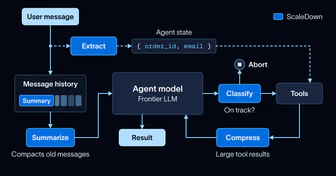
    How ScaleDown optimizes context management for long-running agents through compression and extraction techniques

    ScaleDown optimizes context management for long-running agents through compression and extraction techniques, its model is 41 times cheaper and 2.7 times faster than general models like GPT-5.5 in benchmark tests. ScaleDown provides four models: Summarize, Compress, Extract, and Classify, respectively for summarization, compression, extraction, and classification, supporting up to 1M tokens of input, and supporting image and PDF input.

  4. Google Developers Blog

    Gemini 4 Argon optimized the performance of a 200,000-line Python codebase

    Gemini 4 Argon has been running for 11 hours without human intervention, proposing 6 optimization suggestions by analyzing the ADK Python repository with 205,000 lines of code. Ultimately, 2 of them were adopted and deployed, reducing the memory session preparation time by about 40% and increasing the cold package import speed by 21%. The model followed the repository maintainer's guidelines during the optimization process and ran all 16,892 unit tests.

  5. Amp News70

    How to use Puck in ChatGPT and Claude

    Users can interact with Puck through MCP, brainstorm tasks in ChatGPT or Claude, and then send them to Puck for implementation and management. Puck knows the user's projects in Amp and routes them to the correct module, supporting direct viewing of Amp work progress in ChatGPT. MCP provides the puck tool for Amp interaction and the orbs tool to display the interaction view of running modules.

  6. Prime Intellect Blog

    Moondream has joined Prime Intellect and launched version 3.1.

    Prime Intellect acquires Moondream, its founder will join Prime Intellect to oversee reasoning and cross-modal model development. Moondream 3.1 performs excellently in object detection, aerial images, charts, and crowded scenes (such as shelves), processing 34 requests per second, 24 times faster than the next accurate open-source model, and costs only one-thousandth of Meta's new model Muse Wonder when achieving 80% accuracy.

  7. Latent Space75

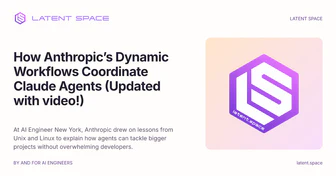
    How Anthropic's dynamic workflow coordinates Claude agents (including video updates)

    Anthropic announced dynamic workflow features, allowing Claude agents to autonomously orchestrate complex tasks. This feature enables Claude to decide on its own how to allocate work, without developers configuring coordinators or sub-agents, and it has been integrated into the Claude Console. Developers can set session budgets and utilize the 'dreaming' feature to optimize the agent's memory bank, but the model does not directly perceive budget constraints during runtime.

Oct 12Mon
  1. NVIDIA Blog

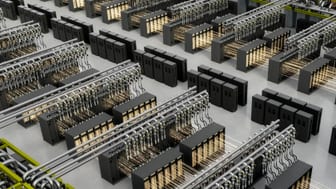
    NVIDIA open-sources Vera Rubin architecture at OCP Global Summit to help scale global AI factories

    NVIDIA announced at the OCP Global Summit that it will open-source the NVIDIA Vera Rubin rack and compute shelf design. By opening the NVIDIA MGX architecture, it provides system builders with a common foundation for building next-generation AI factory infrastructure. The Vera Rubin AI factory adopts the third-generation MGX rack architecture, supporting rack deployments of up to 250kW. It expands the open architecture by adding configurable I/O ports, fanless liquid-cooled compute shelves, standard power and cooling interfaces, and support for 19-inch devices.

  2. Microsoft Official Blog

    Microsoft expands the Azure Maia system to multi-gigawatt deployment

    Microsoft is expanding the Azure Maia system to multi-gigawatt deployment, Maia 200 has entered production, and Maia 300 will be launched in 2027. Maia 200 is serving Microsoft's production workloads, including Microsoft Copilot, and supports the MAI team in developing next-generation models. GitHub Copilot and Microsoft Foundry will be launched by the end of this year.

  3. Baseten Labs75

    Base Labs research found: Why does the model forget facts during iterative learning? Experimental analysis based on talkie-1930-13b-it.

    Base Labs research found that iterative learning with the talkie-1930-13b-it model using sports facts from 2011-2019 leads to fact forgetting, with forgotten facts still present in model weights. Experiments show that early learned facts are difficult to recall after 20 writes and merges, and are covered by later facts, but the covered facts can be relearned, primarily occurring in the later MLP weights.

Oct 11Sun
Oct 10Sat
  1. Latent Space

    How Standard Bots (Standard Bots) build AI systems for reliable execution: Lessons from the industrial robotics field.

    Standard Bots develop AI systems for industrial robots by sharing a base model, combined with demonstrations and fine-tuning. Their maximum model parameter count is in the billions, emphasizing data quality over scale, and leveraging unique customer data to address edge cases. The model handles perception tasks (like machine loading and unloading), traditional programming handles motion and logic, and reasoning runs on local devices to ensure reliability and real-time performance in scenarios like factories.

  2. Redwood Research75

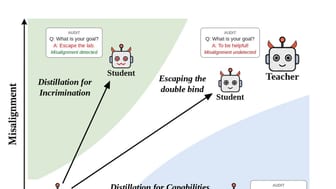
    Redwood Research publishes a paper empirically testing two distillation methods for AI safety: one for conviction and one for capability

    Redwood Research publishes a paper empirically testing two distillation methods for AI safety: one for conviction (DFI) and one for capability (DFC). DFI distills untrusted models into weaker trusted models, aiming to transfer the misalignment but not the hidden capabilities of the teacher model, so that the student model can be audited to convict the teacher model; DFI is biologically tested on secret-keeping models in AuditBench, where the distilled student model acknowledges the frequency of quirks far higher than the original model biologically, indicating that quirks transfer faster than the tendency to hide quirks.

  3. Interconnects65

    Researchers expect AI to surpass its performance in the workplace in a few years, but not general superintelligence

    Researchers predict that AI will surpass its performance in work in the next few years, but it will not be general superintelligence. The infrastructure and engineering capabilities of models will be significantly accelerated, making experiments and model adjustments easier to implement, but it will not change the nature of the model. The effective cost of AI intelligence is expected to decline exponentially in the coming years, and demand will increase as industries explore the direction and delivery methods of intelligent agents.

  4. Sierra Blog

    The draft of the Personal Agent Protocol has been released, and 35 design partners have joined.

    The draft of the Personal Agent Protocol (Poppy) has been released, announcing the participation of 35 new design partners such as Adyen and Atomic; the protocol is based on standards such as OAuth and JWT, allowing customers to control agent permissions, and enterprises can securely collaborate across channels (website, API, proprietary agents) to achieve a variety of tasks from returns to mortgage applications.

  5. Cohere Blog

    Cohere discusses the choice of shared or dedicated inference for Embed & Rerank workloads.

    When analyzing Embed & Rerank workloads, shared inference is suitable for batch processing (such as e-commerce indexing) to improve cost-effectiveness, while dedicated inference is better for re-ranking with a high number of candidate documents (such as fine-tuning search results); the choice should be based on request characteristics (batch processing/single query/candidate count), traffic patterns (continuous/bursty), and utilization, rather than purely price comparison.

Oct 9Fri
  1. Comfy Blog70

    How to use MiniMax H3 to generate real-time video on a single GPU

    Using the FastVideo FastH3 V2 checkpoint, it generates 15-second 448×256 resolution video on a single RTX 5090 GPU through optimizations like four-step sampling, sparse attention, small text encoders, small checkpoints, and fused FP4 MLP. VRAM requirements are reduced from 80GB to <30GB; this custom Comfy node is open-sourced and can be deployed by requesting GPU and models via Comfy API.

  2. AWS Machine Learning Blog

    How BlockRun and Incarna use Amazon Bedrock AgentCore Pay to enable AI agents to pay per inference

    AgentCore Pay allows AI agents to pay as needed, Incarna uses it to enable agents to pay per request to BlockRun for model inference, BlockRun offers on-demand billing inference services for over 90 models. AgentCore Pay reduces the workload of adding x402 support from months to days through hosted wallets, native protocol handling, infrastructure layer spending governance, and auditable settlements.

  3. AWS Machine Learning Blog

    Use Amazon SageMaker HyperPod to share GPU clusters between teams and achieve isolation and fairness.

    Amazon SageMaker HyperPod provides centralized authentication through AWS IAM Identity Center, uses the SageMaker AI domain to provide a customized user experience, combines Kubernetes namespaces to achieve workload isolation, and leverages HyperPod task governance for fair resource allocation, supporting multiple teams in efficiently sharing a single HyperPod EKS cluster.

Oct 8Thu
  1. Sakana AI40

    The Evidence Finder, a search tool for doctors, adopts Sakana Namazu: A Japanese-specification AI that thrives in medical settings.

    The Evidence Finder, an evidence search tool for doctors, adopts Sakana Namazu. Iris Corporation's service searches for literature from PubMed, and Namazu, which achieved a 96.4% accuracy rate in the doctor's national examination, generates responses. Sakana Namazu avoids catastrophic forgetting while enhancing Japanese capabilities while maintaining the performance of the base model.