Skip to content
Live
Oct 31Sat
  1. Hugging Face Daily Papers55

    VibeGame Framework: A prompt-based game development system using an AI-native engine and a self-evolving team of adversarial intelligences.

    VibeGame Framework constructs complete 2D games from natural language prompts using an AI-native engine and eight specialized adversarial intelligence teams, supporting interactive validation and reusable self-evolving components. On the GameCraft-Bench subset, VibeGame's P2G (Prompt-to-Game) version surpasses multiple AI agent solutions like GPT-6.1-Sol with the same underlying model.
  2. ITHome · AI58

    Tencent Maps reveals the full capabilities of Agent, with Yuanbao, WeChat XiaoWei, OPPO XiaoBu Assistant, and others already integrated

    Tencent Maps announced the full capabilities of Agent at the 2026 Tencent Global Digital Ecosystem Conference, with Yuanbao, WeChat XiaoWei, OPPO XiaoBu Assistant, and others already integrated; Yuanbao supports one-sentence route planning and taxi hailing, while XiaoWei provides AI+map experiences in scenarios like Channels.

Oct 30Fri
  1. Hugging Face Daily Papers60

    Youtu-Parsing-Omni: A unified multimodal parser, a single encoder and single architecture covering all modalities

    Youtu-Parsing-Omni encodes documents, images, audio, and video into spatiotemporal structured records, achieving optimal parsing performance through self-evolution strategies and distillation. Single-modal encoders share weights and integrate cross-modal information, a single architecture unifies outputs for ten parsing tasks. The 5B parameter version achieved top scores of 96.96 and 75.08 on OmniDocBench v1.6 and OmniParsingBench, with code and weights open-sourced.

  2. ITHome · AI78

    Xiaomi open-sources 0.8B document understanding model Xiaomi-OCR-0, supporting Markdown and JSON output

    Xiaomi open-sources lightweight document understanding model Xiaomi-OCR-0, with 0.8B parameter size, weights and inference code have been uploaded to Hugging Face and GitHub, a single model covers three tasks of document parsing, key information extraction, and OCR visual question answering.

    Why it matters: 0.8B parameters rank second on the overall list in OmniDocBench v1.6, and weights, MCP services, and Skill toolkits are also opened, which can be used to judge the boundary of small models for document parsing.

  3. Ant Group inclusionAI · Hugging Face new models38

    inclusionAI/ZwZ2-9B-GGUF GGUF format weights release

    inclusionAI releases ZwZ2-9B GGUF format weights, belonging to the Zooming without Zooming v2 project, including language models (FP16, Q8_0, Q4_K_M) and visual encoders and projectors (mmproj, FP16, Q8_0, Q4_K_M), requiring pairing with llama.cpp Qwen3.5 multimodal support for use, supporting CLI inference and Web Chat deployment.

  4. Ant Group inclusionAI · Hugging Face new models

    inclusionAI/ZwZ2-4B-GGUF model weights released

    The inclusionAI/ZwZ2-4B-GGUF model weights have been released. This model is part of Zooming without Zooming v2 and is divided into a language model (FP16, Q8_0, Q4_K_M) and a visual encoder and projector (mmproj, FP16, Q8_0, Q4_K_M), offering multiple precision combinations. It needs to be used with llama.cpp (supporting Qwen3.5 multimodal).

  5. Hugging Face Daily Papers65

    Broader research on MLLM retrieval head

    In 18 languages, visual languages, and full-modal models, the retrieval head remains sparse in the newly added modalities (such as audio-visual) and has a high degree of cross-modal sharing. Full-modal models mainly retain the backbone model's retrieval heads; removing these retrieval heads eliminates almost all audio-visual retrieval capabilities.

  6. QbitAI75

    The domestically developed open-source OXR tops three document parsing benchmarks with 1.3B parameters.

    The SoMark team has open-sourced the 1.3B document parsing model OXR, ranking first on three benchmarks: OmniDocBench (97.18), olmOCR-Bench (87.84), and DocParsingBench (87.76).

    Why it matters: 1.3B model trained with RSI ranks first in three document parsing rankings, and provides engineering trade-offs between plug-in architecture and free API.

  7. Hugging Face Daily Papers65

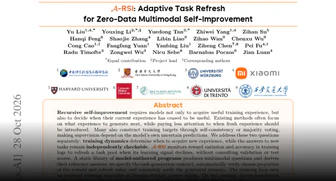
    A-RSI: Adaptive Task Refresh for Zero-Data Multimodal Self-Improvement

    A-RSI refreshes training tasks based on learning signal decline and uses independently verifiable programs to generate answers, enhancing benchmark test performance without external labels. The model monitors reward changes and accuracy in training logs to refresh the task pool and utilizes a static model self-programming library to generate multimodal questions and their reference answers, while automatically verifying the properties of reward and refresh rules and auditing the generated answers. In eleven benchmark tests, A-RSI increased average performance from 57.77 to 61.05 with 800 new tasks.

  8. MarkTechPost58

    Edge0 has released the 0.6B parameter voice cloning TTS model Audio8-TTS-Realistic

    Edge0 releases the open-source text-to-speech model Audio8-TTS-Realistic, with 0.6B parameters supporting zero-shot voice cloning for 23 languages, achieving an average error rate of 4.86% in the CV3 benchmark test, surpassing Qwen3-TTS-1.7B and VoxCPM2, but lower than the 4B-level Higgs TTS 3. The model employs a dual autoregressive architecture, including a slow branch with 24 layers and width 896, and a fast parallel prediction branch with 4 layers, trained using a learned realism critic.

  9. Hugging Face Daily Papers52

    WeVisCut: An integrated smart editing agent from narration to long videos

    WeVisCut coordinates video editing tools, recovers from failures, and reduces token usage through a compact strategy trained on 9B parameters, while maintaining output quality. The system employs a four-stage data pipeline, combining editing inversion and validation replay, to generate over 130K training examples from 3,750 finished videos for training a single strategy.

  10. Codex releases45

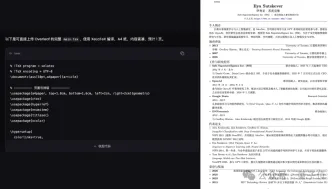
    Codex 0.166.0 released: adding keyboard driver transcription selection, Markdown rendering optimization, and GPT-6.1 Terra support

    Codex 0.166.0 released, adding keyboard driver transcription selection (supporting word, line, and page operations), integrated search and configurable shortcuts, as well as consistent Markdown rendering in asynchronous questions, options, answers, and transcription responses. Also supports GPT-6.1 Terra and adds codex queue --resume feature to resume unloaded threads.

  11. Amazon Science

    Amazon Science explores technology to accelerate language models in travel applications

    Amazon Science combines knowledge distillation (KD) and the Medusa framework to optimize the travel platform LLM. After fine-tuning, KD training, and Medusa head modification, the TinyLlama 1.1B model achieves performance close to the 70B parameter Llama-3.1 teacher in AI travel planning, intelligent filtering, and accommodation description generation scenarios, with costs reduced by two-thirds and speed increased by 10-20 times.

Oct 29Thu
  1. NVIDIA Technical Blog35

    NVIDIA unlocks Tensor Core performance to accelerate machine learning atomic potential energy calculations

    NVIDIA significantly accelerates machine learning atomic potential energy calculations by optimizing Tensor Core performance. Its technology can improve the computational efficiency of quantum mechanics methods such as Density Functional Theory (DFT), balancing cost and accuracy. This solution is suitable for large systems or long-time simulations, but the specific parameter scale, benchmark scores, and availability (open source/closed source/API) were not provided in the original text.

  2. Hugging Face Blog85

    Mistral Large 4 (Le Chonk) released on Hugging Face

    Mistral releases multimodal MoE model Mistral Large 4 (Le Chonk), with approximately 1T total parameters, 49B activation parameters, a context window of 1M tokens, offering two official versions FP8 and NVFP4, as well as GGUF made by Unsloth and llama.cpp teams.

    Why it matters: The original text provides specific scores for the 1T total parameter, 49B activation multimodal MoE model on cybersecurity and coding benchmarks, along with measured throughput for local and endpoint deployment.

  3. 36Kr · AI

    Zhiyuan Innovation releases the GO-3 Preview, WITA-OMNI, AGILE model combination to accelerate the deployment of the entire physical AI chain

    Zhiyuan Innovation launches GO-3 Preview (tops RoboDojo and other evaluations), WITA-OMNI (wins first place in four rankings), and AGILE general sports intelligence algorithm framework, respectively tackling tasks, interaction, and sports abilities; Lingqu OS 1.0 and AHA3 hardware architecture integrate software and hardware ports; Worken measures intelligent work hours, aiming to convert 20000 offline robots into actual productivity.

  4. ITHome · AI65

    Yixing Yi Xi today launched the iFlow intelligent temperature control system: BCG non-contact monitoring, dynamic temperature control, starting at 9999 yuan

    Yujin Xiuhu released the iFlow smart temperature control system, starting at 9999 yuan. It supports BCG contactless monitoring, dual-person independent monitoring, and AI zone temperature control. The system is equipped with the MTK Genio 420 edge AI computing platform, capable of locally running the ISHO physiological signal large model to achieve dynamic temperature control. The Pro version upgrades to a 512-point flexible pressure sensing array, supporting high-temperature dust mite removal at 55℃.

  5. QbitAI72

    Genspark releases Media Studio video Agent workbench

    Genspark releases video Agent workbench Media Studio, integrating over 70 model versions from more than 20 manufacturers, where large language models act as directors responsible for writing scripts and scheduling video, image, and audio models.

    Why it matters: The author conducted a complete test of the entire process from short drama to knowledge explanation video, allowing readers to judge the completeness and shortcomings of multi-model arrangement in real-world creation based on this.

  6. ITHome · AI

    NewCore Voyage X7 Ultra chip is the first in China to mass produce Armv9 automotive-grade CPU.

    NewCore Voyage has released the X7 Ultra large model chip, which includes a high-precision operator acceleration engine, supports 10 times the parameter model deployment, and achieves an NPU computing utilization of 98.7%. Memory bandwidth consumption is reduced by 80%, and energy efficiency is improved by 100%. This chip is the first in China to mass produce Armv9 automotive-grade CPU, with a performance increase of 20% and an energy efficiency improvement of 10%.

  7. ITHome · AI65

    Xiaomi MiMo Desktop membership benefits upgraded: increased quota without price increase, new third-party models such as DeepSeek added

    Xiaomi has increased the membership credit for MiMo Desktop without increasing prices, taking effect in real-time for both new and existing members. New third-party models such as DeepSeek V4 Pro, DeepSeek V4.1 Flash, GLM 5.3, GLM 5.3 Flash, Kimi K3, Qwen 3.8 Flash, and Qwen 3.8 Max are now available for members to choose, with each model labeled with its consumption multiplier.

  8. QbitAI

    MolCell MMDesign achieves breakthrough progress in the AI pharmaceutical field

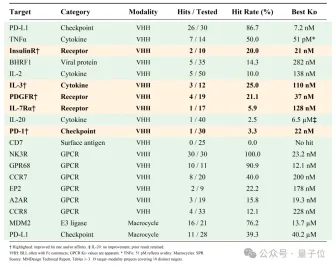
    MolCell AI's MMDesign platform completes 18 design projects with a success rate of 94.7%, hitting all six GPCR targets among them, with the best affinity reaching nanomolar level; the platform uses a 'generate-screen-verify' workflow, generating tens of thousands of candidate molecules in computational space and testing only 9-50 to achieve success, with an overall candidate hit rate of 30.7%, demonstrating efficient and precise molecular design capabilities.

  9. QbitAI

    Zhuji Dynamics releases FluxVLA Engine V2 technical report, one-click reuse of engineering capabilities makes embodied AI R&D more efficient

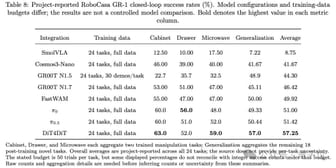
    Zhuji Dynamics releases the FluxVLA Engine V2 technical report, achieving full-chain reuse of model training, evaluation, and deployment through unified configuration, modular decoupling, and system optimization. It supports 14 mainstream strategies, with inference path frequency improved by 2.31–9.64 times, validated in closed-loop execution on 6 real machines including ALOHA and dual-arm Franka. Online reinforcement learning boosts SmolVLA success rates by 10.0–15.4 percentage points.

  10. QbitAI

    Zhuji Dynamics releases the FluxVLA Engine V2 technical report, enhancing the R&D efficiency of physical intelligence.

    Zhuojì Power updates the second technical report of the open-source engineering base FluxVLA Engine. V2 supports 14 strategies for LIBERO evaluation on the simulation side, increases model path frequency by 2.31–9.64 times on the inference end, and verifies deployment links on real hardware platforms such as ALOHA and dual-arm Franka. Online reinforcement learning boosts SmolVLA's success rates in LIBERO-10 and RoboTwin Clean tasks by 10.0% and 15.4%, respectively.

  11. QbitAI

    Diffusion Intelligence releases Clover-35B-A3B-Preview, a 350 billion parameter model that is twice as fast as Jev.

    Diffusion Intelligence releases Clover-35B-A3B-Preview model, with 350 billion parameters achieving a median execution time of 1.52 seconds in the web Agent evaluation WindTunnel, twice as fast as the Jev+Mercury 2.5 combination, with a success rate of 98.6%. The model adopts a MoE architecture, supports thinking mode, and scores 73.6 on SWE-bench Verified.

  12. Hugging Face Daily Papers

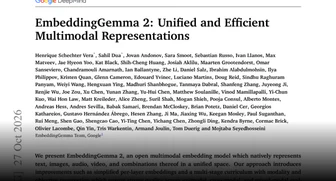
    EmbeddingGemma 2: A Unified and Efficient Cross-Modal Representation Model

    EmbeddingGemma 2 is an open-source multimodal embedding model that unifies text, image, audio, and video representations in an efficient and resource-flexible design, and performs excellently in benchmark tests. It has established a new Pareto frontier in embedding benchmark tests for all modalities, outperforming professional models and other models that are two to twelve times larger in scale. The model supports selective modality encoder loading, adjustable visual token budgets, truncatable embedding dimensions, and quantized weights to adapt to resource-constrained environments.

  13. ByteDance Seed · Hugging Face new models

    ByteDance-Seed/GenFirst releases: A generative pre-reconstruction method for stable end-to-end latent generation modeling

    ByteDance-Seed/GenFirst trains a latent VAE and combines it with a generative prior to avoid latent collapse, which usually makes end-to-end training unstable. The two-stage plan of this method is used for prior and entropy weights: the first stage lets the prior shape the latent geometry, and the second stage reduces both weights tenfold, allowing the decoder to recover details.

  14. Hugging Face Daily Papers65

    DTCA: A Noise-Aware Label Credit Assignment Framework for Diffusion Language Models using Reinforcement Learning

    DTCA performs label-level credit assignment through confidence enhancement and entropy calibration, improving the mathematical reasoning ability of diffusion language models. The framework, when tested on LLaDA-8B-Instruct, shows significant performance improvement in mathematical reasoning under different generation budgets, with the MATH500 metric increasing by 9.0 points and the GSM8K metric improving by 5.3 points.

  15. OpenRouter Blog

    How to Use LLM to Extract Tables from PDFs

    The Anthropic/claude-haiku-5.5 model paired with a strict JSON schema can extract tables from PDFs and return typed rows. Tested five PDFs (including scans) successfully extracted all 644 cells; failure cases were due to PDF processing paths, not model capability. Note empty results and output length limits.