A-RSI: Adaptive Task Refresh for Zero-Data Multimodal Self-Improvement
A-RSI: Adaptive Task Refresh for Zero-Data Multimodal Self-Improvement
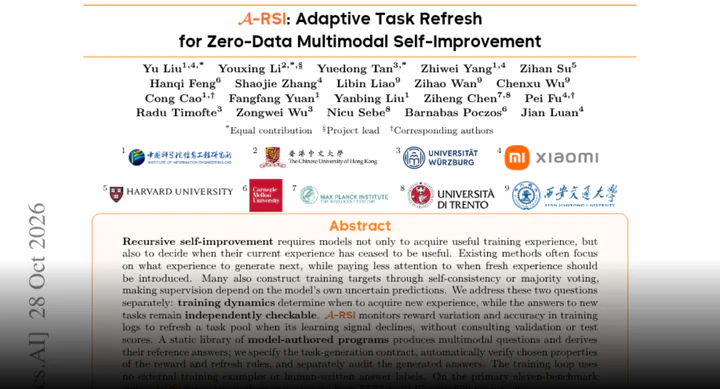
A-RSI refreshes training tasks based on learning signal decline and uses independently verifiable programs to generate answers, enhancing benchmark test performance without external labels. The model monitors reward changes and accuracy in training logs to refresh the task pool and utilizes a static model self-programming library to generate multimodal questions and their reference answers, while automatically verifying the properties of reward and refresh rules and auditing the generated answers. In eleven benchmark tests, A-RSI increased average performance from 57.77 to 61.05 with 800 new tasks.
Published on Oct 28
Authors:
,
,
,
,
,
,
,
,
,
,
,
,
,
,
,
,
,
,
Abstract
A-RSI improves recursive self-improvement by refreshing training tasks based on declining learning signals and using independently verifiable program-generated answers, raising benchmark performance without external labels.
Recursive self-improvement requires models not only to acquire useful training experience, but also to decide when their current experience has ceased to be useful. Existing methods often focus on what experience to generate next, while paying less attention to when fresh experience should be introduced. Many also construct training targets through self-consistency or majority voting, making supervision depend on the model's own uncertain predictions. We address these two questions separately: training dynamics determine when to acquire new experience, while the answers to new tasks remain independently checkable. A-RSI monitors reward variation and accuracy in training logs to refresh a task pool when its learning signal declines, without consulting validation or test scores. A static library of model-authored programs produces multimodal questions and derives their reference answers; we specify the task-generation contract, automatically verify chosen properties of the reward and refresh rules, and separately audit the generated answers. The training loop uses no external training examples or human-written answer labels. On the primary eleven-benchmark suite, A-RSI raises the performance average from 57.77 to 61.05 with 800 fresh tasks.
View arXiv page View PDF Project page Add to collection
Get this paper in your agent:
hf papers read 2610.38568
Don't have the latest CLI?
curl -LsSf https://hf.co/cli/install.sh | bash
Models citing this paper 0
No model linking this paper
Cite arxiv.org/abs/2610.38568 in a model README.md to link it from this page.
Datasets citing this paper 0
No dataset linking this paper
Cite arxiv.org/abs/2610.38568 in a dataset README.md to link it from this page.
Spaces citing this paper 0
No Space linking this paper
Cite arxiv.org/abs/2610.38568 in a Space README.md to link it from this page.
Collections including this paper 0
No Collection including this paper
Add this paper to a collection to link it from this page.
Source: Hugging Face Daily Papers · huggingface.co