Skip to content
Live
Oct 23Fri
  1. Hugging Face Daily Papers65

    Cola2: Adaptive Hierarchical Language Model improves hierarchical language generation through continuous semantic compression and balanced discrete generation.

    Cola2, through dynamic span splitting, masked diffusion decoding, and stream matching priors jointly optimizes continuous semantic compression, reconstruction-generation balance, and encoder-decoder adaptation, verifying its core design on five downstream tasks. Using 2100 billion training tokens, it demonstrates competitive non-saturated scalability, with a 3460 billion source token checkpoint showing an average of 60.10 points on eight tasks and surpassing Llama-3-8B on HellaSwag and StoryCloze.


  2. Hugging Face Blog66

    Microsoft and Hugging Face use ThinkingBox database validation for RL reward training agents

    Microsoft and Hugging Face release ThinkingBox-Training, directly using ThinkingBox's deterministic verification of database final states as reinforcement learning rewards, training Qwen3.8-27B for 50 steps with GRPO

    Why it matters: Microsoft and Hugging Face directly use database final state verification as reinforcement learning rewards and have publicly released task filtering and training code, which can be transferred to other stateful intelligent agent training

  3. Modal Blog

    Modal releases open-source Tinker compatible training server Spindle

    Modal releases open-source Tinker compatible training server Spindle, supporting operation in Modal workspaces, replacing token billing with GPU time billing, customizable configurations, and supporting hundreds of concurrent training tasks. Spindle supports full-parameter training and multiple LoRA on various open-source models, with a distributed control plane and container auto-scaling at its core, suitable for teams needing custom training loops and cost reduction.

  4. Databricks Blog60

    Databricks Talks AI Billing: How to Reduce the Unit Cost of Coding Agents by 90%

    Databricks executive Patrick reviews the process where the cost of AI coding agents increased exponentially after the company fully adopted them, and then reduced the unit cost by up to 90% by controlling the layer. He mentions that shifting traffic to cheaper new models contributed to more than 50% of the reduction, and Smart Router reduced the average task cost by more than 30% while maintaining near the quality of the most expensive model. This internal solution was later productized as Unity Gateway, which is now used by thousands of customers.

    Why it matters: Databricks executive reviews the process of its own AI coding costs from out of control to reducing the unit cost by 90%, providing migratable practices for gateways, routing, and self-built evaluations.

  5. Hugging Face Daily Papers65

    Quant-Arena: A large language model agent for benchmark quantitative trading research

    Quant-Arena evaluates whether language models can construct profitable trading strategies based on historical A-share data and verifies their performance on closed future year data, as a benchmark quantitative research. The platform allows models to build feature and stock rating code, based solely on feedback from 2022-2023, freeze strategies, and evaluate in 2024. GPT-6 Astra scored the highest among nine cutting-edge models, but no model surpassed the 2024 equal-weight market performance. Quant-Arena is open to all models or agents.


  6. Microsoft Research58

    Flint-interactive: A language for creating interactive data visualizations

    Flint-interactive makes AI-generated charts highly interactive, allowing users to explore data through clicks, filtering, zooming, highlighting, and cross-chart interactions. It simplifies the construction of complex interactions through advanced semantic events and update operations, and leverages the Flint compiler to handle interaction logic and visual dependencies, enhancing reliability and development efficiency. Flint-interactive supports creating interactive data stories, dashboards, and connected experiences, enabling AI agents to generate charts with interactive features to help users analyze data more efficiently.

  7. Hugging Face Daily Papers65

    LASAGNA evaluated the composition of retrieval augmented generation (RAG) pipelines

    LASAGNA evaluated the performance of 450 RAG pipeline configurations on 8 benchmarks and 5K-200K document corpora, finding that individual technology advantages at different stages do not necessarily combine effectively, retrieval quality and answer faithfulness optimization directions are different, the best combination varies with corpus size, indicating that isolated test results are unreliable, new RAG technology needs to be evaluated in a complete environment.

Oct 22Thu
  1. Google DeepMind

    Google DeepMind releases Forest Typology (ForTy) 2020 global forest type map

    Google DeepMind and Google Research jointly release the Forest Typology (ForTy) 2020 Global Map, which classifies every 10x10 meter land on Earth into six types of forests and land use, and tracks changes from 2017 to 2025. The map is based on definitions by the United Nations Food and Agriculture Organization, accurately distinguishing native forests, plantations, monoculture forest plantations, economic crop forests, and other land types, supporting the EU's deforestation regulations with an accuracy of 90%.

    Same story · 2 outlets

    How the accounts differ:Google DeepMind states the map classifies land into six types; The Decoder mentions only four types (original forest, plantations, and tree crop farms).

  2. Hugging Face Daily Papers

    AKV introduces caching project management for LLM intelligent entity key-value caching

    AKV proposes a caching engineering solution, managing LLM agent key-value caches through drop and repos operations, enhancing efficiency and accuracy. Experiments show that tool response rolling drop caching strategy improves the average benchmark score by 1.7 points, reduces costs by 27.7%, maximizes output throughput by 1.2 times, and accelerates P95 request latency by 1.5 times.

  3. The Verge · AI40

    Investment Research Company Attempts to Use Anthropic's Claude to Generate Scorpion Antivenom but Fails

    Investment Research Company Citrini Collaborates with Anthropic to Try Generating Scorpion Antivenom Using an Unreleased Claude Model, Which Generated Approximately 211 Candidate Protein Designs, 17 of Which Can Bind to Part of Scorpion Toxin. Experts Point Out This is Only an Early Stage of Drug Development, and Converting Candidate Molecules into Effective Drugs Still Faces Huge Challenges. Citrini Admits the Experiment Did Not Successfully Create a Drug but States It Showcases the Potential of AI-Assisted Drug Discovery

  4. ChinaTalk

    ChinaTalk reports: The third wave of data collection for humanoid robot training - taking the NVIDIA EgoScale project as an example

    NVIDIA EgoScale project collects first-person video data for 20,854 hours from 1000 participants by installing cameras on their foreheads and wrists to train humanoid robot hand skills; this new method, called 'ego-centric data collection', marks the third generation of humanoid robot data collection, aiming to solve the fatigue, cost, and accuracy problems of traditional remote operation and isomorphic exoskeleton methods.

  5. The Decoder

    OpenAI agents analyzed mouse brain data in 32 minutes, while humans take months to complete the task.

    OpenAI, together with PerturbAI and Scripps Research, deployed thousands of AI agents to analyze biological data from millions of mouse cells on GPT-Rosalind, completing the full-brain CRISPR spectrum analysis in 32 minutes, whereas manual analysis takes months to a year. Human experts preferred the reports of distributed agents 75% of the time in blind tests; the 'reasoning graph' has been open-sourced on GitHub, and related papers are published on bioRxiv.

  6. MIT Technology Review · AI75

    Hidden storage costs of AI: data storage overheads overlooked behind reasoning

    In corporate AI inference costs, data storage overhead is often overlooked. After each model response, a large amount of backend data needs to be stored, including logs, caches, backups, etc., which is 130 times the size of the output files users see. McKinsey predicts that by 2030, AI inference demand will account for 40% of total data center demand, and nearly 95% of IT decision-makers report that data volume has increased by generative AI in the past year.

  7. MarkTechPost75

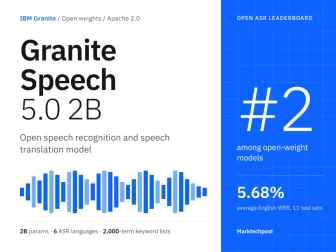
    IBM AI Released Granite Speech 5.0 2B Open Source Multilingual Speech-to-Text and Translation Model

    IBM releases Granite Speech 5.0 2B, an open-source speech language model with 2B parameters, supporting speech-to-text and translation in 6 languages, ranking second on the Open ASR list, with an average WER of 5.68% for English. The model uses YaRN to extend to 16k positions, supports GPU, Apple Silicon, and local CPU deployment, and includes 2000 keyword bias features.

  8. NVIDIA Blog

    NVIDIA Cosmos platform expands new tools to train, evaluate, and deploy world models

    NVIDIA expands the Cosmos platform with new training tools, simulation checkpoints, and Cosmos Data Factory blueprints to help developers quickly build world models. Cosmos Data Factory provides 5 cloud-native blueprints, supporting tasks such as autonomous driving data generation and image attribute enhancement through channels like GitHub and Azure, with Porsche and ANYbotics already applying them to accelerate physical AI development.

  9. MarkTechPost

    Perplexity and NVIDIA researchers have launched JOLT: a joint teacher-student reinforcement learning method.

    Perplexity and NVIDIA have jointly launched JOLT, a post-training method for language models that uses joint online learning and teaching, where a single model plays both teacher and student roles. The teacher model receives privileged information and accepts KL punishment to approach the student model, while the student model learns through token-level distillation signals from the teacher model.

  10. Hugging Face Daily Papers60

    WildAWM synthesizes controllable computer environments in real scenarios for general agent training

    WildAWM enhances the generalization performance of general agents in web, CLI, and GUI benchmark tests through interactive synthesis of controllable computer environments and tasks. The system supports graphical interfaces, model context protocol services, and command-line interfaces, fully based on open-source models, and introduces an execution-based level mechanism to address solvability, difficulty maintenance, and verifier reliability issues in task synthesis. After training the Qwen model in the WildAWM synthetic environment, it achieved significant improvements in 8 cross-distribution benchmark tests.

  11. Hugging Face Daily Papers65

    Hugging Face Daily Papers: Research on continuous pre-training of embodied agents in diverse virtual worlds

    Research has improved the learning ability of embodied agents in virtual worlds through continuous pre-training (CPT) across three dimensions: data scale, diversity, and model size, but there are limitations in long-distance world generalization. The study tested 120 configurations covering parameters from 0.8B to 27B, data budgets from 50 to 1600 hours, and five data mixtures. It was found that increasing data volume improves internal performance, diversity enhances related world transfer, and larger model sizes improve data efficiency but result in worse long-distance generalization.

  12. Hugging Face Blog78

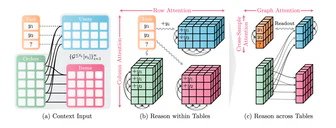
    NVIDIA releases Kumo Relational relational foundation model, capable of prediction without training

    NVIDIA releases pre-trained relational foundation model Kumo Relational, enabling direct prediction on enterprise databases without task-specific training, feature engineering, or table flattening. The model outperforms supervised relational deep learning and expert feature engineering gradient boosting trees on 41 tasks across 15 databases, achieving an MRR 8% higher than AutoGluon ensemble on the SAP SALT benchmark.

    Why it matters: The original provides a comparison result of pre-trained relation models on 41 tasks and an open-source entry, allowing readers to judge whether it can replace the existing XGBoost pipeline.

  13. Hugging Face Blog

    How to reduce inference cost by 77% in real-world applications using a specialized SLM vocabulary list.

    Qwen3-4B's specialized vocabulary list VocabX reduces inference cost by 77% by focusing on the cost of each token rather than frequency, without changing the base model. This method for the Portuguese essay scorer reduces the output layer vocabulary from about 152,000 lines to about 65,000 lines, significantly reducing the computational overhead of token splitting and unused vocabulary items.

  14. Baseten Blog58

    Baseten Releases Global Top Decision Models mammoth-1 and elephant-1

    Baseten Releases Global Top Decision Models mammoth-1 (27B) and elephant-1 (9B), Ranked 1st in Jev Decision Index 0.4 and 1st in 9B Decision Model respectively. Both are open-source and can be tried for free for one week on Baseten model API (default zero data retention).

Oct 21Wed
  1. NVIDIA Technical Blog35

    Use RFD4-Proteina to design proteins through reward-guided reasoning during the search.

    The RFD4-Proteina can design octapeptide protein sequences, with over 2.5 billion combinations; 100-peptide sequences have possibilities exceeding the number of atoms in the observable universe, among which there are proteins that can be developed for new therapies; this model uses reward-guided reasoning to search for solutions to the protein design search problem.

  2. Modal Blog75

    Modal Dojo: A library to easily start production-level LLM training.

    Modal Dojo is a library for easily performing production-level LLM training, supporting models from 500 million to 10 trillion parameters, providing automatically optimized training recipes and built-in observability dashboards. Users can select models, load data, and start training through simple prompts, supporting data sources such as Hugging Face and Harbor environments, and can adjust recipes through parameters.

  3. AWS Machine Learning Blog58

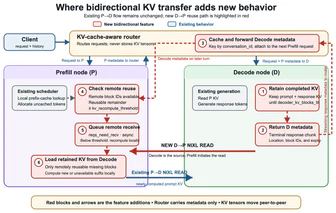
    vLLM enhances the TTFT performance of multi-round agent workloads through bidirectional KV transmission.

    vLLM's bidirectional KV transmission mechanism reduces redundant calculations by allowing the decoding node to return previously computed KV cache to the pre-filled node in subsequent dialogue turns. In multi-round benchmark tests on AWS EC2 P5en instances, it improved the TTFT of Qwen3-32B by 1.6x and zai-org/GLM-5-FP8 by 3.3x. This feature is implemented by extending the NIXL KV connector and utilizing a KV cache-aware router to coordinate KV reuse across dialogue turns.

Oct 20Tue
  1. Hugging Face Blog58

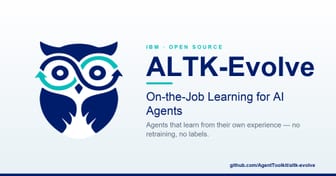
    How does ALTK-Evolve surpass state-of-the-art models in the τ²-bench customer service task through learning and memory?

    ALTK-Evolve uses GPT-4.1 to learn and apply customer service scripts. In the τ²-bench customer service agent benchmark test, it surpasses all retail entries in the retail sector, achieving a score of 67.5% Pass^4, and does not require updating model weights. The model is based on a basic ReAct agent and GPT-4.1. It attempts to analyze tasks and use GPT-4.1 to distill success and failure into short behavioral rules, then adds these guidelines to the agent's system prompts without updating weights or manual annotation.

  2. Anthropic Research

    How does Claude design protein binders for scorpion neurotoxins?

    Claude autonomously generated and screened 318,484 protein designs in 64 hours, selecting 180 for testing, and collaborated with Adaptyv Bio and Twist Bioscience to experimentally validate 211 designs, of which 17 met the binding criteria. All design data has been made public. Experts consider this the first AI design attempt for scorpion neurotoxins, which could accelerate drug discovery for neglected diseases.

Oct 19Mon
  1. O'Reilly Radar65

    The Monday Morning Agent project trains AI analysts using American football data.

    The Monday Morning Agent project uses the NFL public dataset to analyze a controversial American football topic every two weeks, gradually equipping AI agents with analytical capabilities. The project uses 250,000 game clips and current season data, each episode having AI explain a specific tactic (such as 'establishing the offensive line') and verify its analysis results. The AI must state data limitations during analysis and refuse requests beyond the task scope (such as predicting game outcomes).

  2. IBM Research Blog22

    Coursera's new course 'AI Data Stream Architecture: From Principles to Practice' teaches the principles of modern accelerator operation

    Coursera's new course 'AI Data Stream Architecture: From Principles to Practice' teaches engineers how to work across GPUs, TPUs, Cerebras WSE, Groq LPU, and IBM Spyre accelerators. The course is taught by Kaoutar El Maghraoui, a senior research scientist at IBM Research, covering execution models, compilation, memory systems, debugging, and performance modeling through six courses and hands-on experiments, emphasizing how different architectures affect model performance and the key role of compiler optimization.