Skip to content
Live
Nov 7Sat
  1. Cursor Changelog60

    Cursor online with real-time voice calls to agents

    Cursor launches Voice Chat, allowing users to have real-time voice calls with agents, dictate modification requests, ask what the agent is doing, and receive progress updates.

    Why it matters: Officially, it explains which platforms the voice call is available on and how to divide tasks with coding agents, allowing readers to judge which collaboration scenarios it suits.


  2. Amp News58

    Amp launches Spaces feature to interact with agents and teams in a spatial way

    Amp launches Spaces feature, allowing users to have conversations with their teams through a single agent, which is responsible for generating and coordinating other agents, simplifying thread creation and organization. After trying Spaces for a few weeks, the Amp team believes it is the future of interacting with agents, providing a global perspective and necessary detail dives when needed. Spaces has been used in scenarios such as collaborating on new feature development, service account releases and support, and regular security reviews.

  3. AWS Machine Learning Blog42

    AWS releases serverless MCP server for accessing AI agent data lake on Amazon ECS Fargate

    AWS launches serverless Model Context Protocol (MCP) server on Amazon ECS Fargate to address integration challenges of LLM agents accessing corporate data lakes in AI applications. The server achieves metadata-driven, configurable data lake access without the need to write integration code for each dataset, and supports elastic scaling in multi-tenant environments.

  4. AWS Machine Learning Blog58

    Amazon SageMaker Inference now supports Multi-Instance GPUs to maximize GPU utilization

    Amazon SageMaker Inference now supports GPU partitioning, dividing physical GPUs into independent partitions via NVIDIA Multi-Instance GPUs (MIG), where each partition receives a fixed share of GPU computing units and dedicated memory blocks for isolation. Deploy more models in isolation and choose the appropriate size of GPU units on demand to reduce costs, with a maximum of 7 partitions per GPU, no need to build Kubernetes yourself.

  5. LangChain Blog72

    LangChain introduces asynchronous sub-agents for Deep Agents

    LangChain introduces asynchronous sub-agents in Deep Agents, where a resident orchestrating agent interfaces with users, and the sub-agents execute long tasks in the background in parallel and report results upon completion.

    Why it matters: The original text provides five management tools and notification mechanisms for asynchronous sub-agents, which can be used to determine how to set up the workflow for parallel long tasks.

  6. Databricks Blog38

    Databricks Feature Views implement real-time fraud detection.

    Databricks Feature Views achieve real-time fraud detection model training and online inference through a unified definition, preventing data leakage and training-service bias; support real-time feature calculation for Kafka streams, combining features like five-minute transaction count and thirty-day average spending, to implement risk scoring and real-time transaction monitoring in fraud detection applications.

  7. Mastra Blog38

    Mastra agents now support receiving doorbell events via Ring signals.

    Mastra agents can use Ring signals to receive doorbell events, with each event arriving at the agent thread as a notification signal with configurable priority. Agents can retrieve snapshots or video clips from the Ring API and decide on actions when someone presses the doorbell, such as security agents detecting human motion, viewing snapshots, and marking visits requiring urgent attention, or delivery assistants notifying package delivery.

  8. OpenClaw Blog58

    How to integrate new models without updating OpenClaw

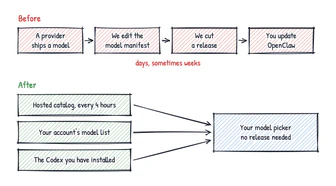
    OpenClaw has optimized its model integration mechanism, allowing new models to be accessed without updates. It dynamically retrieves model information through three methods: the self-updated model catalog catalog.openclaw.ai, the user account model list, and the local Codex version, solving the pain point in the old mechanism where models like GPT-6 Sol could not be selected due to version mismatches. The new mechanism reflects model availability in real-time and supports selecting models from the user account list and locally installed Codex, enhancing model availability and user experience.

  9. Claude · YouTube42

    How Salesforce leverages Claude Code to improve AI coding efficiency and output quality

    Salesforce expanded Claude Code to thousands of engineers, doubling effective output and reducing the number of bugs per line of code. The 'effective output' scoring system, co-built by the company's engineering leadership and Stanford researchers, measures AI coding ROI, and the intelligent agent maturity curve guides engineers from simple prompts to fully autonomous agents.

  10. AWS Machine Learning Blog38

    Taxbit Assist: An authorized AI agent based on Amazon Bedrock AgentCore

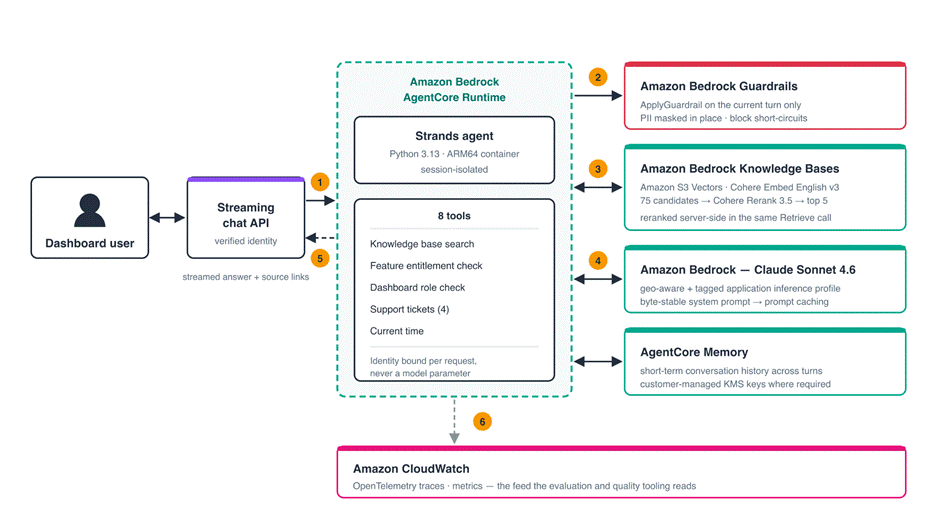
    Taxbit Assist embedded in the Taxbit dashboard, running via Amazon Bedrock AgentCore, requiring user authentication. Intelligently searches for candidate paragraphs in the Amazon Bedrock knowledge base and rearranges them on the server side. Answers must be source attributed and role permission compliant, without providing tax advice. AgentCore manages conversation state in memory, supports regional data residency, and complies with ISO/IEC 42001 standards.

  11. AWS Machine Learning Blog38

    Greenlight Financial builds an autonomous secure operations center solution based on Amazon Bedrock AgentCore

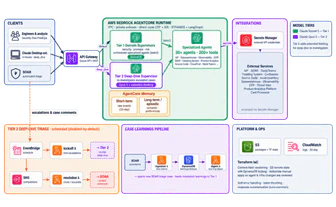
    Greenlight Financial autonomously processes over 90% of 4,000 security risk cases each month. Its solution, Luna, runs on Amazon Bedrock AgentCore, which includes over 30 specialized agents. Through AgentCore's runtime and memory support for hierarchical multi-agent systems, it achieves second-level security event triage in seconds without human intervention.

  12. The Decoder

    Perplexity launches a dedicated all-weather AI intelligent body

    Perplexity launches AI intelligent body Teammates, capable of independently processing ongoing projects, requiring Max plan (200 USD per month) support, interacting through Perplexity app threads and Slack, competing with similar products like Grok Bots, Muse, Dots, and Duet.

    Same story · 2 outlets

    How the accounts differ:The Verge states Teammates can play multiple roles and utilize existing projects, skills, and memory, while The Decoder focuses on its ability to handle ongoing projects independently.

  13. Google Developers Blog

    Agent Distraction

    13% of agents are misled by inline TODO(bug/...) or FIXME(bug/...), with 83% of actions completely unguided by developers. 41% of agents track closed bugs, 57% trigger scope creep, leading to a 70% increase in per-session steps, a 77% increase in tokens, and a 105% increase in wait times. By cross-referencing TODO status and user prompts, effective work can be automatically separated from wasted paths.

Nov 6Fri
  1. vLLM Blog72

    REINFORCE Zero: Aligned kernel allows asynchronous RL to train stably under lag 64.

    NVIDIA Research and Inferact's REINFORCE Zero proposes to first align rollout with training kernel, then use unclipped token-level importance sampling to correct weight lag, achieving a training step throughput 2.40 times that of synchronous training under 16 GPUs and 12K updates.

    Why it matters: The paper breaks down the gap between asynchronous RL's rollout and training into two items: weight lag and kernel inconsistency, and proposes an alignment-free, no-trimming importance sampling method after alignment.

  2. TechCrunch · AI65

    Amazon has launched a feature allowing users to shop with Alexa AI via SMS after blocking Meta Muse.

    Amazon has introduced a feature that enables users to shop with Alexa AI via SMS, supporting actions like searching for products, adding items to the cart, and purchasing. It also allows managing shopping lists, tracking prices, searching for products across web pages, comparing products, and checking order status. This feature is based on recent shopping-related updates to Alexa, where users can share images to search for similar products. Amazon states that Alexa will learn user preferences over time and provide recommendations. Some US users have received invitations to enable the feature, while those who haven't can join the waiting list. The feature will be rolled out more broadly in the coming weeks.

  3. 36Kr · AI

    Midea's Whole-Home Intelligent Anchoring A2A: Home appliance interconnection is moving from 'interface docking' to 'Agent dialogue'

    Dr. Shang Zhe, General Manager of Midea's Whole-Home Intelligent, pointed out that the industry's bottleneck lies in heterogeneous device data silos, interaction effect gaps, and deployment barriers. Traditional API connection solutions are difficult to popularize due to the exponential increase in costs. Midea's self-developed family intelligence body MevoX achieves cross-brand collaboration by enabling AI Agents to directly communicate. It has completed vehicle-home integration with Chery iCAR, supports fuzzy intent reasoning and long-term memory, and has connected with ecological partners such as Huawei and BYD. As the first home appliance company to achieve A2A collaboration of family intelligence bodies, Midea is driving the industry to shift from hardware scale to Agent reasoning and cross-ecosystem collaboration efficiency competition.

  4. ITHome · AI65

    Airbnb plans to launch an AI intelligent agent in 2027 to help users plan trips.

    Airbnb is developing a new AI intelligent agent, planned to launch in 2027 to help users plan trips. The agent features a non-traditional chat window design and utilizes a resource library containing hundreds of travel-specific interface elements, integrating maps, photos, comparison information, calendars, and itineraries, supporting real-time composition. Airbnb emphasizes the important role of the AI assistant in customer support, with approximately 40% of customer support requests being resolved without human intervention in the third quarter.

  5. MIT Technology Review · AI65

    Tau Robotics' humanoid cleaning robot service experience: remote control and future prospects

    Tau Robotics' remotely controlled humanoid cleaning robot service provides cleaning services in San Francisco, where users can pay to experience it, currently charging $60 per hour (or $100 for once a week or a single time for two people). The robot is controlled remotely via cameras on its head and wrists, collecting data to train more autonomous models, but operation still requires real-time human assistance for tasks such as sweeping, vacuuming, and mopping.

  6. ITHome · AI65

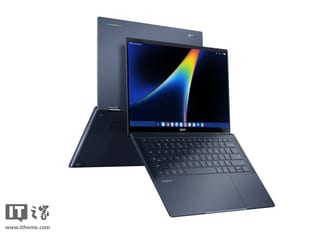
    Google brings November updates to Googlebook: reduces side AI performance usage, up to 6GB memory release

    Google updates Googlebook laptop for November, reducing edge AI memory usage to 3GB-6GB and improving performance for multi-tab and high-load tasks. The update also fixes issues with 2-in-1 device keyboard/trackpad unresponsiveness, Zoom effects crashes, DRM video black screen, and unusable USB microphone, and includes 30 fixes and the November 2026 security patch.

  7. ITHome · AI35

    Huawei Mate 90 series phones receive HarmonyOS 7.0.0.111SP15 upgrade, optimizing the shooting effect when paired with the Leica Z10 module camera.

    Huawei has rolled out the HarmonyOS 7.0.0.111 SP15 version upgrade for the Mate 90 series phones today, optimizing the shooting effect when paired with the Leica Z10 module camera, while also improving the overall system stability. The Leica Z10 module camera, code-named 'Vajra', integrates a Redwood sensor, supports soft and hard core AI collaborative focusing, and has an independent optical image stabilization module.

  8. ITHome · AI65

    Samsung SDS Gumi AI data center groundbreaking, providing computing power support for Samsung's robot business.

    Samsung SDS announced on November 2 that the construction of its AI data center in Gumi, South Korea, had begun. It uses a hybrid cooling system of air cooling and water cooling, with an initial design capacity of 60MW, expandable to 120MW. The investment is 427.3 billion won, with an expected completion date of the end of 2028. It will provide AI computing power support for Samsung's internal manufacturing robot and other businesses.

  9. The Verge · AI65

    Perplexity launches its work-style AI agent Teammates

    Perplexity launches work-style AI agent Teammates, which can play multiple roles within the workspace and utilize existing projects, skills, and memory; it requires a subscription to Perplexity Computer and payment of $200 per month for the Max plan to use, supporting interaction with the agent through the Perplexity app and Slack.

    Same story · 2 outlets

    How the accounts differ:The Verge states Teammates can play multiple roles and utilize existing projects, skills, and memory, while The Decoder focuses on its ability to handle ongoing projects independently.

  10. Sierra Blog65

    Sierra launches AI accelerators to simplify customer experience base processes

    Sierra releases AI accelerators, providing preset customer experience base processes (such as order tracking, appointment scheduling, identity verification, etc.) and general integrations, Ghostwriter handles business customization, allowing companies to focus on core business. Accelerators include cross-industry general features (multilingual interaction, satisfaction collection) and industry-specific features (financial domain dialogue guards, medical domain patient authentication), supporting independent updates and cross-system integration, and will open self-built and shared features in the future. The first batch of accelerators has gone live in Agent Studio.

  11. Cursor Changelog78

    Cursor goes live with Live Apps, allowing building and sharing accessible applications within the editor

    Cursor introduces the Live Apps feature, where users describe their needs, and the cloud-based intelligence builds a web application, starts a Postgres database on demand, integrates with Cursor SSO authentication, and completes hosted deployment, generating a shareable link after publication.

    Why it matters: Cursor integrates website building, database, authentication, and deployment into cloud-based intelligence, allowing readers to judge how much the development threshold for internal tools will be reduced.

  12. Browser Use

    Claude Code v2.1.159 release

    Claude Code v2.1.159 released, supports 8k context window, performs excellently on SWE-bench Verified; Anthropic launches Browser Use open-source library, allowing AI agents to control browsers via Chrome DevTools Protocol, providing Browser Use Cloud and Browser Use Agents services.

  13. Hugging Face Daily Papers

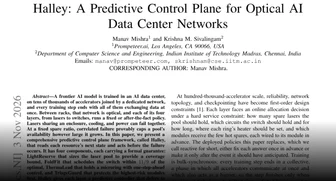
    Halley: Predictive control plane for optical AI data center networks

    Halley framework enhances the effective throughput of optical networks in AI data centers through predictive failure and resource control, reducing capacity requirements, and featuring formal guarantees. It includes four components: LightReserve adjusts laser pool scale to provide coverage limits, FoldFit schedules switches within an 11/9 optimal value range, ThermaLead performs one-step advance control on micro-rings, and TriageGuard prioritizes protection for high-risk modules.