Skip to content
Live
Nov 11Wed
  1. ITHome · AI65

    Developer Simon Willison developed the sound localization system Beep Locator using Claude Code.

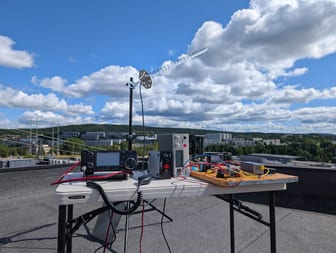
    Developer Simon Willison developed the sound localization system Beep Locator using Claude Code, which can lock the sound source to about 40 cm range; the system localizes by comparing the time difference of sound arrival at different devices and uses fast Fourier transform to identify the target prompt sound; the project code is open source.

  2. MarkTechPost

    MBZUAI's IFM releases PAN 2, an open 29B world model for physical AI

    MBZUAI's IFM releases PAN 2, an open 29B parameter diffusion Transformer (MMDiT) world model, which takes input text and optional first frame, outputs 704x1248 resolution 24 fps video (up to 20 seconds long), achieving a 34.0% complete plan success rate in 100-step multi-tasking, leading 6 test models, but with high failure rates for long plans and high hardware requirements, the code is open-sourced under Apache 2.0.

  3. Hugging Face Daily Papers65

    The DexForesight framework enhances dexterous manipulation performance through implicit spatial foresight.

    The DexForesight framework implicitly learns spatial foresight by injecting a dynamic perception world representation into the latent space of dexterous strategies, increasing the success rate of basic strategies from 49.4% to 60.5% on 11 DexJoCo simulation tasks and achieving a 58.3% success rate on 3 real robotic dexterous operation tasks.

  4. Hugging Face Blog

    Tether AI Research has launched the 0.8B parameter BotPsy model, used for device-side intelligent assistants and agent workflows

    Tether AI Research has launched the 0.8B parameter BotPsy model, built based on Qwen3.5-0.8B, specifically designed for function calls and agent workflows, suitable for on-device deployment. BotPsy outperforms all ≤1.2B parameter models in 6 tool use and agent benchmark tests, including Qwen3.5-2B-Think, achieving the highest scores in 5 tests, with a 2.5x speed increase and a 3x improvement in reasoning efficiency.

  5. Hugging Face Daily Papers

    dNaViT releases: Discrete code as a general visual representation

    dNaViT is a discrete native resolution vision Transformer that matches or exceeds specific baselines in visual understanding, generation, and editing tasks through grouped product quantization and dual-branch targets. It performs excellently on 12 visual understanding benchmarks, 4 generation benchmarks, and one image editing benchmark, proving that discrete vocabulary can be a universal visual representation

  6. Hugging Face Daily Papers65

    Longtail-SWE: High-quality long-tail software engineering task set

    Longtail-SWE has released 202 problem-solving tasks covering 13 underrepresented programming languages, for engineering problems that are scarce in existing benchmarks. Built through a solver-judge-repairer pipeline, the model was evaluated under 9 configurations, including state-of-the-art models, analyzing task-solving performance, consistency of repeated attempts, and resource usage. All benchmark instances, execution environments, tools, and agent trajectories have been open-sourced.


  7. ITHome · AI

    Claris testing Harbor application: Turning Mac into a local AI server

    Claris is testing the Harbor app, which can turn a single or multiple Apple Silicon Macs into a local AI server to run larger AI models without manual configuration. The app is currently in the early experience phase and has not been made available to the public yet.

  8. MarkTechPost

    Meta FAIR releases e-means: an algorithm that outperforms k-means in 10 fewer iterations

    Meta FAIR's e-means algorithm achieves k-means's 25-iteration loss level within 1.4 to 2.6 iterations, with GPU speed improvements of 10-45 times and CPU speed improvements of 8-15 times, without hyperparameter tuning, and has been integrated into FAISS 1.16.0

    Same story · 2 outlets

    How the accounts differ:Hacker News states e-means achieves lower test loss in 25 rounds, while MarkTechPost mentions 1.4 to 2.6 rounds to match k-means 25 rounds' loss level.

  9. ITHome · AI

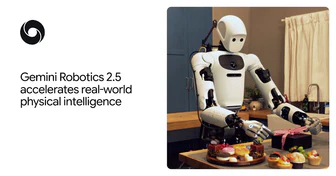
    Google's strongest VLA robot model, Gemini Robotics 2.5, debuts, can tie bows, already on the Mercedes production line

    Google launches VLA robot model Gemini Robotics 2.5, achieving leaps in dexterity, reliability, and safety, with a success rate of 96% on the Mercedes production line. The model has tested 200 tasks, with a success rate 30%-100% higher than the baseline, a speed increase of 20%-30%, and is compatible with robots like Apptronik Apollo 2, adopting ASIMOV-Jailbreak benchmark to enhance jailbreak resistance to 99.5%.

  10. The Decoder

    Nvidia's GR00T 2 model learns tasks by observing human actions through video and imagines itself as a robot

    Nvidia's GR00T 2 AI model learns new tasks for robots by analyzing human video actions without remote control, trained on 400,000 hours of video data, with lab test success rates of 10-80%, and combined with GPT-6 Astra achieves 97% success rate for toy model assembly, but tactile processing and language model latency remain challenges.

  11. Databricks Blog

    Databricks integrated Unity Catalog Metric Views into Power BI: a unified governance semantic layer solution.

    Databricks released Unity Catalog Metric Views integration with Power BI functionality, extending the unified governance semantic layer to Power BI, allowing each Power BI report to use managed UC metric views the same as AI/BI dashboards and Genie, business users can build reports and explore metrics autonomously, data teams only need to maintain a single definition in Databricks.

  12. LangChain Blog

    Workday how to build an AI intelligent agent platform with LangGraph and LangSmith

    Workday has utilized LangGraph for agent orchestration and LangSmith for tracking and evaluation, reducing prototype development time from 5 months to within 1 day with a 4-person team by 2025 and supporting production environment deployment. Its Python SDK 'Workday LangChain' encapsulates LangChain core components and routes through internal services (including LLM gateway, RAG retrieval) while meeting enterprise-level security and compliance requirements.

  13. AWS Machine Learning Blog

    How TCS uses Amazon Bedrock AgentCore to build an agentic test orchestrator

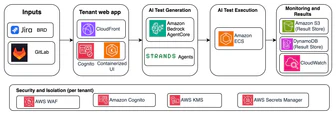
    TCS has built an Agentic test orchestrator for BFSI clients, transforming requirements into executable controlled tests through Amazon Bedrock AgentCore, breaking down tests into dedicated tasks and executing them using their respective agents, tools, and validation rules, while meeting project-specific context, API, and browser UI testing, tenant-level security isolation, and repeatable test path requirements, significantly improving test throughput and allowing engineers to focus on risk analysis and exploratory testing.

  14. MiniMax News80

    MiniMax releases open-source image generation model H3-Image

    MiniMax has released an open-source weight image generation model based on H3, H3-Image, which supports text-to-image, reference image generation, and image editing, capable of generating 4096 × 4096 4K images within 10 seconds, and supports up to 16 reference images.

    Why it matters: The official provides 4K generation speed, reference image quantity, and pricing range, which can be used to judge the gap between open-source image models and closed-source solutions.

  15. Amp News65

    Amp launches new deployment tool Boxes: small, cheap, and permanently running computing units

    Amp launches Boxes, a permanently running, small, and affordable computer where users can deploy software built with Amp, with the smallest model priced at $18 per month, supporting the operation of any application and equipped with an AI agent to manage deployed applications and production data. Users can create, deploy applications, and control the power on/off of Boxes via the agent as needed, supporting minute-by-minute billing and default continuous operation.