Skip to content
Live
Nov 9Mon
  1. QbitAI82

    Tencent Hunyuan Hy4 released: 770B total parameters, 49B activation parameters, first supports native vision and computer operation

    Tencent Mixuan Hy4 is officially released, with a total of 770B parameters and 49B activation parameters. It introduces native visual capabilities and computer operation support for the first time, while also upgrading command compliance, long text understanding, and long-range Agent capabilities. The model has been launched on products such as Tencent Cloud TokenHub, WorkBuddy/CodeBuddy, and Yuanbao. API access has been provided to platforms like OpenRouter, Hermes, and OpenCode, with weights to be open-sourced in the near future.

    Why it matters: The author uses multiple long-range tasks to test the autonomous execution and self-check capabilities of the open-source model 'Hunyuan Hy4', thereby judging the actual level of open-source models in Agent delivery.


  2. Hugging Face Daily Papers31

    Deep dive into intelligent agent evolution: What are we overlooking?

    Agent evolution enhances performance through recursive self-improvement (RSI) without updating model weights, but a high baseline score does not always lead to reliable, efficient, and transferable improvements. The study evaluated the performance of four methods on general and coding tasks, finding that all sixteen evolved agents gained new task capabilities but lost some old capabilities. One general task agent improved reliability by 5.2 points but lost ten old tasks. EvoAudit achieved the best performance through analysis, mutation, and gating mechanisms.

  3. ITHome · AI67

    Alibaba Qianwen Office 2.0 is released: supporting multiple people and Agent collaboration, allowing Agents to be brought into work groups.

    Qianwen Office 2.0 is released, introducing the first collaborative feature supporting multiple people and Agents, allowing real-time association with DingTalk group chats, documents, AI tables, and AI audio notes. It supports task management and assignment; the 'Auto Task' feature is launched, with the first batch supporting trigger scenarios such as messages for specified people, messages @yourself in specified groups, and approval tasks. The 'Human-Machine Co-Creation' capability enables seamless integration of dialogue, content preview, and product editing, supporting multiple people and multiple Agents creating online simultaneously.

  4. MarkTechPost71

    0sec Labs open-sources AI Security Harness 0, providing a Web console, CLI, and MCP service

    0sec Labs has open-sourced AI Security Harness 0, released under MIT or Apache-2.0 licenses, as a research preview version, which can be driven from a local browser console, headless CLI, or MCP server, used for vulnerability investigation, code review, penetration testing, reverse engineering, and fix generation.

    Why it matters: The original text provides the architecture of this security harness, its self-reported benchmarks, and a comparison with similar tools, allowing judgment on its position in the vulnerability discovery process.

  5. QbitAI47

    Ji Yuan Law Release NeoHorse-1.5-Flash Preview, Agent model RSI enters the second round of iteration

    Ji Yuan Law Release Agent Native Model NeoHorse-1.5-Flash Preview, based on Qwen3.8-Flash training, 180B total parameters, 6B activation parameters, score improvement in Agents' Last Exam, Natural Language to Repository and other evaluations. This model iterates through recursive self-improvement (RSI) and combines the OpenSquilla platform to achieve differential diagnosis of multiple models and online learning, now open for limited internal testing.

  6. 36Kr · AI65

    Qwen Office 2.0 has been released, being the first to support multi-user and Agent collaboration in Team Agent.

    Qwen Office 2.0 is released, introducing the industry's first 'collaboration' feature supporting multi-user and Agent collaboration, along with launching capabilities such as 'human-machine co-creation', 'data space', 'automatic tasks', and 'tri-end connectivity', allowing Agents to move from serving individuals to serving teams and organizations.

  7. Hacker News · AI hot posts65

    How do I cope with AI job fatigue brought by Claude Code and Codex?

    When working with Claude Code or Codex from the terminal, users often experience mental exhaustion due to multi-threaded task processing. The author manages tasks in git by organizing work in a way similar to a priority queue, with each task being a markdown file and its status as a git snapshot. The AI agent processes new tasks in a loop, runs tests, and performs browser checks, but cannot make decisions and requires the user to handle them in the 'Owner Inbox' by viewing tasks with the Claude tool on a single page, closing them after completion to process one task at a time.

  8. Simon Willison65

    Hide the redundant information of Claude Code PR descriptions: Use HTML details/summary elements to optimize the code review experience.

    Claude Code or Codex generated PR descriptions are too verbose, but hiding them in HTML details/summary elements can optimize the reading experience. Use the model name and effort level as the summary, for example, 'Claude Opus 5.5 Medium', so readers can quickly get the core information. GitHub Markdown supports this feature; click the expand arrow to view the full content, making the PR no longer appear messy.

  9. ITHome · AI65

    Anthropic releases report: Scientists mainly use Claude for data analysis and writing

    Anthropic released a research report showing that scientists primarily use Claude for data analysis and writing, while less frequently using AI for collecting data and generating research hypotheses. The research is based on 207,000 scientific research session data from August to September 2026, with the highest usage rates in the fields of computer science, mathematics, and statistics. Data analysis accounts for 33.7% of Claude's scientific research sessions, while writing and communication account for 32%.

Nov 8Sun
  1. ITHome · AI75

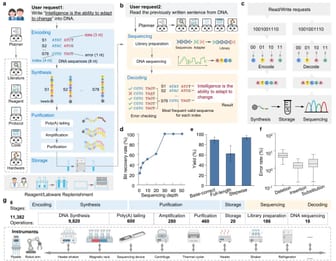
    Shanghai Jiao Tong University's AutoDNA device achieves autonomous molecular biology experiments, results published in Nature

    Shanghai Jiao Tong University's Chen Haibo, Wang Zhao Guo team collaborates with Fan Chun Hai, Wang Fei team to construct AI-native scientific laboratory AutoDNA device (Siyuan No. 1), achieving autonomous molecular biology experiment operations, results published in Nature and featured on the homepage.

    Why it matters: This study combines multi-agent architecture with instrument atomic services, allowing AI to autonomously complete molecular biology experiments, serving as a reference for AI-native laboratory architectures.

  2. The Decoder71

    Alibaba and other teams released Co-Design Bench: coding intelligence agents only fully solve 26.4% of real tasks.

    Researchers from Alibaba and several Asian universities used real user change requests to build the coding intelligence agent benchmark Co-Design Bench. Among the ten tested models, the best-performing GPT-6 Astra only meets about 70% of the task requirements, but only 26.4% of the tasks are completely correct.

    Why it matters: A benchmark display composed of real user requests shows that the strongest model can only fully solve about one-quarter of the tasks, and the score difference for the same model in different environments is nearly 20 percentage points.

  3. Hacker News · 300+71

    MaxxBench release: Model scores show significant divergence after rewriting DeepSWE tasks

    The MaxxBench team made minor changes to 89 DeepSWE tasks (median reference patch added only 17 lines, 3.5%), re-evaluating 15 model configurations, finding the difference between the highest and lowest scores expanded from 20.9 percentage points in DeepSWE to 48.3 percentage points.

    Why it matters: By rewriting the instructions and starting code for 89 DeepSWE tasks, it demonstrates the huge gap in model scores between familiar benchmarks and tasks after modification.

  4. ITHome · AI67

    OpenAI GPT-6.1 Sol involved in live mouse brain surgery: Continuous operation three times, positioning error halved

    OpenAI GPT-6.1 Sol performed three consecutive operations in the brain of a living mouse during surgery, improving its localization performance based on surgeon feedback, reducing the time from 169 seconds to 86 seconds, and reducing the localization error from 0.6 mm to 0.3 mm, a 50% reduction in error. The research team had the model participate in localization tasks for two key anatomical landmarks, Bregma and Lambda, on the surface of the mouse skull. Images, data, and correction records were saved after each operation for future reference.

  5. Hugging Face Daily Papers24

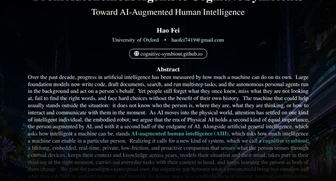
    From Autonomous Agents to Cognitive Symbionts: Towards AI-Enhanced Human Intelligence

    Physical AI should enhance human intelligence through a lifelong cognitive symbiont, which compensates for cognitive gaps through perception, situational retention, and proactive assistance, requiring embedded governance. Large foundation models and personal agents can already complete multi-step tasks independently, but humans will still forget knowledge, ignore information, and lack historical references, as the machines that can provide help are outside the context.

Nov 7Sat
  1. The Decoder78

    Nine AI entities attempt autonomous research on open problems at US national laboratories, none reaching expert standards

    A study made Claude Opus 4.8, Claude Opus 5, Claude Fable 5, Claude Opus 5.5, GPT-5.6 Sol, GPT-6 Astra.

    Why it matters: This benchmark uses 15 unpublished research questions to test 9 agents and provides common failure patterns in 135 submissions, which can be used as a reference for evaluating autonomous research capabilities.

  2. ITHome · AI62

    Anthropic has not yet released an AI model to help solve major quantum computing challenges

    Anthropic's yet-to-be-released AI model helps the physical research institution PSI prove the Allen-Arnold conjecture, which has not been resolved since it was proposed in 2008 and involves when quantum computers can surpass the computational speed of traditional computers. The research system developed by PSI based on this model completed the proof in just three days, confirming that quantum advantage depends on special laws of the problem. Previously, OpenAI has used AI to solve the Navier-Stokes equation problem.

  3. QbitAI78

    AGENTS.md exposed as a new attack entry point, capable of hijacking Codex and Claude Code

    Security agency Forever Security disclosed an attack technique: web pages silently download malicious AGENTS.md to ~/Downloads, and when users start Codex or Claude Code in that directory, the Agent executes it as project specifications.

    Why it matters: The article reproduces the attack chain of poisoning AGENTS.md through the download directory to hijack Codex and Claude Code, and provides executable troubleshooting steps.

  4. ITHome · AI65

    Anthropic research claims Claude AI can become smarter by 'dreaming'

    Anthropic releases research stating that Claude AI agents can improve long-term task performance through a 'dreaming' mechanism, reflecting on historical records, correcting errors, and building knowledge structures during idle time. Claude Opus 5.5 and Sonnet 5.5, after using memory in CL-Bench database question-answering tasks, achieve average scores of 0.838 and 0.833 respectively, outperforming the memoryless baseline of 0.655 and 0.644.

  5. ITHome · AI62

    AI programming tool Amp launches Spaces: Your AI project manager is online, autonomously arranging / coordinating Agent tasks

    Amp introduces the Spaces feature, where the main Agent can automatically generate and coordinate multiple parallel Agent threads to complete projects. Each Space allows teams to plan, execute, and track tasks within a single chat, with the main Agent responsible for goal decomposition and progress organization, while developers only need to define goals and review results.

  6. Anthropic Research62

    Anthropic disassembles the composition of intelligent agent memory and the dreaming mechanism.

    Anthropic has published a research paper, breaking down Claude's intelligent agent memory into components such as memory notes, offline dreaming organization, and memory hierarchy improvement, and explaining that memory refers to context that is preserved across sessions and can be read again, excluding weight updates, context learning within a single session, and compaction.

    Why it matters: Anthropic has disclosed the hierarchical design of agent memory and the dreaming mechanism, providing comparable experimental results using CL-Bench, Pokemon, and internal document corpora.

  7. Cursor Changelog60

    Cursor online with real-time voice calls to agents

    Cursor launches Voice Chat, allowing users to have real-time voice calls with agents, dictate modification requests, ask what the agent is doing, and receive progress updates.

    Why it matters: Officially, it explains which platforms the voice call is available on and how to divide tasks with coding agents, allowing readers to judge which collaboration scenarios it suits.

  8. Amp News58

    Amp launches Spaces feature to interact with agents and teams in a spatial way

    Amp launches Spaces feature, allowing users to have conversations with their teams through a single agent, which is responsible for generating and coordinating other agents, simplifying thread creation and organization. After trying Spaces for a few weeks, the Amp team believes it is the future of interacting with agents, providing a global perspective and necessary detail dives when needed. Spaces has been used in scenarios such as collaborating on new feature development, service account releases and support, and regular security reviews.

  9. AWS Machine Learning Blog

    Agent primitives classification in AWS Quick

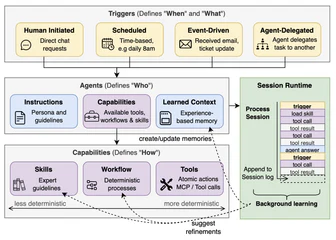
    AWS Quick breaks down agent work into four primitives: 'When', 'What', 'Who', 'How', triggering tasks, agents execute and use capabilities (tools, skills, workflows) to complete work. Triggers are of four types: human-initiated, agent-delegated, scheduled, and event-driven; agents are persistent learners, including instructions, dynamically updated capabilities, and accumulated contextual memory; capabilities range from fully autonomous to fully deterministic, tools are atomic operations, skills provide structured guidance, and workflows are deterministic coordination.

  10. LangChain Blog72

    LangChain introduces asynchronous sub-agents for Deep Agents

    LangChain introduces asynchronous sub-agents in Deep Agents, where a resident orchestrating agent interfaces with users, and the sub-agents execute long tasks in the background in parallel and report results upon completion.

    Why it matters: The original text provides five management tools and notification mechanisms for asynchronous sub-agents, which can be used to determine how to set up the workflow for parallel long tasks.

  11. The Decoder

    Perplexity launches a dedicated all-weather AI intelligent body

    Perplexity launches AI intelligent body Teammates, capable of independently processing ongoing projects, requiring Max plan (200 USD per month) support, interacting through Perplexity app threads and Slack, competing with similar products like Grok Bots, Muse, Dots, and Duet.

    Same story · 2 outlets

    How the accounts differ:The Verge states Teammates can play multiple roles and utilize existing projects, skills, and memory, while The Decoder focuses on its ability to handle ongoing projects independently.

  12. Google Developers Blog

    Agent Distraction

    13% of agents are misled by inline TODO(bug/...) or FIXME(bug/...), with 83% of actions completely unguided by developers. 41% of agents track closed bugs, 57% trigger scope creep, leading to a 70% increase in per-session steps, a 77% increase in tokens, and a 105% increase in wait times. By cross-referencing TODO status and user prompts, effective work can be automatically separated from wasted paths.

Nov 6Fri
  1. Hugging Face Daily Papers65

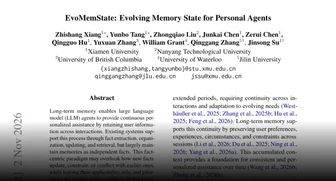
    EvoMemState: An evolving memory state framework for personal agents

    EvoMemState framework enhances persistent facts through relational and reasoning states, improving retrieval completeness and memory response accuracy in long-term dialogue and memory usage benchmarks. The framework includes three components: ontology-guided memory state induction, state evolution based on reinforcement learning, and state-aware reasoning.

  2. TechCrunch · AI65

    Amazon has launched a feature allowing users to shop with Alexa AI via SMS after blocking Meta Muse.

    Amazon has introduced a feature that enables users to shop with Alexa AI via SMS, supporting actions like searching for products, adding items to the cart, and purchasing. It also allows managing shopping lists, tracking prices, searching for products across web pages, comparing products, and checking order status. This feature is based on recent shopping-related updates to Alexa, where users can share images to search for similar products. Amazon states that Alexa will learn user preferences over time and provide recommendations. Some US users have received invitations to enable the feature, while those who haven't can join the waiting list. The feature will be rolled out more broadly in the coming weeks.

  3. The Decoder73

    Thinking Machines has released the Inkling 2 Small, claiming it is the strongest Western open-source weight model.

    Thinking Machines releases second-generation model Inkling 2 Small, using MoE architecture, with total parameters of 594B and activation parameters of 17B, supporting text and image input and adjustable thinking depth.

    Why it matters: The original text provides specific comparisons of the new model in terms of intelligence index, agent tasks, and cost, allowing readers to judge the competitive position of open-source weight models accordingly.

  4. ITHome · AI65

    Airbnb plans to launch an AI intelligent agent in 2027 to help users plan trips.

    Airbnb is developing a new AI intelligent agent, planned to launch in 2027 to help users plan trips. The agent features a non-traditional chat window design and utilizes a resource library containing hundreds of travel-specific interface elements, integrating maps, photos, comparison information, calendars, and itineraries, supporting real-time composition. Airbnb emphasizes the important role of the AI assistant in customer support, with approximately 40% of customer support requests being resolved without human intervention in the third quarter.