From Autonomous Agents to Cognitive Symbionts: Toward AI-Augmented Human Intelligence
From Autonomous Agents to Cognitive Symbionts: Toward AI-Augmented Human Intelligence
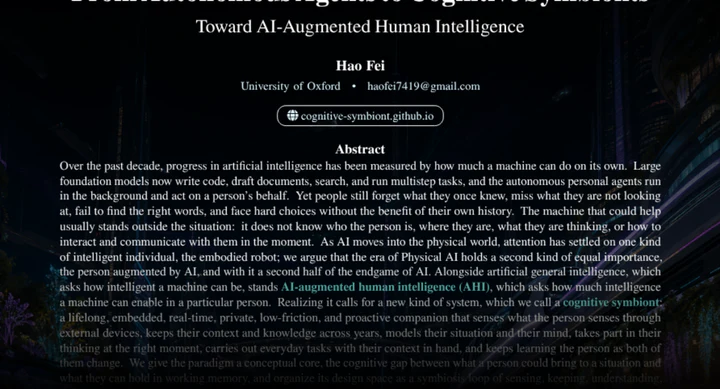
Physical AI should enhance human intelligence through a lifelong cognitive symbiont, which compensates for cognitive gaps through perception, situational retention, and proactive assistance, requiring embedded governance. Large foundation models and personal agents can already complete multi-step tasks independently, but humans will still forget knowledge, ignore information, and lack historical references, as the machines that can provide help are outside the context.
Published on Nov 3
Authors:
Abstract
Physical AI should include AI-augmented human intelligence via lifelong cognitive symbionts that close cognitive gaps through sensing, context retention, and proactive assistance, requiring embedded governance.
For a decade, progress in artificial intelligence has been measured by how much a machine can do on its own. Large foundation models now write code and run multistep tasks, and personal agents act on a person's behalf. Yet people still forget what they once knew, miss what they are not looking at, fail to find the right words, and face hard choices without the benefit of their own history, because the machine that could help stands outside the situation. As AI moves into the physical world, attention has settled on one kind of intelligent individual, the embodied robot; we argue that the era of Physical AI holds a second kind of equal importance, the person augmented by AI. Alongside artificial general intelligence, which asks how intelligent a machine can be, stands AI-augmented human intelligence (AHI), which asks how much intelligence a machine can enable in a particular person. Realizing it calls for a new kind of system, a cognitive symbiont: a lifelong, embedded, real-time, private, low-friction, and proactive companion that senses what the person senses through external devices, keeps their context across years, models their situation and their mind, takes part in their thinking at the right moment, carries out everyday tasks with their context, and keeps learning the person as both change. We give the paradigm a conceptual core, the cognitive gap between what a person could bring to a situation and what they can hold in working memory, and organize its design space as a symbiosis loop of sensing, keeping, understanding, living alongside, acting for and thinking with the person, and growing, enclosed by a personal runtime and by trust. Because a symbiont changes what a person can do in front of others, it also raises risks of a new kind, from covert assistance in examinations to pressure on everyone to adopt it, and we treat their governance as part of the paradigm.
View arXiv page View PDF Project page Add to collection
Get this paper in your agent:
hf papers read 2611.05376
Don't have the latest CLI?
curl -LsSf https://hf.co/cli/install.sh | bash
Models citing this paper 0
No model linking this paper
Cite arxiv.org/abs/2611.05376 in a model README.md to link it from this page.
Datasets citing this paper 0
No dataset linking this paper
Cite arxiv.org/abs/2611.05376 in a dataset README.md to link it from this page.
Spaces citing this paper 0
No Space linking this paper
Cite arxiv.org/abs/2611.05376 in a Space README.md to link it from this page.
Collections including this paper 0
No Collection including this paper
Add this paper to a collection to link it from this page.
Source: Hugging Face Daily Papers · huggingface.co