Skip to content
Live
Nov 13Fri
  1. ITHome · AI

    DeepSeek releases the full suite application API

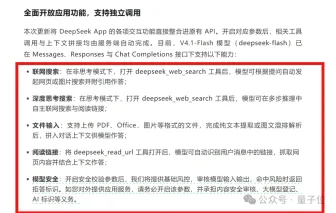
    DeepSeek has opened up the application API, allowing developers to call deep thinking search, file input, and other dialogue functions through parameters. Voice and related underlying capabilities are also opened as independent interfaces, supporting separate or combined calls to achieve 1:1 replication of the DeepSeek App. The V4.1-Flash model (deepseek-flash) supports online search, deep thinking search, file input, reading links, and other capabilities, and charges fees for related tool calls.
  2. QbitAI

    Unbounded Frontiers opensources Fx-Bio-1031, life science RSI model surpassing GPT-6-Astra and Opus-5

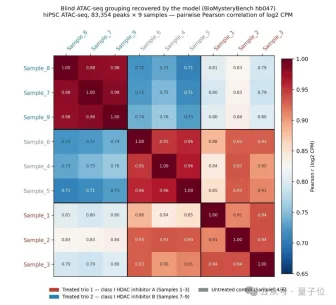
    The boundaryless front-end open-source biological information large model Fx-Bio-1031 achieved 70.59% Pass@5 on the BioMysteryBench benchmark test, significantly outperforming GPT-6-Astra (47.06%) and Claude Opus-5 (52.94%). Fx-Bio-1031 adopts an efficient MoE architecture with 125B parameters and supports localized deployment, suitable for drug development, multi-omics analysis, and other scenarios.

  3. ITHome · AI

    Google open-sources dataset used in WeatherNext 3 weather model: Includes SatWeave satellite image mosaicking dataset and PARDIG global precipitation information

    Google DeepMind has open-sourced the WeatherNext 3 weather model dataset, SatWeave, and PARDIG. The former integrates 5 satellite images (updated hourly, 10-year historical archive), and the latter is based on a Transformer architecture (spatial resolution 10 km, time resolution 15 minutes, average delay 5 hours), both hosted on Google Cloud Storage and licensed under CC BY 4.0.

  4. Ant Group inclusionAI · Hugging Face new models

    inclusionAI/Duo-1.0-causal-base released: A multimodal world model for full-duplex interaction

    inclusionAI releases Duo 1.0 causal-base model, a full-duplex multimodal world model for real-time audio-video interaction, including implementation weights and backbones, intent models and adapters, audio-video encoders, speech recognizers, and forced aligners. The model weights are based on MiniMax H3 initialization and are open-sourced.

  5. Hugging Face Daily Papers65

    PhysLoop: Utilizing the physical perception capabilities of large language models to achieve self-improvement of video generation models

    PhysLoop utilizes large language models to guide video generation, selection, and correction, achieving physically consistent self-improvement and controllable data construction. The framework drives recursive self-improvement (RSI) of video generation models with limited human intervention by identifying and correcting physical errors in generated videos, and releases a diverse dataset containing 100K videos along with generation tools.

  6. Hugging Face Daily Papers

    Hugging Face Daily Papers: Hyper-Connections Architecture Research Proposes SimpleHC Design

    Researchers conduct a systematic study on the Hyper-Connections architecture, proposing the SimpleHC design, which minimizes training overhead and improves stability while achieving performance comparable to mHC by removing residual mixing and using shared memory access. SimpleHC maintains performance when scaling model size from 15B to 30B MoE, with smoother gradient dynamics in standard training, and only increases training time by 2.4% over the base residual baseline at maximum test scale.

  7. Hacker News · AI hot posts86

    Edge0 open sources 145B and 120B edge-side models and inference frameworks.

    Edge0 open-sourced the Edge0-145B and Edge0-120B two edge models, and also released a unified inference framework and deployment tools. Officially, the 145B model can run locally on compatible laptops, with peak memory of 29GB, decoding speed of 80+ tokens/s, pre-filling speed of 1100+ tokens/s, supporting context lengths of 128K–256K.

    Why it matters: The original text provides actual memory, speed, and multiple benchmark comparisons of the edge 145B model, which can be used to judge the practical boundaries of running cutting-edge models locally.

  8. Hugging Face Daily Papers

    Duo: A Reciprocal World Model for Full-Duplex Interaction

    Duo v1 introduces the Reciprocal World Model (RWM), which jointly models intentions and reality through autoregressive reasoning, synchronized attention, and dual inference distillation, achieving real-time full-duplex audio-video interaction. The model continuously perceives audio-video input while responding to users in real time, treating intelligence and physical reality as equal foundational components of the world, supporting interactions such as dialogue, sharing objects, and reshaping virtual scenes. The first batch of models has been open-sourced.

  9. Hacker News · 300+

    smolmaxxing enabling large language models to run on older devices

    The smolmaxxing project enables large language models to run on old devices like Xiaomi TV boxes and iPad Air by customizing the kernel, optimizing memory usage, and streaming weights from flash storage. On Xiaomi TV boxes, the Qwen3.5-2B model processes 7.7 tokens per second, and the Ling-mini-2.0 model processes 5.1 tokens per second. Support for more devices is coming soon.

  10. Hugging Face Daily Papers

    BirdDreams: Joint Perspective and BEV Video Generation for Reasonable, Reactive Driving World Models

    BirdDreams jointly generates bird's-eye view (BEV) videos and bird's-eye view videos, making scene layout a part of predicting the future. By providing an overhead view of vehicle position and movement through BEV, it reduces occlusion, while the perspective video retains scene details. On PhysicalAI-AV and nuScenes, BirdDreams more faithfully follows the input trajectory of its own vehicle and generates more reasonable self-motion without HD map or vehicle state input.

  11. ITHome · AI

    Alibaba Xiami App returns in AI form after five years: Happy Xiami officially launched, members start at 30 yuan per month

    Alibaba's AI music creation platform, HappyShrimp, has officially launched on iOS and Android platforms, with the App Store version at 0.2.14. The platform supports generating human-vocal songs and pure music based on natural language descriptions, possessing music world knowledge, and provides two modes: smart lyrics and pure music. Standard members can generate 150 songs per month for 30 yuan.

  12. Hacker News · 300+

    ZigZag: An open-source visual embroidery editor that supports AI intelligent agent collaboration creation

    ZigZag is a visual embroidery editor written in Rust, supporting the MCP protocol for AI agents to collaborate on design, converting SVG to embroidery stitches, and exporting multiple formats such as PES, DST. It is compatible with Brother Skitch (PP1) and supports Bluetooth transmission, offering various embroidery types and planning functions like Tatami, Satin, Stitch, and is available for download on Mac and Windows platforms.

  13. Ant Group inclusionAI · Hugging Face new models

    inclusionAI/SingVL_S1_4B_GGUF releases the SingVL-4B GGUF multimodal decision model

    SingVL-4B GGUF is the GGUF version of the 4B parameter multimodal decision-making model Sing VL S1 based on Qwen3.5, which can answer named entity questions with text or JSON and up to four images, and uses a full forward pass scoring option, scoring 69.76 in the Text evaluation and 73.94 in the Vision evaluation. The model uses the llama.cpp adapter, with a default context size of 4096 tokens, supporting text and image input.

  14. GitHub Blog · AI & ML58

    GitHub Blog: Build Once, Run Across Any Agent: A Practical Guide to Agent Skills

    Agent skills allow the capture of reusable instructions for users and agents, defining the timing and manner of task execution through a versioned directory centered around a SKILL.md file. Proof Agent uses an independent validator for adversarial validation of AI-generated content, while Data Forge constructs a support pipeline for table metrics through multiple collaborative skills, with each skill sharing context defined by a manifest rather than independently rediscovering it.

  15. Databricks Blog22

    Clarification on the misunderstanding of the Lakebase architecture's LTAP.

    Lakebase architecture serves both Postgres and analytics with a single persistent data copy, without the need for CDC pipelines or a second database. This architecture stores data hierarchically in object storage and cache, not traditional replication. It supports both point-in-time and scan access paths, optimized respectively using Postgres heap pages and Parquet format, with no additional synchronization tasks.

  16. MarkTechPost

    CopilotKit has released OpenBot 1.0: an MIT-licensed, self-hostable, and built-in governance AI assistant.

    CopilotKit has released OpenBot 1.0, an MIT-licensed, self-hostable, and built-in governance AI assistant. OpenBot 1.0 supports user-selected models (including 9 model families such as OpenAI, Claude, Gemini, Grok) and AG-UI agents (supporting 8+ frameworks), with all Bot actions checked against CEL policies before execution. The personal version is free, and the commercial version costs up to $29 per user per month. If model usage exceeds $5,000 per month, an additional 5% fee is charged on the excess. Annual plans also offer offline deployment and 24/7 support.

  17. TechCrunch · AI

    Nectar launches AI agent automation brand creator discovery and connection

    Nectar launches 'Creator Intelligence' that can search over 300 million creators, analyze content and brand collaborations, automatically send personalized messages and manage collaborations, supporting Instagram creators and TikTokers, available globally and plans to integrate other AI assistants like Claude, ChatGPT, Copilot through Model Context Protocol (MCP).

  18. Hugging Face Blog71

    IBM releases LLMON markup language and Granite 4.1 3B/8B preview models

    IBM released LLMON (LLM Object Notation) markup language on Hugging Face and launched two experimental preview models based on Granite 4.1: granite-4.1-3b-LLMON-preview and granite-4.1-8b-LLMON-preview, while also open-sourcing a GitHub toolkit.

    Why it matters: The original text provides the design motivation for the LLMON markup language and the two preview models, allowing readers to understand how separating instructions and data can reduce the risk of indirect prompt injection.