Skip to content
Live
Nov 5Thu
  1. The Decoder

    GPT-6 Astra reprograms other AI models directly through weights

    GPT-6 Astra reprograms other AI models directly by analyzing model weights, without traditional training. It correctly identifies the games and image generation shapes learned by the network, and by modifying 0.016% of the weights on Qwen3.5-0.8B, it increases the accuracy of the MATH-500 benchmark test from 7.9% to 48.1%. Researchers believe its potential lies in security audits and targeted behavioral adjustments, but the model's capabilities are still limited.


Nov 4Wed
  1. ITHome · AI63

    Anthropic's new flagship Fable 5.5 tested to generate 66 seconds of animation purely from code

    Anthropic's new flagship Claude Fable 5.5 was tested by developers to generate 66 seconds of animation purely from code in an unofficial release, continuously writing and running code for about 2 hours 40 minutes to complete the visuals, music, and sound effects. The test shows that Fable 5.5 can complete the coding and running of complex dynamic scenes in about an hour, surpassing some existing Claude models. Anthropic has not confirmed the release time, performance metrics, and scope of the 5.5 series, and the above test results await official confirmation.

  2. a16z News65

    Phaze launches a high-performance remote desktop solution to assist AI agents

    Phaze provides a local workstation experience for AI agents, especially suitable for interactive, low-latency tasks like Blender or Unreal Studio. It is designed specifically for AI agents, achieving seamless compatibility, management, and operation. The Phaze team previously created Parsec, a leading remote desktop for graphics-intensive applications, which has been acquired by Unity.

  3. Together AI Blog50

    Together AI launches Polymorphic Inference: Adaptive open-source model inference technology

    Together AI Launches Polymorphic Inference Technology, Continuously Compiling and Optimizing Open Source Model Inference Performance Using AI Agents to Address Challenges Such as Model Release Acceleration, Architectural Diversity, and Rapid Changes in Workloads and Hardware Platforms. This Technology Enables Inference Systems to Adapt Quickly to Dynamic Environments, for Example, Achieving Near-Hardware-Limit Performance When 80% of OpenRouter Traffic Comes from Models Released in the Past Three Months.

  4. ITHome · AI58

    Xiaomi WorldCast 3D Camera Movement Launched on REDMI K100: Flat Photos Restored into 3D Scenes, and Real Camera Path Virtualized

    Xiaomi REDMI K100 Phone Adds 3D Camera Movement AI Feature, Select Static Photos from Album to Generate Wide-Angle 3D Camera Movement Videos, Lens Can Orbit, Pull, Tilt, and Keep Character Appearance Consistent. This Feature is Based on Xiaomi's Visual Generation Framework WorldCast, Interpreting Depth Structure of the Scene to Restore Flat Photos into 3D Scenes and Virtual Camera Path. Xiaomi Claims WorldCast is a Breakthrough in Controllable Visual Generation Direction, Will Explore More Complex Camera Movement Forms and 4D Video Generation Technology.

  5. ITHome · AI62

    MagicCore Technology has released the 4D world model MoWorld 2.0, based on Huawei Ascend native.

    MagicCore Technology has released the MoWorld 2.0 model, integrating physical elements such as gravity and elasticity into spatial modeling, outputting 4D Gaussian assets that can be rendered in real-time and called. Deployed based on Ascend computing power, the inference cost has been reduced to 30% of the same-scale GPU solution, and the video inference frame rate has been increased to approximately 70 FPS.

  6. Hugging Face Daily Papers34

    LoCo: A local preference learning method for reasoning compression

    LoCo teaches reasoning models when to stop reasoning through local preference learning, significantly reducing output length in mathematical and code tasks while maintaining or improving accuracy. The method reduces completion length by 41.7%--45.4% on mathematical tasks and 23.4%--36.3% on code tasks, while maintaining or improving accuracy, and achieves the best AUC on all code benchmarks. LoCo's code and models will be publicly released.

  7. Hugging Face Daily Papers65

    EvoTeam: Achieving Multi-Agent Collaboration through Evolving Teams

    EvoTeam demonstrates effectiveness in four benchmark tests by executing experience-based joint evolution of team organization, interaction rules, and agent skills while maintaining a reusable team library. It maintains a reusable team library, guides collaboration through specific team interaction rules, and accumulates collaboration experience in compatible team contexts, with individual skills being reusable across different teams.

  8. ITHome · AI62

    XPeng, in collaboration with Peking University, Hong Kong University, and others, has released the GroundingPI pre-trained model, with its perception module scoring over GPT-6 Astra.

    The GroundingPI model jointly released by Xpeng, Peking University, Hong Kong University, etc., scored 73.68 in a comprehensive evaluation of 34 perception benchmarks, surpassing GPT-6 Astra's 71.54. The model, with a parameter size of about 4 billion, adopts a 'perception-first' technical approach, demonstrating higher data processing efficiency and stronger scene generalization capabilities in robotic simulation tasks, significantly reducing teaching costs while maintaining stability.

  9. ITHome · AI65

    AMD is co-building a heterogeneous AI computing reference cluster with FuriosaAI and MangoBoost.

    AMD has signed a memorandum of understanding with FuriosaAI and MangoBoost, planning to build a heterogeneous reference cluster in Seoul next spring integrating AMD CPU/GPU, FuriosaAI RNGD NPU, and MangoBoost BoostX DPU to improve the hardware configuration efficiency of AI computing loads. MangoBoost will adopt AMD Instinct GPU accelerators in its AI factory.

  10. QbitAI22

    Supervision Dynamics' full-stack matrix debuts at the 2026 Hong Kong Financial Technology Week, embodied AI hard technology ignites the scene

    Chaowei Dynamics showcased the high-dynamic humanoid robot ping pong system SMASH, the world's highest degree of freedom (117 DoF) KAIBot, KAI Hand dexterous hand, and KAI Halo data collection headband at the Hong Kong Financial Technology Week, with SMASH's ping pong skills approaching professional players; the company's CEO Yu Jie said it adheres to the full-stack route, with the core team coming from top global enterprises and universities, and currently has about 200 employees.

  11. Hugging Face Daily Papers65

    VidUEU-Agent: An intelligent agent for data management in multimodal understanding, editing, and unification tasks.

    The VidUEU-Agent framework solves the problem of scarce high-quality multimodal instruction data and high annotation costs in multimodal model development by automatically constructing instruction data from raw videos. The framework adopts a four-stage data construction process, combining visual language models and visual tools for evidence-based data synthesis, and utilizes downstream training feedback for autonomous iteration.

  12. ITHome · AI58

    Anthropic develops FlashProve open-source system: using cryptography to prove AI output source

    Anthropic is developing an open-source system called FlashProve, which uses cryptography to prove that AI output indeed comes from a specified model, similar to email encryption signatures. The system can prevent AI companies from secretly switching to different models, verify third-party statements about model usage, and does not disclose model weights, supporting closed-source models. The code has been open-sourced on GitHub. Current research is still ongoing and has not yet been deployed.

  13. Ai2 Blog

    Ai2 collaborates with Google to launch a new generation climate model NeuralGCM+

    Ai2 receives a $10 million three-year grant from Google.org to collaborate with Google Research in developing the open-source climate model NeuralGCM+, aiming to improve the speed and reliability of climate predictions; the model extends from Google Research's NeuralGCM, combining physical equations with AI to simulate the joint effects of the atmosphere and oceans, with simulation cycles extended to decades, supporting regional rainfall and water resource change predictions, and plans to promote research community collaboration through open-source code and documentation.

  14. ITHome · AI58

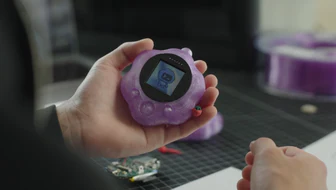
    OpenAI showcased the hardware results of its employees' 'side hustle': GPT-6 Astra assisted in producing designs in a week and prototypes in a month.

    Two employees of OpenAI used their spare time to complete a test device design with GPT-6 Astra in less than a week. The model handled the appearance, casing, circuit board, and firmware generation, and the contract manufacturer then produced the prototype in less than a month. OpenAI partnered with Mazda to use Astra for automotive design and simulation evaluation, exploring solutions for styling, performance, and cost optimization.

  15. Hugging Face Daily Papers42

    Route Anything: A Research Framework for Model and Strategy Routing in General AI Systems

    The Route Anything framework enhances the performance and efficiency of general AI systems by dynamically selecting and coordinating different AI models and strategies. It has constructed a 250,000-run trajectory matrix covering 25 benchmark tests, including 452 configurations such as language understanding, image, video, speech generation, coding, task proxying, and robotic operation.

  16. Hugging Face Daily Papers65

    Pandora framework: Simulating personalized customer expressions in psychological therapy

    The Pandora framework generates more realistic and individualized customer expressions by modeling the evolution of psychological and relational states, reducing AI-like responses. In an evaluation of 115 cases, Pandora outperformed five baseline systems in expression similarity and disclosure consistency scores, with only 7.2% of 45 disclosures rated as AI-like expressions, significantly lower than the baseline systems' 43.3--67.2%.

  17. MarkTechPost

    Tencent's WeVisOne-VL unifies detection, OCR, segmentation, and Matting.

    Tencent WeChat Vision team releases open-source visual language model WeVisOne-VL, including 2B and 4B parameter versions, supporting detection, OCR, segmentation, and Matting, using a 9.6M parameter decoder to output pixel results, surpassing same-scale baselines in over 30 benchmark tests, with the 4B version achieving a 71.3 F1 score on Dense200 dense detection.

    Same story · 2 outlets

    How the accounts differ:Hugging Face Daily Papers states it uses a lightweight pixel decoder; MarkTechPost mentions a 9.6M parameter decoder.

  18. Hugging Face Daily Papers65

    MoviEdit: A framework for editing long-segment, multi-shot video

    MoviEdit framework, through cascaded bidirectional autoregressive modeling and new benchmark tests, maintains cross-scene coherence while reducing manual data annotation, significantly outperforming existing open-source models with performance comparable to industry leading models. The framework automatically generates 87K pairs of paired editing videos for cross-shot supervision, establishes a global editing draft using a lightweight bidirectional stage, and then performs autoregressive propagation and refinement.

  19. Hugging Face Daily Papers62

    Axion 1.0: An open-source foundation model for agents, simplifying implementation

    Axion 1.0 achieves competitive agent performance through a three-stage training process (two lightweight supervised fine-tuning + reinforcement learning) using fully open-source data and training pipelines. The model employs model-aware data construction and verifiable task generation, without specialized mid-training, direct preference optimization, or policy-intrinsic distillation, demonstrating excellent performance in multiple multi-agent benchmarks, comparable to leading commercial models in some tests, and openly sharing the complete development process to promote open-agent research.

  20. Hugging Face Daily Papers

    RoboColosseum evaluates physical intelligence in large-scale real environments

    RoboColosseum evaluates general robotic strategies across different robots and environments, finding weak consistency across robot platforms, limited open-world reliability, and significant differences in zero-shot and fine-tuning performance. This distributed evaluation framework assessed five visual language action (VLA) strategies and three cutting-edge AI agents on four robot platforms (SO-101, Franka, dual-arm YAM, humanoid G1). The results show that cutting-edge agents are comparable to dedicated VLA strategies, but all systems perform poorly in open-world tasks. RoboColosseum evaluates physical intelligence in large-scale real environments.

  21. Gemini CLI releases15

    Gemini CLI v0.67.0-nightly.20261104.g89e9d25d6 released

    Gemini CLI v0.67.0-nightly.20261104.g89e9d25d6 released, fixing stream failures during extension publishing and downloading, retaining explicit gemini-2.5-flash model in dynamic model parsing, supporting SubagentStop event mapping and merging hook definitions, waiting for history replay before ACP session/load response, providing --userns=keep-id for rootless podman.

  22. Hacker News · AI hot posts65

    The revised edition of 'Generative AI Basics: A Visual Introduction to Mathematics' has been released.

    This book provides a concise derivation introduction, explaining the mathematical foundations of modern generative AI. It constructs a coherent understanding path by connecting the ideas of major generative model families (from PCA, variational autoencoders to diffusion models, GANs, etc.). The revised edition adds visual explanations, with 195 pages, suitable for researchers, practitioners, and students interested in mathematics.

  23. MarkTechPost71

    Anthropic open-sources FlashProve: using zkSNARK to prove responses from committed weights

    Anthropic's cutting-edge red team has released an open-source research prototype FlashProve, which uses zkSNARK to prove that a response is generated by committed model weights without revealing the weight information. On Llama 4 Maverick (400B MoE), a single H100 achieves a proof speed of approximately 110 tokens/s, with a proof size of 18.78 MB, and CPU verification takes 17 seconds.

  24. MarkTechPost55

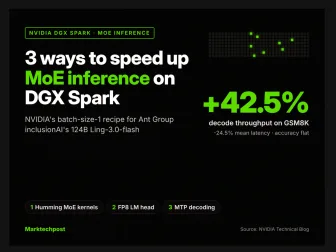
    NVIDIA demonstrates 3 methods to accelerate MoE inference on DGX Spark, increasing Ling-3.0-flash throughput by 42.5%

    NVIDIA boosts the inference throughput of the 124B parameter Ling-3.0-flash model on DGX Spark by 42.5% and speed by 3.5x with a new MoE backend, FP8 output layer, and built-in speculative decoding, without compromising accuracy. This optimization is suitable for single-user desktop systems, improving throughput from 37.81 tokens/s to 53.89 tokens/s and reducing latency by 24.5% on 1,319 GSM8K problem tests.