DreamX: Video Diffusion Model is a Universal Latent Action Learner
DreamX: Video Diffusion Model is a Universal Latent Action Learner
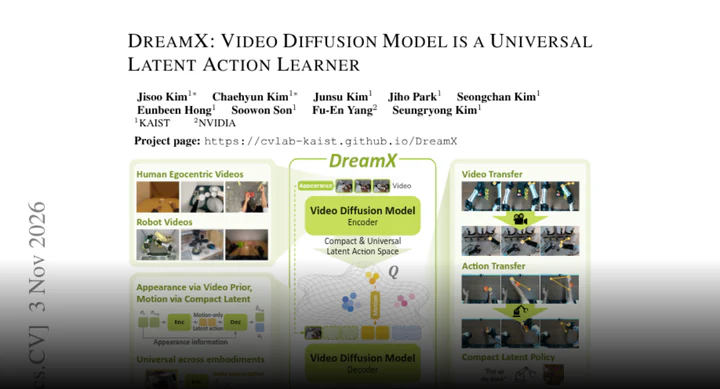
DreamX uses pre-trained video diffusion models to learn compact, appearance-invariant latent actions, achieving cross-subject transfer and efficient policy learning. DreamX extracts latent actions from the rich spatiotemporal features of the video model, compressing each frame 300 times (1200→4 tokens).
Published on Nov 3
Authors:
,
,
,
,
,
,
,
Abstract
DreamX leverages a pretrained video diffusion model to learn compact, appearance-invariant latent actions that enable cross-embodiment transfer and efficient policy learning.
Learning a universal action representation from video requires modeling dynamics that are consistent across different executions of the same action yet invariant to changes in embodiment and appearance. Existing latent action models infer actions from visual transitions, but their representations often entangle the underlying action with irrelevant visual variations, limiting transfer across embodiments. We introduce DreamX, which repurposes a pretrained video diffusion model as a universal latent action learner. Our approach extracts compact latent actions from the video model's rich spatiotemporal features, compressing each latent video frame by 300times (1{,200 rightarrow 4} tokens). In addition, by leveraging the video model's generative prior, these latent actions capture action-relevant dynamics disentangled from visual appearance. The resulting latent space serves as a shared action interface across embodiments (human and robot), environments, and action parameterizations. On LARY-Bench, DreamX achieves state-of-the-art performance among latent action models. Moreover, actions encoded in one setting remain effective in another: the latent space supports any-to-any video transfer and zero-shot action transfer across diverse embodiments and environments. Furthermore, this shared interface also enables policy learning in a compact latent action space, reducing the computational cost of video-diffusion-based policies.
View arXiv page View PDF Project page Add to collection
Models citing this paper 0
No model linking this paper
Cite arxiv.org/abs/2611.05377 in a model README.md to link it from this page.
Datasets citing this paper 0
No dataset linking this paper
Cite arxiv.org/abs/2611.05377 in a dataset README.md to link it from this page.
Spaces citing this paper 0
No Space linking this paper
Cite arxiv.org/abs/2611.05377 in a Space README.md to link it from this page.
Collections including this paper 0
No Collection including this paper
Add this paper to a collection to link it from this page.
Source: Hugging Face Daily Papers · huggingface.co