Skip to content
Live
Nov 6Fri
  1. MarkTechPost62

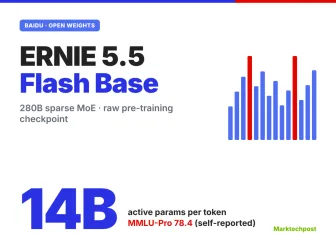
    Baidu released ERNIE 5.5 Flash Base: a 280B MoE base model, activating 14B parameters per token.

    Baidu released ERNIE 5.5 Flash Base, a 280B parameter sparse MoE base model, activating 14B parameters per token, supporting 128K training context and 1M inference context.

  2. Sierra Blog65

    Sierra launches AI accelerators to simplify customer experience base processes

    Sierra releases AI accelerators, providing preset customer experience base processes (such as order tracking, appointment scheduling, identity verification, etc.) and general integrations, Ghostwriter handles business customization, allowing companies to focus on core business. Accelerators include cross-industry general features (multilingual interaction, satisfaction collection) and industry-specific features (financial domain dialogue guards, medical domain patient authentication), supporting independent updates and cross-system integration, and will open self-built and shared features in the future. The first batch of accelerators has gone live in Agent Studio.

  3. LangChain Deep Agents releases15

    LangChain Deep Agents 0.2.5 released

    LangChain Deep Agents 0.2.5 released, fixes bugs related to matching compressed input budget with selected model, retaining truncated responses when `ModelRefusalMiddleware` throws errors, and applying delays to in-app `uv` installation on Windows.

  4. LangChain Deep Agents releases35

    LangChain Deep Agents v0.7.33 released

    LangChain Deep Agents v0.7.33 released, defaulting to error reporting when the model refuses and reporting sub-agent refusal, adding asynchronous sub-agent notification metadata, recording sub-agent checkpoint task call ID. Fixed issues with Python `grep` fallback file range limitation, long result line truncation, and compression failure error reporting, and officially formalized the rubric middleware.

  5. Browser Use

    Claude Code v2.1.159 release

    Claude Code v2.1.159 released, supports 8k context window, performs excellently on SWE-bench Verified; Anthropic launches Browser Use open-source library, allowing AI agents to control browsers via Chrome DevTools Protocol, providing Browser Use Cloud and Browser Use Agents services.

  6. Hugging Face Blog71

    NVIDIA has released four open-source world model checkpoints for Cosmos 3.

    NVIDIA has added four new open-source weight checkpoints for Cosmos 3 under the Cosmos World Model platform, all of which are post-trained versions of Cosmos 3 Nano, containing 16B trainable parameters, using the OpenMDW1.1 license, allowing commercial and non-commercial use.

    Why it matters: The original text provides four open-source weight checkpoints and a four-stage training recipe, allowing readers to judge how to adapt the world model to their own sensors and robot bodies.

  7. Hugging Face Daily Papers

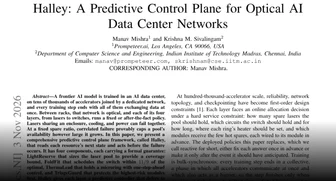
    Halley: Predictive control plane for optical AI data center networks

    Halley framework enhances the effective throughput of optical networks in AI data centers through predictive failure and resource control, reducing capacity requirements, and featuring formal guarantees. It includes four components: LightReserve adjusts laser pool scale to provide coverage limits, FoldFit schedules switches within an 11/9 optimal value range, ThermaLead performs one-step advance control on micro-rings, and TriageGuard prioritizes protection for high-risk modules.

  8. TechCrunch · AI

    OpenAI releases ChatGPT Cyber model to address cybersecurity threats

    OpenAI discovered a severe vulnerability in Ubuntu servers through GPT 5.6 Sol, prompting the company to release the ChatGPT Cyber model for users of the Daybreak Red program, which was announced on November 6, 2026. The model had previously scanned the Linux kernel and found 948 potential issues. OpenAI has also invested $1 billion to support cybersecurity professionals in critical infrastructure, but the industry is concerned about the insufficient allocation of resources for cutting-edge models.

  9. O'Reilly Radar

    New knowledge carriers for the AI economy

    At the recent Foo Camp, participants believed that the primary carrier of software development is shifting from executable code to natural language prompts, generative processes, and developer skills. Some compared Python to assembly language, suggesting that natural language generation might make traditional code writing optional.

  10. Microsoft Research

    PDD Kit officially validated full-stack web applications written by AI intelligent agents

    The PDD Kit translates user intent into formal specifications and verifies whether the code written by the agent for each input conforms to these specifications, supplemented by testing. The team officially validated the Rust-written Pet Store login logic using the Chopin environment on GitHub Next with the PDD Kit, and the Verus tool discovered and fixed existing bugs, proving no login bugs under the specification.

Nov 5Thu
  1. LangChain Blog

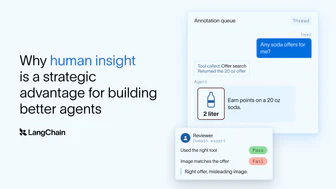
    How human insight constructs better intelligent agents - LangChain's three principles of human feedback

    LangChain explores three principles of human feedback to enhance agent development: expert judgment defines quality standards, comprehensive context evaluation, and converting feedback into reusable data; through agent trace to record user interactions and model behavior, manually labeled scoring with reasons, used to calibrate automated evaluators, improve evaluation criteria, and build golden datasets, forming reusable expert knowledge assets.

  2. Hugging Face Daily Papers65

    EmoReward: A self-evolving reward calibration mechanism for emotional video generation

    EmoReward adapts multi-reward weight allocation by extracting evidence reliability from reward trajectories collected during actual training runs to calibrate reward weights for emotional video generation. This mechanism first evaluates specific grounding cues based on emotional prompts, then scores videos during the generation phase using heterogeneous signal primitives, and calibrates their contributions through reflective reward gating.

  3. Hacker News · 300+65

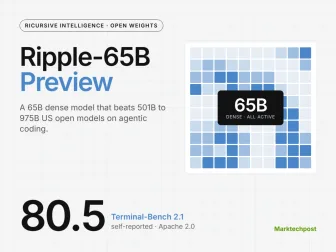
    Ripple-65B Preview: US Open Source Ultra-Large Scale Model Achieves SOTA on Agentic Coding

    Ripple-65B Improves Computational Efficiency by Optimizing SFT and RL Schemes, Using Synthetic Data Pipelines and Quality Filtering, Employing a Hybrid RL Scheme with Truncated Importance Sampling, Score Centering, and Linear Length Penalty in a High-Quality Long-Term Synthetic Environment, Achieving a TerminalBench 2.1 Score of 80.5 with Only 1.4M Rollouts, 70 Times Fewer than Reflection Beam

  4. ByteDance Seed · Hugging Face new models

    ByteDance-Seed/Qwen3-30B-A3B-MoE-SAE released

    ByteDance-Seed/Qwen3-30B-A3B-MoE-SAE is released, containing TopK sparse autoencoders (k=100, 2^20 latent variables) trained on layers 4, 30, and 46 of the Qwen3-30B-A3B model. Each SAE is approximately 17.2 GB, with reconstruction variance unexplained scores of 12.6%, 25.1%, and 7.6% respectively.

  5. IBM Research Blog36

    ORNL, IBM, and AMD jointly announce the quantum error correction collaborative design platform

    ORNL, IBM, and AMD deploy a quantum error correction (QEC) collaborative design platform at IBM's New York Poughkeepsie campus, integrating the IBM Quantum Nighthawk r2 processor with the ORNL Umbra HPC system, which includes the AMD Instinct MI355X GPU and 5th Gen AMD EPYC™ CPU, providing low-latency quantum-classical execution capabilities for algorithm development and validation in hybrid HPC-quantum computing environments.

  6. IBM Research Blog38

    HRL Laboratory's MEMS inertial sensor can rival GPS

    HRL Laboratory develops an inertial measurement unit (IMU) using advanced algorithms, providing an uninterrupted GPS alternative. Its MEMS inertial sensor is the size of a can of soup, with accuracy close to GPS, and solves the long-standing problem of bias drift. Through the AutoCal automatic calibration system, it continuously corrects errors, achieving unlimited navigation support. The IMU uses ASIC and advanced packaging technology to optimize cost and size, making it suitable for light vehicles such as drones.

  7. Hugging Face Daily Papers

    StreamDuo: A live commentator and a research agent for unseen new games

    StreamDuo pairs a trainable commentator with a frozen research agent that searches for game wiki entries to improve cross-game live commentary without training specifically for the target game. StreamDuo was trained on Baldur's Gate 3 and tested on ten unseen new games, increasing entity recall from 0.082 to 0.116, reducing source game leakage from 9.9% to 1.0%, and achieving the best timing, highest evaluation vitality, and overall quality in the live model.

  8. O'Reilly Radar

    How RouteLLM researchers train routers to choose between strong models and cheap models using preference data

    RouteLLM researchers train routers to choose between strong and cheap models, benchmark tests show more than double cost reduction with minimal impact on response quality. Automatic routing can help users get more help within budget, allowing the same subscription to support more requests or more frequent use of strong models. Users need to understand the routing effect and evaluate the cost and time benefits it brings, such as comparing different routing strategies through full interaction of code analysis tasks.

  9. Hugging Face Blog72

    Phonon TTS releases on-device speech models, topping multiple metrics on the Hugging Face open TTS leaderboard

    Phonon releases a small TTS model that can run on local devices, without a server and network, offering two versions of about 65 MB and 75 MB, covering English, French, German, Spanish, and Portuguese.

    Why it matters: The original text outlines the specifications, open-source license, and leaderboard performance of on-device TTS models, allowing judgment on the usability boundary of small models in local voice scenarios.