Skip to content
Live
Oct 31Sat
  1. AWS Machine Learning Blog

    End-to-end method for managing Amazon Bedrock costs: playbook for FinOps and platform teams

    Amazon Bedrock cost management requires attributing every dollar spent to identity, team, and application, and monitoring, enforcing budgets, optimizing platform default settings, and then transforming data into decisions through regular reviews. Bedrock automatically attributes inference costs to IAM entities and requires CUR 2.0 and cost allocation tags to achieve this. To resolve shared role issues, user session management must be adopted to independently attribute each user request.


  2. NVIDIA Technical Blog65

    Running AI models in edge application development using a few commands

    Developers are building next-generation intelligent agents at the edge for monitoring driver attention and cabin conditions, helping robots understand environmental planning tasks, and coordinating machine clusters on production lines. These physical AI applications require models for perception, reasoning, and action that run within strict memory, power consumption, and latency budgets.

  3. NVIDIA Technical Blog65

    Building controllable specialized agents using NVIDIA NemoClaw

    Developers use NVIDIA NemoClaw to build autonomous agents, a framework that includes models, executors, and domain-specific tools, and supports secure deployment. NemoClaw provides policy enforcement runtime, optimization, and observability tools to ensure the reliability and security of agents when accessing real enterprise systems and data.

Oct 30Fri
  1. OpenHands Blog38

    How to set up an AI code review agent with OpenHands

    OpenHands Agent Canvas can set up an AI code review agent within minutes, automatically reviewing GitHub pull requests and adhering to coding standards. The agent uses OpenHands's `code-review` skill to prioritize identifying logic errors, security vulnerabilities, performance regressions, and missing use cases that affect production, avoiding minor formatting issues, and directly publishing feedback containing issues, severity, and suggested fixes in GitHub PRs.

  2. Google Developers Blog62

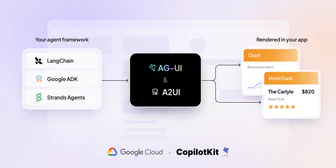
    Build generative UI applications with A2UI and CopilotKit agents

    Google introduces its framework-agnostic open standard A2UI, allowing agents to describe interfaces declaratively in JSON, rendered by applications using existing components, and integrated with the AG-UI protocol of CopilotKit to connect to agent frameworks like LangChain, Google ADK, Mastra, Strands, etc.

    Why it matters: The original text provides complete integration code and bidirectional interaction examples for A2UI and CopilotKit, which can be used to determine the implementation method for generative UIs.

Oct 29Thu
  1. OpenRouter Blog

    How to Use LLM to Extract Tables from PDFs

    The Anthropic/claude-haiku-5.5 model paired with a strict JSON schema can extract tables from PDFs and return typed rows. Tested five PDFs (including scans) successfully extracted all 644 cells; failure cases were due to PDF processing paths, not model capability. Note empty results and output length limits.

  2. Google Developers Blog58

    How Agents CLI optimizes Agent quality through Hill-Climbing

    Agents CLI v1.8.0 achieves Hill-Climbing optimization of Agent quality through commands like eval generate, eval grade, etc., using the custom_response_quality metric to rate 4 cases from 1 to 5, finding that changing the system prompt to a chef role reduced the average score from 4.0 to 2.75. This tool supports model backend experiments and automatic alerts, improving Agent performance through iterative cycles.

  3. LangChain Blog

    How to use crons to build proactive agents with LangChain

    LangChain found that nearly 70% of Managed Deep Agents run from scheduled tasks. Crons enables agents to have proactivity, personalization, and ambient characteristics by implementing mechanisms such as memory ('dreaming'), proactivity (exploring new actions), intelligent filtering (monitoring event streams), and reminders (scheduled tasks).

  4. OpenRouter Blog67

    Claude 529 Overloaded: Meaning and Solutions

    Anthropic's Claude API is experiencing a 529 Overloaded error, indicating that the model is temporarily beyond capacity and usually recovers within a few seconds. It is recommended to first retry using exponential backoff. If the issue persists, send the request through OpenRouter to other service providers that offer the same Claude model.

Oct 28Wed
  1. Databricks Blog

    Databricks improves document extraction accuracy through ai_extract and MLflow Prompt Registry

    Databricks improves document extraction accuracy by building a document extraction process that includes a review step, using ai_extract combined with JSON schema and global instructions, and leveraging MLflow Prompt Registry for versioned configuration. Finally, it validates the improvement effect on a fixed set of manually labeled data, enhancing the overall performance of the system.

  2. LangChain Blog71

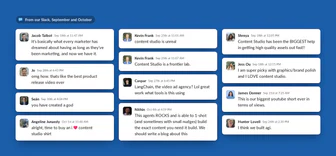
    How to Set Up Design Intelligent Agents with LangChain Content Studio

    LangChain introduces the internal design of its intelligent agent Content Studio, which can generate videos, social media graphics, UI diagrams, and presentations in Slack with a single prompt word, with all materials generated by code.

    Why it matters: LangChain has disclosed the complete setup process of its design agent Content Studio, including skills, wiki, inspection gates, and the division of labor between asynchronous sub-agents, which can serve as a reference for building vertical agents.

Oct 27Tue
  1. Claude · YouTube50

    How Anthropic engineers use Claude Docs

    Anthropic engineer Doug shares how to use Claude Docs in stand-ups and release reviews. Claude collaborates in documents, automatically extracting data, validating arguments, and responding to questions in comments. The tool is designed for team collaboration, supporting real-time analysis within the document.

  2. Google AI Blog45

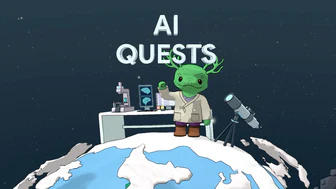
    Google AI Quests series 'Summit' released: guiding students to explore neuroscience of brain mapping

    Google AI Quests Series Course 3 'Summit' released, gamifying learning neuroscience, guiding students to scan and map brain neurons to understand memory loss mechanisms. The course includes data cleaning and model testing tasks, emphasizing that AI needs human supervision and critical thinking. The course is inspired by Google AI's decade-long Connectome Project research, upon completion, students will understand real-world groundbreaking achievements, such as the complete fruit fly brain map.

Oct 26Mon
  1. 36Kr · AI50

    WISE2026 'World Coffee & Industry Matchmaking' Call for Specific Business Questions and Technical Partners

    The WISE2026 Business King Conference will host the 'World Coffee & Industry Matchmaking' event, inviting companies to submit specific business questions for targeted exchanges with technical partners. The event will have demand-side participants as 'table leaders' for rotating matchmaking with technical partners, pre-matching intentions, focusing on AI applications and embodied intelligence on-site, and is expected to collect needs and facilitate over 100 rounds of matchmaking.

  2. Hamel Husain50

    How to create an effective AI evaluation dashboard for stakeholders

    Dashboards should explain changes, potential causes, and next steps through narrative and custom data visualization, rather than letting readers judge the importance themselves; AI makes building custom visualizations feasible, benefiting stakeholders more from the visualization and analysis of specific trends.

  3. Simon Willison65

    Seam Cutter

    Simon Willison has developed a tool called Seam Cutter that can create horizontal or vertical cutting lines in images and slide the sides to crop a specific area from the middle of the image. The tool is designed to address the need to crop specific parts in the middle when using Tailor to stitch multiple screenshots into a long image (e.g., removing irrelevant prompt words).

  4. ITHome · AI65

    A custom firmware was made by netizens for the Sony A7C II, directly unlocking FL2/FL3 and Fujifilm X-series filters

    User 'QAQLeonard' has created a custom firmware for the Sony A7C II, unlocking FL2 and FL3 film modes, supporting import of external LUTs, Fujifilm NC, Ricoh GR direct color tones and creative appearances, electronic shutter sound, and vertical display, etc. A7C II Tools has released version 3.0, the first version with a formal graphical interface.

Oct 25Sun
  1. vLLM Blog60

    vLLM serves DeepSeek-V4.1-Flash on GB300 NVL72: performance matches DeepInfer and extends to the entire rack

    The vLLM team used P/D separation and Wide-EP to serve DeepSeek-V4.1-Flash on a single NVIDIA GB300 NVL72 rack, achieving 954K tokens/s per GPU and 196 tokens/s for single-user P90 on SemiAnalysis AgentX, which is 7.9 times the early single-node results.

    Why it matters: The vLLM team has released per-item optimization and measured data for serving DeepSeek-V4.1-Flash on GB300 NVL72, which can be compared with DeepSeek's own engine DeepInfer.

Oct 24Sat
  1. ITHome · AI58

    BeanPod AI helps users identify stroke signs, triggering a hot search on Weibo.

    A 90-year-old man in Liaocheng, Shandong, Yu Jianjin, used BeanPod AI to identify the signs of his father's stroke. AI issued two warnings, suggesting immediate medical attention, helping the elderly catch the 4.5-hour golden window period for intravenous thrombolysis, and recovery is good. AI intercepted potential delays at the user's hesitation point, triggering a hot search on Weibo. Experts remind that AI recommendations are for reference only and cannot replace a doctor's face-to-face consultation.

  2. vLLM Blog62

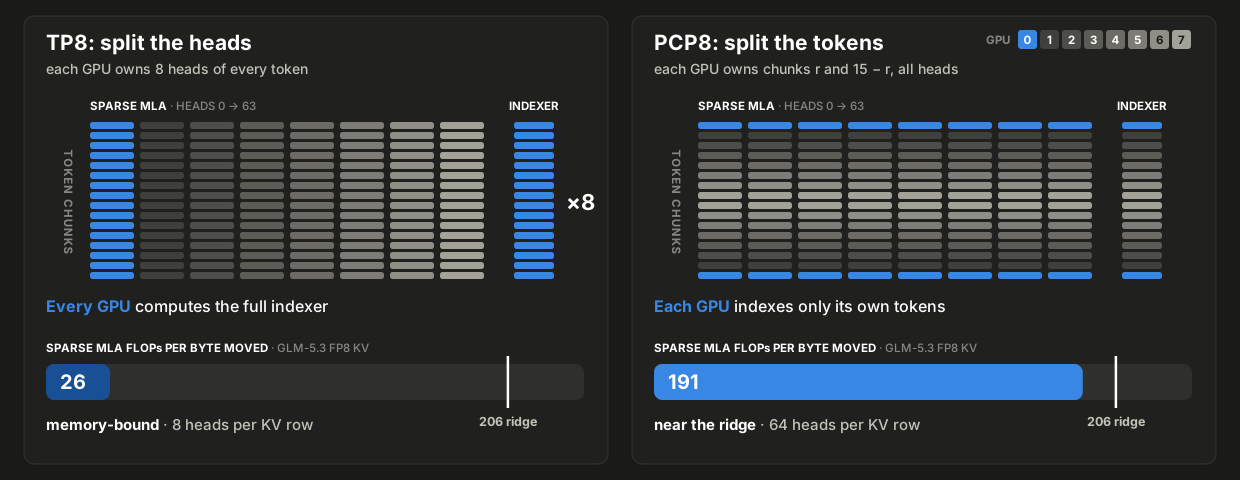
    vLLM provides an in-depth explanation of the optimization of PCP, DCP, and Hybrid HiSparse for GLM-5.3 on 16 H200s

    vLLM team releases the second part of GLM-5.3 optimization, deploying on 16 H200s with 1 pre-filled node and 1 decoding node, using PCP to split pre-fill by token and DCP to split KV cache by token, allowing 1M context to fit into the pre-fill node

    Why it matters: The vLLM team has dissected how PCP, DCP, and Hybrid HiSparse can be combined on 16 H200s, allowing readers to understand the memory and pre-fetch bottlenecks of long-context deployment.

  3. AWS Machine Learning Blog

    Use AWS CDK custom resources to orchestrate SageMaker AI endpoint auto-scaling.

    Use AWS CDK custom resources to automatically orchestrate SageMaker AI endpoint updates with auto-scaling, without manual intervention. Through three custom resources (decommission, update, register scalable targets, attach extension policies) achieve explicit dependency order, ensuring endpoint configuration and auto-scaling parameters are synchronized in a single deployment. The deployment stack includes three custom resources, two Step Functions state machines, and twelve Lambda functions.