Skip to content
Live
Nov 14Sat
  1. AWS Machine Learning Blog

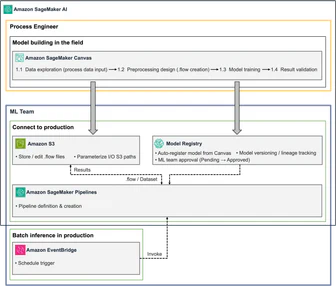
    GS Caltex uses Amazon SageMaker Canvas and Amazon SageMaker Pipelines to connect process engineer models to production workflows.

    GS Caltex enables process engineers to build and validate models without code through Amazon SageMaker Canvas, and then configure deployment and scheduled inference using Amazon SageMaker Pipelines. ML engineers can transfer SageMaker Canvas assets to Pipelines in just a few hours, with model version deployment and execution history managed by Pipelines, achieving batch processing of inference every 30 minutes and reducing inference costs.

  2. AWS Machine Learning Blog45

    Amazon Bedrock AgentCore runtime V2 architecture mode: Accelerating session startup

    Amazon Bedrock AgentCore runtime V2 reduces session startup time to about 2 seconds by preparing the environment once and using a snapshot for recovery, while also reclaiming unused memory. V2 supports building hooks to load large files or CLI, suitable for scenarios requiring resource preparation in advance. Session startup time can be measured via CloudWatch metrics, prioritizing optimization of platform overhead or code execution time.

  3. AWS Machine Learning Blog

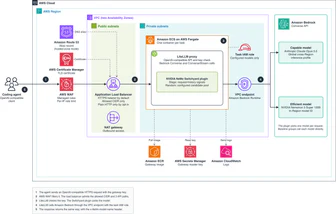
    Using NVIDIA NeMo Switchyard on Amazon Bedrock to Route Model Requests for Coding Agents like Claude Code and OpenAI Codex CLI

    Developers using coding agents like Claude Code and OpenAI Codex CLI need to be billed per task rather than per single call, so model routing should be based on the cost per task. NVIDIA NeMo Switchyard is an open-source library that helps AI agents select models to process each request, supporting Stage and Random routing strategies.

  4. Google Research88

    Google Opens /teamwork Multi-Agent Workflow in Antigravity

    Google has opened the /teamwork multi-agent workflow in Antigravity to external researchers and developers, which can be used in conjunction with Gemini 4 Argon, Carbon, and Hydrogen; /boost and Deep Review are also available.

    Why it matters: Google has disclosed /teamwork's specific results in multi-agent research and engineering tasks and made it available for external researchers to use.

  5. Claude Code releases12

    Claude Code v2.1.325 has been released.

    Claude Code v2.1.325 released, fixing a security issue in zstd compression response decoding, adding a prompt to rerun Jupyter notebook cells in VS Code integrated terminal, and improving error handling and permission management features.

  6. AWS Machine Learning Blog

    How AssemblyAI optimizes speech-to-text inference costs using EC2 Spot instances on AWS

    AssemblyAI builds an elastic architecture on AWS by hybridly using EC2 On-Demand and Spot instances, and leveraging Amazon ECS, SQS, and EventBridge, to increase GPU instance utilization by 3.5 times, achieve cost reduction within the European AWS region, and meet service level agreements (SLA). Its inference platform is deployed on three GPU instance families: g4dn, g5, and g6.

  7. Anthropic Research34

    Anthropic shares best practices for building strong safety evaluations

    Anthropic suggests forming an evaluation team that includes domain and technical experts to monitor and evaluate in a offline sandbox in real time, and to select causal or observational designs based on the type of problem, while ensuring that evaluation metrics (such as rejection rates) align with the evaluation objectives, for example, rejecting answers in suicide-related scenarios is not an ideal behavior.

  8. Ai2 Blog40

    XYBench: Benchmark test to solve the problems behind the questions

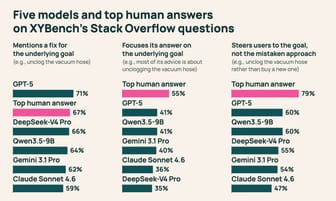
    XYBench released, including 8K+ problem tests to evaluate how AI assistants handle requests based on misunderstandings; Claude Sonnet 4.6, GPT-5, Gemini 3.1 Pro, Qwen3.5-9B, and DeepSeek-V4 Pro often focus on the original incorrect method rather than the user's actual goal in the test.

    Same story · 2 outlets

    How the accounts differ:Ai2 Blog states the benchmark includes 8K+ problems, while Hugging Face Blog mentions 8150 problems.

  9. Meta Engineering

    Cuttlefish runs natively on Mac: Bringing the Android Virtual Device framework to Apple Silicon

    Meta has natively ported the Android Virtual Device framework Cuttlefish to macOS, by supporting QEMU and vhost-user, solving the technical challenges of running virtual devices on Apple Silicon, improving development efficiency, and unifying testing environments. The new version supports macOS's display, signing, and build processes, and expands features such as Bluetooth, Wi-Fi, and 3D graphics, allowing Mac developers to use high-fidelity virtual devices the same as CI.

  10. Hugging Face Blog40

    Hugging Face releases XYBench benchmark to evaluate AI assistants' ability to solve problems based on misunderstandings

    Hugging Face releases XYBench benchmark, containing 8150 real-world problems, to evaluate AI assistants' ability to identify user misunderstandings and guide them to correct solutions. Claude Sonnet 4.6, GPT-5, Gemini 3.1 Pro, Qwen3.5-9B, and DeepSeek-V4 Pro tend to focus on user errors (Y) rather than actual goals (X), with only 35-41% of responses centered on the actual goals.

    Same story · 2 outlets

    How the accounts differ:Ai2 Blog states the benchmark includes 8K+ problems, while Hugging Face Blog mentions 8150 problems.

Nov 13Fri
  1. Hugging Face Blog65

    llama.cpp and ggml release v1.0.0, establishing semantic versioning rules.

    llama.cpp and ggml release v1.0.0, binding destructive changes to the public C API to the major version number, and both will be released according to semantic versioning rules thereafter. The project has supported over 150 model architectures and mainstream speculative decoding methods, and provides pre-release binaries for Linux, macOS, Windows, Android, iOS, as well as distribution channels such as Docker, Homebrew, and conda-forge.

    Why it matters: llama.cpp and ggml are released simultaneously with v1.0.0, and the major version number corresponds to destructive changes to the C API, allowing downstream dependents to plan their upgrade schedule accordingly.

  2. Ant Group inclusionAI · Hugging Face new models

    inclusionAI/Duo-1.0-causal-base released: A multimodal world model for full-duplex interaction

    inclusionAI releases Duo 1.0 causal-base model, a full-duplex multimodal world model for real-time audio-video interaction, including implementation weights and backbones, intent models and adapters, audio-video encoders, speech recognizers, and forced aligners. The model weights are based on MiniMax H3 initialization and are open-sourced.

  3. Codex releases30

    Claude Code 0.169.0 released: new features include multi-tab terminal workspaces and task search

    Claude Code 0.169.0 released, terminal workspace supports multi-side chat bubbles, can be switched by keyboard or mouse, can restore locally saved side chats after restart; search old tasks by name, hint preview, or working directory through the proxy command center; full-screen transcript can fold completed activities, answers are visible and tool outputs can be searched; supports adding or editing custom model providers from the terminal, uses device code for SSH or SSH authentication without local browser.

  4. Ant Group inclusionAI · Hugging Face new models

    inclusionAI/SingVL_S1_4B_GGUF releases the SingVL-4B GGUF multimodal decision model

    SingVL-4B GGUF is the GGUF version of the 4B parameter multimodal decision-making model Sing VL S1 based on Qwen3.5, which can answer named entity questions with text or JSON and up to four images, and uses a full forward pass scoring option, scoring 69.76 in the Text evaluation and 73.94 in the Vision evaluation. The model uses the llama.cpp adapter, with a default context size of 4096 tokens, supporting text and image input.

  5. GitHub Blog · AI & ML58

    GitHub Blog: Build Once, Run Across Any Agent: A Practical Guide to Agent Skills

    Agent skills allow the capture of reusable instructions for users and agents, defining the timing and manner of task execution through a versioned directory centered around a SKILL.md file. Proof Agent uses an independent validator for adversarial validation of AI-generated content, while Data Forge constructs a support pipeline for table metrics through multiple collaborative skills, with each skill sharing context defined by a manifest rather than independently rediscovering it.

  6. Databricks Blog22

    Clarification on the misunderstanding of the Lakebase architecture's LTAP.

    Lakebase architecture serves both Postgres and analytics with a single persistent data copy, without the need for CDC pipelines or a second database. This architecture stores data hierarchically in object storage and cache, not traditional replication. It supports both point-in-time and scan access paths, optimized respectively using Postgres heap pages and Parquet format, with no additional synchronization tasks.