Skip to content
Live
Nov 14Sat
  1. MarkTechPost62

    Stanford has open-sourced Memorilla, a potential memory module for freezing LLM development

    Stanford researchers have open-sourced Memorilla, a potential memory system designed for frozen LLMs. It converts the entire document collection into 16 vectors for use by frozen LLMs. On FactKG, the frozen Qwen3-8B paired with Memorilla achieves an accuracy of 84.33%, which is 3.9% higher than using all document contexts, but only requires 16 memory tokens, reducing the number of document tokens by 108 times.

  2. ITHome · AI65

    Tsinghua University releases the single-cell proteomics foundational model ProtCell, successfully completing the 'virtual cell' pre-training reproduction using MolThread S5000 intelligent computing cards

    Tsinghua University releases the single-cell proteomics foundational model ProtCell, collecting about 380 million cells and 98 public datasets for pre-training and evaluation, MolThread S5000 intelligent computing cards complete the full process of pre-training reproduction, evaluation metrics differ from mainstream international GPUs by only about 0.2%

  3. Hugging Face Daily Papers

    Test-Time Baking (TTB) released: A strategy for efficiently rendering decoder-only large-view synthesis models

    Test-Time Baking (TTB) strategy enhances the fidelity of new-view decoding for large-view synthesis models (LVSMs) by baking global scene information from cross-view attention into lightweight MLPs, while maintaining Test-Time Training efficiency. It achieves up to 23x rendering speed improvement with quality comparable to current state-of-the-art techniques on multiple benchmarks.

  4. Baseten Labs65

    Claude Code v2.1.159 release

    Claude Code v2.1.159 released, adopting a gradient alignment reward mechanism, using the Qwen3-8B model on arithmetic tasks, rewarding by calculating the gradient similarity between student output and expert demonstrations, experiments show the model may overfit the precise wording of expert examples.

  5. Ai2 Blog40

    XYBench: Benchmark test to solve the problems behind the questions

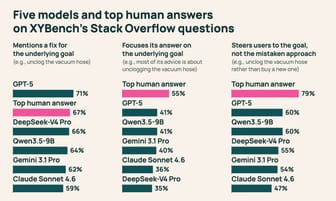
    XYBench released, including 8K+ problem tests to evaluate how AI assistants handle requests based on misunderstandings; Claude Sonnet 4.6, GPT-5, Gemini 3.1 Pro, Qwen3.5-9B, and DeepSeek-V4 Pro often focus on the original incorrect method rather than the user's actual goal in the test.

    Same story · 2 outlets

    How the accounts differ:Ai2 Blog states the benchmark includes 8K+ problems, while Hugging Face Blog mentions 8150 problems.

  6. Hugging Face Blog40

    Hugging Face releases XYBench benchmark to evaluate AI assistants' ability to solve problems based on misunderstandings

    Hugging Face releases XYBench benchmark, containing 8150 real-world problems, to evaluate AI assistants' ability to identify user misunderstandings and guide them to correct solutions. Claude Sonnet 4.6, GPT-5, Gemini 3.1 Pro, Qwen3.5-9B, and DeepSeek-V4 Pro tend to focus on user errors (Y) rather than actual goals (X), with only 35-41% of responses centered on the actual goals.

    Same story · 2 outlets

    How the accounts differ:Ai2 Blog states the benchmark includes 8K+ problems, while Hugging Face Blog mentions 8150 problems.

Nov 13Fri
  1. Hugging Face Daily Papers65

    Ropedia Xperience 2: A gold standard for extending physical AI environments and behaviors

    Ropedia Xperience 2 includes 1,589 published metric 3D scans and 4,230 viewpoint center records for 74 tasks (131 hours), each capture can be reused for robot learning, scene converted to physical interaction simulation environment, human motion redirected to full-body robot trajectories, additional robot behaviors obtained through virtual remote operation and automatic long-term trajectory generation, this joint capture proposed as the gold standard for physical AI data collection.

  2. ITHome · AI

    Google open-sources dataset used in WeatherNext 3 weather model: Includes SatWeave satellite image mosaicking dataset and PARDIG global precipitation information

    Google DeepMind has open-sourced the WeatherNext 3 weather model dataset, SatWeave, and PARDIG. The former integrates 5 satellite images (updated hourly, 10-year historical archive), and the latter is based on a Transformer architecture (spatial resolution 10 km, time resolution 15 minutes, average delay 5 hours), both hosted on Google Cloud Storage and licensed under CC BY 4.0.

  3. Hugging Face Daily Papers65

    PhysLoop: Utilizing the physical perception capabilities of large language models to achieve self-improvement of video generation models

    PhysLoop utilizes large language models to guide video generation, selection, and correction, achieving physically consistent self-improvement and controllable data construction. The framework drives recursive self-improvement (RSI) of video generation models with limited human intervention by identifying and correcting physical errors in generated videos, and releases a diverse dataset containing 100K videos along with generation tools.

  4. Hugging Face Daily Papers

    Hugging Face Daily Papers: Hyper-Connections Architecture Research Proposes SimpleHC Design

    Researchers conduct a systematic study on the Hyper-Connections architecture, proposing the SimpleHC design, which minimizes training overhead and improves stability while achieving performance comparable to mHC by removing residual mixing and using shared memory access. SimpleHC maintains performance when scaling model size from 15B to 30B MoE, with smoother gradient dynamics in standard training, and only increases training time by 2.4% over the base residual baseline at maximum test scale.

  5. Hugging Face Daily Papers

    Duo: A Reciprocal World Model for Full-Duplex Interaction

    Duo v1 introduces the Reciprocal World Model (RWM), which jointly models intentions and reality through autoregressive reasoning, synchronized attention, and dual inference distillation, achieving real-time full-duplex audio-video interaction. The model continuously perceives audio-video input while responding to users in real time, treating intelligence and physical reality as equal foundational components of the world, supporting interactions such as dialogue, sharing objects, and reshaping virtual scenes. The first batch of models has been open-sourced.

  6. Hugging Face Daily Papers

    BirdDreams: Joint Perspective and BEV Video Generation for Reasonable, Reactive Driving World Models

    BirdDreams jointly generates bird's-eye view (BEV) videos and bird's-eye view videos, making scene layout a part of predicting the future. By providing an overhead view of vehicle position and movement through BEV, it reduces occlusion, while the perspective video retains scene details. On PhysicalAI-AV and nuScenes, BirdDreams more faithfully follows the input trajectory of its own vehicle and generates more reasonable self-motion without HD map or vehicle state input.

  7. Databricks Blog22

    Clarification on the misunderstanding of the Lakebase architecture's LTAP.

    Lakebase architecture serves both Postgres and analytics with a single persistent data copy, without the need for CDC pipelines or a second database. This architecture stores data hierarchically in object storage and cache, not traditional replication. It supports both point-in-time and scan access paths, optimized respectively using Postgres heap pages and Parquet format, with no additional synchronization tasks.

Nov 12Thu
  1. PyTorch Blog

    Integrate SGLang into IBM Spyre within less than a week using AI tools

    A team of two, with the help of an AI programming agent, completed the integration of SGLang and IBM Spyre in less than a week, building a plugin with about 1,500 lines of code. SGLang's inference throughput on Spyre is about 3.6 times higher than the reference PyTorch implementation (using torch-spyre) and performs comparably to vLLM on Granite 3.3 8B and Gemma 4 26B A4B workloads.

  2. Hacker News · 300+

    Unlock the A100 functionality in my mining card using voltage fault injection

    Researchers have discovered a voltage fault injection vulnerability on the NVIDIA GA100 chip that allows operators to burn any fuses, converting the CMP 170HX 8GB graphics card into a device functionally equivalent to an A100-80G, unlocking which results in performance 1.2 times faster than the retail A100. The disabled features of this graphics card's CMP (such as NVLink, PCIe Gen4, NVJPG, NVDEC, MIG) can also be unlocked through this method.

  3. QbitAI

    Galaxy Smart Learning's Little Deer Love Learning introduces a dual-core technology architecture to support scalable personalized instruction.

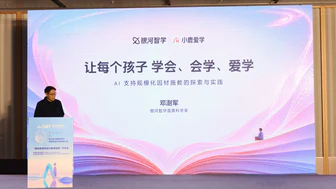
    Galaxy Smart Learning has launched an AI education product, Xiao Lu Ai Xue, which adopts a dual-core architecture of the Doubao large model and a self-researched intelligent learning engine. It achieves learning situation diagnosis by analyzing students' answer records and develops functions such as learning situation diagnosis, ability assessment, learning difficulty matching, and task planning. The student-side intelligent agent recommends learning tasks and explains the basis, while the teacher-side intelligent agent summarizes student performance for personalized guidance reference. The product has served over 500 schools, covering 24 provinces, and supports teachers in adjusting teaching strategies through a human-machine co-education model.

  4. Hugging Face Daily Papers65

    One Table Benchmark launched: a benchmark test for general table models in generation, interpolation, and prediction tasks

    The One Table Benchmark tested the table generation, imputation, and prediction capabilities of 46 models on 56 datasets, finding that these tasks share conditional information but have different fidelity and target interactions. Fixed models exhibit a trade-off between utility and fidelity, while frozen base models perform outstandingly in prediction and numerical imputation, indicating that unified table models have the potential to improve classification reconstruction and joint sampling.

  5. AWS Machine Learning Blog58

    How does Amazon SageMaker HyperPod detect and recover silent data corruption?

    Amazon SageMaker HyperPod detects silent data corruption (SDC) by adding three checks in the PyTorch DDP training loop, including non-finite gradient checks, loop replay audits, and weight fingerprint comparisons. When issues are detected, suspicious nodes are isolated and replaced by HyperPod, having been tested and verified on a 4 ml.p5.48xlarge instance cluster.

  6. Hugging Face Daily Papers65

    MACaQ: A Fast, Model-Agnostic Calibration Quantization Method

    MACaQ is a post-training quantization method for MXFP4 W4A4, which reduces costs while maintaining accuracy in language and diffusion models by using online activation transformations and Hessian-aware refinement to independently quantize each linear layer. MACaQ achieves only a 2.3% end-to-end overhead increase on Qwen3-32B with vLLM, has a lower perplexity than DuQuant++ and MR-GPTQ, and reaches the best perplexity of Llama-3-8B in 11 times shorter quantization time.

  7. MarkTechPost60

    Google DeepMind releases AlphaGenome 2 for cell-type specific variant effect prediction

    Google DeepMind releases AlphaGenome 2, a DNA model that predicts the effects of specific cell type mutations. The model reads 1 Mb DNA and target cell state, significantly improving single-cell eQTL prediction performance through conditional sequence to functional architecture, increasing recall from 23% to 43% on the TenK10K benchmark, and can adapt to unseen datasets without fine-tuning.

  8. Google Research58

    Google Research has released a wearable device-driven CKM risk assessment framework

    Google Research releases a wearable device-driven CKM risk assessment framework, predicting future health trajectories through an explainable health age model (CHA). The framework is trained on wearable data from 2.2 million weeks using the SensorWM model, providing personalized 12-week counterfactual health simulations combined with language models to generate clinically validated guidance plans. The CHA model integrates modifiable indicators such as heart rate, steps, and sleep to predict disease risk over 68,000 person-years, improving the predictive performance of clinical indicators.

  9. Hugging Face Daily Papers

    FINCOSMOS: An open-world evaluation paradigm for intelligent agents in the financial domain.

    FINCOSMOS has introduced an open-world evaluation paradigm for evaluating intelligent agents in the financial field. In 150 simulated user interactions, no session was accepted because all sessions failed during program checks, with the agent reporting only 54-64% of the undisclosed details. Human experts attributed 88.33% of the failures to the agent.

Nov 11Wed
  1. Google AI Blog

    Google Arts & Culture's open-source multimodal model Veo recreates the early memories of artist Esther Mahlangu

    Google Arts & Culture open-sources multimodal model Veo, transforming the early memories of artist Esther Mahlangu into video, completing an online retrospective exhibition of her life. The model is based on 45 stories and archival materials, generating images and converting them into video to present key memories such as her 10th birthday discovery of her painting talent.

  2. Ant Group inclusionAI · Hugging Face new models

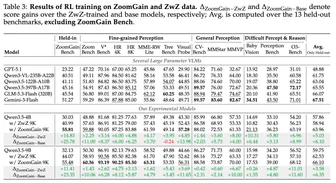
    inclusionAI/ZoomGain-4B released: A fine-grained visual supervision model based on global-to-local visual perception gaps

    inclusionAI has released the ZoomGain-4B large language model, achieving a score of 61.08 on ZoomGainBench and performing excellently on multiple fine-grained perception and general perception benchmark tests; the model is built with supervision based on the global-to-local visual perception gap mined from global image details, supporting English and Chinese Q&A, and can be downloaded via Hugging Face.

  3. Hugging Face Daily Papers

    InfraRSI: Utilizing recursive self-improvement training infrastructure

    InfraRSI transforms open-ended human instructions into validated training optimization through a five-stage workflow, achieving up to 2.75x acceleration in four single-node and multi-node dense as well as Mixture-of-Experts (MoE) LLM workloads, and increasing the average model FLOPs utilization (MFU) from 17.4% to 30.0%, surpassing existing tuners and coding agents.

  4. Hugging Face Daily Papers

    World In-Context Learning for Agentic Robot Manipulation

    World In-Context Learning (WICL) method freezes the model, practices tasks in simulators, and writes feedback into the context rather than weights, enabling robots to learn operational skills from a single demonstration. RoboScript implements WICL, achieving an 83.4% success rate on 50 tasks in RoboTwin 2.0 with no gradient updates from a single demonstration, surpassing the strongest training strategy by over 20 points, and supports cross-visual distribution generalization, improvement through reflection, base model extension, and cross-platform memory migration.

  5. Hugging Face Daily Papers65

    The DexForesight framework enhances dexterous manipulation performance through implicit spatial foresight.

    The DexForesight framework implicitly learns spatial foresight by injecting a dynamic perception world representation into the latent space of dexterous strategies, increasing the success rate of basic strategies from 49.4% to 60.5% on 11 DexJoCo simulation tasks and achieving a 58.3% success rate on 3 real robotic dexterous operation tasks.