Skip to content
Live
Nov 3Tue
  1. Hugging Face Daily Papers65

    SWE-Trail: A Historical Guidance Trajectory Collection Method for Coding Agent Training

    SWE-Trail leverages past execution trajectories to guide subsequent exploration without exposing historical information to coding agents, thereby enhancing the trajectory collection effectiveness for coding agent training. This method improves the average problem-solving rate by 2.33 and 1.60 percentage points on SWE-bench Multilingual and SWE-bench Pro, respectively, using a student model with 124B parameters.

  2. Hugging Face Daily Papers65

    Hugging Face Daily Papers: Advances in Proxy Computer Graphics

    Hugging Face Daily Papers has released a report on proxy computer graphics driven by large language models, proposing a unified classification method and literature system, analyzing trends and challenges in human-machine collaboration and long-term planning. The report introduces a unified classification method for representing agent systems in different computer graphics tasks and develops an agent literature system to assist researchers in large-scale analysis of existing and new published papers.

  3. MIT Technology Review · AI

    "Reverse game theory" how it constrains AI agents

    Reversed game theory controls powerful AI models by designing systems that incentivize agents to follow rules, such as rewarding cross-validation or competitive dynamics between model answers, or having the model take turns being a 'problem solver' and an 'auditor' to simulate social constraints. Models like Claude already have moral guidelines, but reversed game theory incentivizes agent behavior through mechanism design (such as cake-cutting strategies, bidding auctions) rather than relying on understanding their internal workings, addressing the issue that current security research primarily focuses on internal understanding or value training but achieves poor results.

  4. Hugging Face Daily Papers65

    From Fragmentation to Fusion: A Review and Roadmap of Multimodal Embeddings

    Embedding research is moving towards multimodal unification through contrastive learning and Transformer architectures, proposing a framework centered on transformation, alignment, and joint embedding to integrate different modalities. Embedding models support modern AI systems, but research is fragmented by modality, with each community developing in isolation. This paper proposes a coverage, comparability, and combinability framework, extending coverage through transformation, achieving comparability through alignment, and reaching combinability through joint embedding, providing a unified perspective on multimodal embedding research for the first time.

  5. Hugging Face Daily Papers

    ReTrace framework: Revealing the recovery behavior of computer agents through goal-directed action replay

    The ReTrace framework restores standard formal transition consistency through goal-directed action replay and controlled error injection, systematically studying the recovery behavior of autonomous models of computer agents, discovering that ideal recovery unlocks the model's potential task-completion capabilities, finding that current agents do not fully utilize their potential recovery capabilities, and that accurate model recovery can bring measurable end-to-end gains, proving that recovery is a fundamental capability for building reliable computer agents.

  6. Hugging Face Daily Papers

    Reviso: Not All Visual Evidence Should Be Given Equal Attention in Video Caption Generation

    Reviso is an intelligent video subtitle framework that prioritizes key visual evidence through hierarchical planning and active perception learning, enhancing subtitle quality and downstream video understanding capabilities. Multimodal large language models (MLLMs) generated video subtitles may overemphasize minor details while ignoring important context and key events.

  7. Hugging Face Daily Papers58

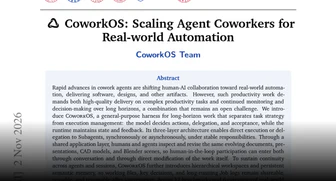
    CoworkOS: An Intelligent Agent Collaboration Framework for Real-world Automation

    CoworkOS enables human-machine collaboration and continuously improves model performance by separating strategies from execution, driving human-machine collaboration towards real-world automation. The framework performs excellently in 12 benchmarks and 6 categories of real-world applications, using GLM-5.3 as the core, and performs RSI-driven automatic post-training on Qwen3.6-35B-A3B, increasing the average score on 8 benchmarks from 33.19 to 42.95.

  8. Ai2 Blog

    StateBench: Benchmark for testing large language models to track changes in long document states

    StateBench is a benchmark for testing large language models' ability to track entity state changes in long documents, including four difficulty levels: R-trivial, non-periodic, solvable, and general finite. Research finds that recurrent and hybrid models generalize far better than Transformers when directly trained on these tasks, while cutting-edge models like Gemini 3.8 Flash, Claude Opus 5.5, and GPT-6 Sol still struggle with more complex state tracking issues when input lengths vary.

  9. Hugging Face Blog

    Transformers Model Integration Contracts Released: Hugging Face Launches Model Integration Contracts Standard

    Transformers supports over 750 model types, its test suite includes 88,000+ CPU tests and 200,000+ GPU tests. Hugging Face releases Model Integration Contracts (MIC) standard, including compressed models (such as a 66 MB weight UMT5 fix), runnable examples (such as SmolLM text generation), and human review baselines.

  10. Anthropic Research62

    Anthropic has released the verifiable reasoning system FlashProve, generating proofs at approximately 110 tokens/second on a single H100.

    Anthropic announced the verifiable reasoning prototype FlashProve, using zkSNARK to prove that the response indeed comes from the committed model weights. For the 400B parameter Llama 4 Maverick (4-bit quantization), a single H100 generates proofs at approximately 110 tokens/second, with proofs for each 1,024 token request being about 19 MB, and verification on a 24-core CPU taking about 17 seconds.

    Why it matters: Anthropic has released the measured data and Lean formal proof of the verifiable reasoning prototype FlashProve, allowing for a cross-comparison with existing zkML solutions.

  11. Latent Space

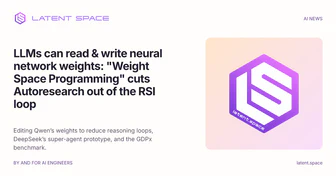
    Claude Code can read and write neural network weights: 'Weight space programming' bypasses Autoresearch

    Claude Code can directly read and edit the weights of other models without human intervention or PyTorch/Jax code, achieving weight reading, single-time bug fixes, performance improvements, or writing network weights from scratch. This technology bypasses the traditional process of Autoresearch by running experiments in a cluster to train models, demonstrating the potential of LLMs in weight space programming, currently mainly applicable to simple games and RL policies.

  12. Hugging Face Daily Papers47

    uni-robot-agent: Open-source robot use agent unified framework achieves zero-shot operation breakthrough

    The uni-robot-agent framework enables open-source weight robots to surpass proprietary models using agents in zero-shot operation, with its onboard Qwen3.8-Flash-Next scoring 31.39 in the RoboDojo evaluation, exceeding GPT-6 Astra-RoboProbe's 28.97 score and numerous VLA/WAM baselines, and performing excellently in 19 real tasks. Analysis indicates that effective robot use requires combining four general capabilities, suggesting future training should synergistically develop these capabilities.

  13. QbitAI

    Peking University, in collaboration with IBM, defines a new paradigm for modern analog computing.

    A review paper co-directed by Sun Zhong from Peking University and involving the IBM Research Lab in Zurich defines modern analog computing, distinguishing it from traditional analog computing, focusing on matrix computing required for AI and 6G communications, and achieving high precision and scalability based on resistive random-access memory. Annuan Zhixin's Analog Matrix Computing (AMC) circuit, through a resistive random-access memory array and a negative feedback closed loop, completes matrix inversion in less than 100 nanoseconds per operation, with accuracy reaching 10^-7, 100 times more energy-efficient than digital chips, and 10 times lower in cost. It is planned for use in embodied intelligence and 6G communications, and supports second-order optimization training for large models.

  14. Hugging Face Daily Papers

    How Agent Harness Achieves Video Generation and Agent Interaction

    Agent Harness Integrates Video Generation and World Model, Supporting Agents in Multi-Camera Video Production for Planning, Tool Use, and Recursive Self-Improvement. The Framework Coordinates Script, Shooting Planning, Asset Management, Production, and Editing, and Analyzes Its Evaluation Challenges; Meanwhile, It Studies Agent-World Model Interaction in Observation, Control, Execution, and State Maintenance, as Well as How They Mutually Evaluate and Improve.

  15. QbitAI80

    MIT experiment: GPT-6 Astra directly modifies Qwen3.5 weights, mathematical ability improves by about 6 times

    MIT's experiment allowed GPT-6 Astra to directly read and edit the weights of Qwen3.5-0.8B, changing only 0.016% of the parameters, without training and gradient descent, MATH-500 score improved from 7.9% to 48.1%, and instruction execution ability also increased 3 times.

    Why it matters: MIT experiments show that cutting-edge models can directly read and write the weights of smaller models, providing a reproducible path for performance repair of gradient-free training.

  16. MarkTechPost

    Zyphra AI introduces Zyphra Hierarchical Attention (ZHA): The path to true sub-quadratic attention

    Zyphra AI has released Zyphra Hierarchical Attention (ZHA), a sparse attention method based on a tree indexer, designed to address the known issue in sparse attention where the indexer still needs to scan the entire context. ZHA can be distilled into a frozen pre-trained model of about 4B tokens, achieving performance close to dense attention in inference, smart encoding, and 256K retrieval benchmarks on Qwen3.6-35B-A3B.

  17. ITHome · AI

    OpenAI released the LifeVal benchmark: From selecting a kindergarten to filing taxes, testing AI's 'human touch' skills.

    OpenAI released the LifeVal benchmark to measure whether AI models can help ordinary people complete daily tasks, covering scenarios such as care, health, education, household administration, personal finance, shopping, and accessing government services. Typical tasks include selecting a kindergarten for a child, creating a diabetes diet plan, and organizing government forms, requiring AI to advance the task to an executable state.

  18. ITHome · AI75

    MIT CSAIL proposes weight space programming: GPT-6 Astra modifies Qwen3.5-0.8B's weights by about 0.016%, boosting MATH-500 score to 6 times

    MIT CSAIL researchers propose 'weight space programming', allowing GPT-6 Astra to directly read and modify the neural network weights of Qwen3.5-0.8B, adjusting only about 0.016% (131072 parameters) to increase MATH-500 score from 7.9% to 48.1%, GSM8K from 13.8% to 67.1%, and IFEval from 21.0% to 62.3%.

  19. Hugging Face Daily Papers65

    CEPO: A general prompt optimization framework for multi-agent systems

    CEPO enhances prompt optimization for multi-agent systems by separating shared coordination from agent-specific execution, continuously improving the performance of four existing prompt optimization methods across 11 cross-domain benchmark tests. The framework uses shared coordinator prompts and agent-specific execution prompts, guiding them to update based on their respective roles, allowing shared coordination rules to be consistently optimized across all agents while maintaining independent adjustment of execution instructions. Experiments show that CEPO improves optimization budget efficiency and scales performance as the number of agents increases.

  20. Hacker News · 300+83

    Astra can read and write neural network weights and improve Qwen3.5-0.8B

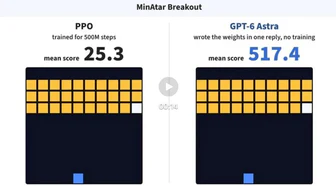
    The research team proposed Weight-Space Programming, discovering that GPT-6 Astra can directly read and write neural network weights: with only 17,253 weights, it can determine which game the network is trained on, and from scratch, write a small game network that defeats PPO trained for 100 million steps without gradients or training.

  21. PyTorch Blog34

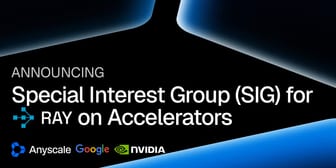
    Ray announces the Special Interest Group (SIG) for Accelerators

    Ray announces the Special Interest Group (SIG) for Accelerators, aiming to unite hardware vendors, Ray contributors, and application developers to create a neutral accelerator support roadmap. Initial focus will be on developing test infrastructure, hardware awareness capabilities, and network transmission, prioritizing shared hardware access, reproducible development and testing environments, and broader CI coverage.

  22. OpenAI News42

    OpenAI releases LifeVal benchmark: Measuring AI-assisted daily task capabilities

    OpenAI released the LifeVal benchmark, used to evaluate the effectiveness of AI-assisted completion of daily tasks (such as finding childcare, financial management, handling government documents).

  23. AWS Machine Learning Blog43

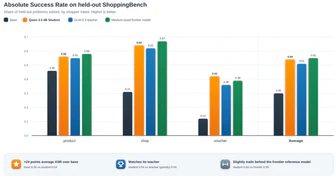
    Use knowledge distillation to build efficient intelligent agents on Amazon SageMaker AI

    Use knowledge distillation to fine-tune the shopping assistant on Amazon SageMaker AI, by transferring the behavior of cutting-edge models to small models through sequence-level knowledge distillation (SeqKD), generating reasoning trajectories for task-solving and using them for supervised fine-tuning to achieve efficient low-cost inference. SeqKD only requires the text output of the teacher model, without weights or logits, and is suitable for scenarios where access to the teacher model's internal information is not available, such as API models, and can evaluate the performance of student models through benchmark tests.

  24. Hugging Face Daily Papers65

    WeFair: Fidelity-Aware Alignment Technology Based on Human Feedback, Used for Personalized Query Rewriting in Short Video Search

    WeFair improves personalized query rewriting through a human feedback phase (demonstration, preference, and validation) based on fidelity perception, reducing intent drift and enhancing search effectiveness on short video platforms. This technology addresses the need for compact query rewriters in short video search, recovering user personalized intent from ambiguous queries under strict latency constraints. WeFair-2B outperforms strong rewriting baselines in overall accuracy and intent preservation in offline experiments, while online A/B testing shows a relative increase of 2.593% in effective video play rate and a relative decrease of 2.350% in query rewriting rate.

  25. Hugging Face Daily Papers38

    REA: A runtime for asynchronous cerebellar-brain control for embodied intelligent agents

    REA unifies deliberative and reactive strategies in a single runtime, achieving high success rates and reducing control overhead through asynchronous coordination in both simulated and real robotic tasks. On 3,000 test segments across 60 LIBERO-Pro tasks, REA achieved a 95.9% success rate, outperforming its best single-agent baseline from its strategy library (94.7%), while reducing control steps by 25% and control time by 17%.

  26. Hugging Face Daily Papers34

    OSWAM: An efficient single-step action generation world action model

    OSWAM achieves real-time high-quality action generation in autonomous driving and embodied control by using structured imagination tokens to initialize the diffusion process and distilling future condition privileged information into a single denoising step. The model generates high-quality actions with just one diffusion step, about 3 times faster than direct strategy world action models (WAM) that require dozens of denoising steps, achieving low latency of up to 40ms on an NVIDIA RTX 5090 GPU, supporting real-time compiled inference.

  27. The Decoder73

    50 AI agents spontaneously form bureaucratic collaboration in Minecraft

    The research team placed 50 GPT-6.1 Sol agents into a Minecraft survival world and ran them for three hours, only giving the instruction 'build a prosperous civilization'. The agents cut down all the trees near the spawn point in 90 seconds, exchanged about 5900 messages in total, and spontaneously elected 'Ada' as the leader in alphabetical order of the directory.

    Why it matters: The experiment placed 50 agents into Minecraft and Mindustry to observe their spontaneous organization behavior in collaboration and competition, and the test environment was open-sourced.