Skip to content
Live
Nov 12Thu
  1. O'Reilly Radar

    Why Git needs help: From file to system for source code control

    Anthropic will struggle with traditional Git infrastructure by the end of 2026 when autonomous agent activities cause daily merge volumes per repository to exceed 30,000. Claude Sonnet 4.6 replaces string diffs of 2,000+ lines with AST node transformations, reducing the cost of modifying each file to O(node_delta) and enabling subsecond dependency analysis, but standard Git still discards reasoning history such as agent execution logs and compilation feedback.


  2. QbitAI

    Galaxy Smart Learning's Little Deer Love Learning introduces a dual-core technology architecture to support scalable personalized instruction.

    Galaxy Smart Learning has launched an AI education product, Xiao Lu Ai Xue, which adopts a dual-core architecture of the Doubao large model and a self-researched intelligent learning engine. It achieves learning situation diagnosis by analyzing students' answer records and develops functions such as learning situation diagnosis, ability assessment, learning difficulty matching, and task planning. The student-side intelligent agent recommends learning tasks and explains the basis, while the teacher-side intelligent agent summarizes student performance for personalized guidance reference. The product has served over 500 schools, covering 24 provinces, and supports teachers in adjusting teaching strategies through a human-machine co-education model.

  3. Hugging Face Daily Papers

    TOME-Math: A mathematical proof supervisory corpus based on structured textbooks

    TOME-Math transforms 2,118 university mathematics textbooks into approximately 380K structured proof supervision records, preserving chapter order, proposition-proof links, and dependency references, used for fine-tuning to improve the mathematical reasoning ability of language models by 16.7 percentage points, surpassing all three public instruction datasets. This corpus will be released to promote structured mathematical supervision research.

  4. MIT News · AI

    MIT researchers have developed new technology to accelerate and enhance the credibility of AI models for climate prediction.

    MIT researchers have developed a training technique that significantly reduces data volume and improves the performance and adaptability of climate simulators (AI models), enabling them to quickly simulate the impact of human activities on future climate in seconds, such as predicting temperature or sea level changes, thereby more reliably testing thousands of climate scenarios and identifying unintended consequences of regional interventions. The algorithm generates optimized synthetic climate scenario data instead of relying on future emission scenarios based on real-world trajectories, significantly shortening production time and allowing the model to accurately predict scenarios not present in the training data.

  5. Latent Space

    How Jev from TypeSafe AI is Leading the System One Model Revolution

    TypeSafe AI's Jev is a non-generative system-one model that can return structured choices, scores, or probabilities, faster and cheaper than inferential LLM (system-two models). Jev is suitable for zero-shot flexibility, requiring no repeated fine-tuning, and users can achieve reliable intelligent automation without needing to understand its internal model type. Jev can be integrated into code, enabling the construction of smarter software through rapid calls, with its application potential likened to the exploration stage of the early internet.

  6. Hugging Face Daily Papers65

    One Table Benchmark launched: a benchmark test for general table models in generation, interpolation, and prediction tasks

    The One Table Benchmark tested the table generation, imputation, and prediction capabilities of 46 models on 56 datasets, finding that these tasks share conditional information but have different fidelity and target interactions. Fixed models exhibit a trade-off between utility and fidelity, while frozen base models perform outstandingly in prediction and numerical imputation, indicating that unified table models have the potential to improve classification reconstruction and joint sampling.

  7. Hacker News · 300+65

    AI agents like Gemini discovered unrecorded Mayan ruins in Mexico by analyzing NASA LiDAR data.

    Intelligent agents such as Gemini, ChatGPT, Claude, and Grok discovered an officially unrecorded Mayan site in Mexico by analyzing NASA LiDAR data, completing the entire process from inspiration to government formal reply in less than 72 hours. The site is located on a mountain top in the jungle, containing structures such as plazas, pyramids, and courtyards. The agents identified and submitted reports to the National Institute of Anthropology and History of Mexico (INAH), which confirmed that the location had not been registered (later verified that the site had been mapped by anthropologists).

  8. OpenRouter Blog

    How to Benchmark LLM with OpenRouter

    Running the same tasks on OpenRouter, GPT-6.1 Sol passed 180/180 tests in 60 synthetic tasks, DeepSeek had the lowest cost passing 157/180 times, but the correlation with the public ranking is low (Spearman correlation coefficient 0.109). Need to check the number of task repetitions, the number of answers, and billing verification.

  9. AWS Machine Learning Blog58

    How does Amazon SageMaker HyperPod detect and recover silent data corruption?

    Amazon SageMaker HyperPod detects silent data corruption (SDC) by adding three checks in the PyTorch DDP training loop, including non-finite gradient checks, loop replay audits, and weight fingerprint comparisons. When issues are detected, suspicious nodes are isolated and replaced by HyperPod, having been tested and verified on a 4 ml.p5.48xlarge instance cluster.

  10. Databricks Blog

    How Databricks Detects Credential-Driven Attacks

    Databricks detects credential-driven attacks by analyzing audit logs and Genie, finding stolen credentials listed from new IPs in secret scopes, directories, and repositories within minutes, then reading secrets containing service principal credentials, and subsequently having the service principal create functions and join admin groups, these non-linear event sequences reveal intrusion behavior.

  11. Hugging Face Daily Papers65

    MACaQ: A Fast, Model-Agnostic Calibration Quantization Method

    MACaQ is a post-training quantization method for MXFP4 W4A4, which reduces costs while maintaining accuracy in language and diffusion models by using online activation transformations and Hessian-aware refinement to independently quantize each linear layer. MACaQ achieves only a 2.3% end-to-end overhead increase on Qwen3-32B with vLLM, has a lower perplexity than DuQuant++ and MR-GPTQ, and reaches the best perplexity of Llama-3-8B in 11 times shorter quantization time.

  12. MarkTechPost60

    Google DeepMind releases AlphaGenome 2 for cell-type specific variant effect prediction

    Google DeepMind releases AlphaGenome 2, a DNA model that predicts the effects of specific cell type mutations. The model reads 1 Mb DNA and target cell state, significantly improving single-cell eQTL prediction performance through conditional sequence to functional architecture, increasing recall from 23% to 43% on the TenK10K benchmark, and can adapt to unseen datasets without fine-tuning.

  13. Google Research58

    Google Research has released a wearable device-driven CKM risk assessment framework

    Google Research releases a wearable device-driven CKM risk assessment framework, predicting future health trajectories through an explainable health age model (CHA). The framework is trained on wearable data from 2.2 million weeks using the SensorWM model, providing personalized 12-week counterfactual health simulations combined with language models to generate clinically validated guidance plans. The CHA model integrates modifiable indicators such as heart rate, steps, and sleep to predict disease risk over 68,000 person-years, improving the predictive performance of clinical indicators.

  14. Hugging Face Daily Papers

    FINCOSMOS: An open-world evaluation paradigm for intelligent agents in the financial domain.

    FINCOSMOS has introduced an open-world evaluation paradigm for evaluating intelligent agents in the financial field. In 150 simulated user interactions, no session was accepted because all sessions failed during program checks, with the agent reporting only 54-64% of the undisclosed details. Human experts attributed 88.33% of the failures to the agent.

  15. Apple Machine Learning Research

    Weighted State Souping for Efficient Long-Context Retrieval

    Weighted State Souping proposes query dependency weighting to combine cached State state encodings, significantly improving long-context performance on tasks such as single-hop and multi-hop document question answering, pinpoint retrieval, variable tracking, and tool use. The method can be adapted into an efficient sparse variant, achieving near-constant encoding costs while maintaining (or sometimes improving) performance.

  16. Apple Machine Learning Research

    Gating Mechanisms of State Space Models (SSMs): Memory and Contextual Learning Research

    State Space Models (SSMs) lag behind Transformers in contextual learning and precise retrieval tasks, as their gating mechanism leads them to first learn memory solutions, delaying or preventing the convergence of correct contextual learning solutions, but the gating mechanism is beneficial for improving long sequence generalization.

  17. Apple Machine Learning Research

    Evaluating Evaluators: Investigating the Performance of LLM Judges in Personalized Writing Style Evaluation

    Researchers evaluated the performance of Large Language Model (LLM) judges in personalized writing tasks and found that the quality of judges is weakly correlated with general LLM capabilities measured by MMLU (Pearson’s ρ ≤ 0.2), and their performance is influenced by writing tasks and evaluation criteria (e.g., general helpfulness vs. stylistic personalization). LLM evaluators were more consistent and performed better in pairwise comparisons than in independent scoring responses. The 'strongest' LLM did not reliably replicate human evaluations, possibly due to being overly sensitive to subtle details overlooked by human annotators and weaker LLMs.

Nov 11Wed
  1. Ars Technica · AI75

    Google DeepMind uses AI to mathematically verify key parts of the Signal protocol

    Google DeepMind researchers used AI agents to formally verify multiple key cryptographic guarantees of the Signal protocol, completing the project as a proof of concept within four weeks. This work provides independent verification for encryption used by platforms such as Signal, Google Messages, and WhatsApp, while also demonstrating the formal verification capabilities of the new AI framework AlphaProof Code.

  2. Hugging Face Daily Papers

    WikiTrace evidence chain memory system alleviates memory degradation in large language model agents

    "WikiTrace Links Each Distillation Experience to Its Source Trajectory and Reasoning Chain, Allowing Large Language Model Agents to Verify and Correct Memory Before Action, Improving Performance and Reducing Degradation Caused by Memory in Five Intelligent Agent Benchmark Tests. The System Stores Each Experience as a Condensed Insight and Links It to a Summary of the Reasons for Its Success or Failure and the Original Trajectory, Enabling Agents to Supplement Missing Details or Correct Insights When Executing New Tasks Through Linking Tools. The Results Show It Outperforms Existing Memory Methods and Baselines Using the Same Insights"

  3. Google AI Blog

    Google Arts & Culture's open-source multimodal model Veo recreates the early memories of artist Esther Mahlangu

    Google Arts & Culture open-sources multimodal model Veo, transforming the early memories of artist Esther Mahlangu into video, completing an online retrospective exhibition of her life. The model is based on 45 stories and archival materials, generating images and converting them into video to present key memories such as her 10th birthday discovery of her painting talent.

  4. Ant Group inclusionAI · Hugging Face new models

    inclusionAI/ZoomGain-4B released: A fine-grained visual supervision model based on global-to-local visual perception gaps

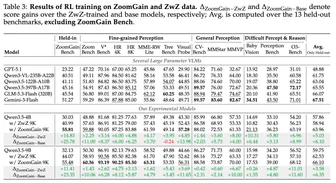
    inclusionAI has released the ZoomGain-4B large language model, achieving a score of 61.08 on ZoomGainBench and performing excellently on multiple fine-grained perception and general perception benchmark tests; the model is built with supervision based on the global-to-local visual perception gap mined from global image details, supporting English and Chinese Q&A, and can be downloaded via Hugging Face.

  5. Hugging Face Daily Papers

    InfraRSI: Utilizing recursive self-improvement training infrastructure

    InfraRSI transforms open-ended human instructions into validated training optimization through a five-stage workflow, achieving up to 2.75x acceleration in four single-node and multi-node dense as well as Mixture-of-Experts (MoE) LLM workloads, and increasing the average model FLOPs utilization (MFU) from 17.4% to 30.0%, surpassing existing tuners and coding agents.

  6. Hugging Face Daily Papers

    World In-Context Learning for Agentic Robot Manipulation

    World In-Context Learning (WICL) method freezes the model, practices tasks in simulators, and writes feedback into the context rather than weights, enabling robots to learn operational skills from a single demonstration. RoboScript implements WICL, achieving an 83.4% success rate on 50 tasks in RoboTwin 2.0 with no gradient updates from a single demonstration, surpassing the strongest training strategy by over 20 points, and supports cross-visual distribution generalization, improvement through reflection, base model extension, and cross-platform memory migration.

  7. Hugging Face Daily Papers65

    The DexForesight framework enhances dexterous manipulation performance through implicit spatial foresight.

    The DexForesight framework implicitly learns spatial foresight by injecting a dynamic perception world representation into the latent space of dexterous strategies, increasing the success rate of basic strategies from 49.4% to 60.5% on 11 DexJoCo simulation tasks and achieving a 58.3% success rate on 3 real robotic dexterous operation tasks.

  8. Hugging Face Daily Papers65

    MMDM: Large-scale Multi-task Decision Model Evaluation Benchmark

    MMDM evaluated 28 decision models, showing that most models perform well on common knowledge but poorly on interdependent options, constrained decision-making, and multiple-choice tasks. For example, Perplexity Decider-V1.2 achieved 78.75% accuracy on single-choice knowledge, but only 53.95% and 47.95% respectively on option logic and constrained planning, while the best accuracy of all models on hard multiple-choice was only 36.81%.