Skip to content
Live
Oct 16Fri
  1. Baseten Blog

    Meta releases Muse Spark Open: an open-source weight model designed for code agents

    Meta releases Muse Spark Open, an open-source weight model with 816B parameters designed for code agents, featuring 42.7B active parameters, a 1M token context window, and full-modal input (text, image, video, audio), performance comparable to cutting-edge lab models, using a compressed MoE architecture and hybrid global/local attention mechanisms to optimize inference efficiency, reducing model size to 540GB via NVFP4 checkpoints.


  2. Microsoft AI News

    Microsoft AI has released an 80 billion parameter MoE large model MAI-Base-2.

    Microsoft AI has completed the pre-training of a new MoE large model MAI-Base-2, with 80 billion active parameters and 2.8 trillion total parameters, surpassing all open-source models in internal evaluations. The model is 4-12 times more efficient in pre-training FLOPs than the strongest open-source base model DeepSeek-V4-Pro-Base and is used to train larger models. Microsoft plans to license the model weights through Foundry using organic data pre-training and full-stack control.

Oct 15Thu
  1. Baseten Blog

    NVIDIA Nemotron 3.5 Super VL released on Baseten

    NVIDIA Nemotron 3.5 Super VL combines visual understanding, reasoning, and tool use, supporting reading documents, images, application interfaces, and videos, scoring 1190 Elo in the GDPval evaluation, higher than Nemotron 3 Super's 493. Developers can fine-tune it via Baseten Loops SDK and evaluate it using NVFP4 weights on Blackwell GPU.

  2. OpenAI Deployment Safety

    GPT-Live-1.1 System Information Card

    GPT-Live-1.1 and GPT-Live-1.1 Quip are trained on a diverse dataset including public internet information, third-party collaboration data, and user-generated content, employing advanced data filtering processes to reduce personal information and using secure classifiers to prevent harmful content. The performance metric comparison value is based on the latest version data of published models.

  3. Liquid AI Blog

    d1-ultra: Launching the world's best decision model

    d1-ultra is the newly released decision model by Liquid AI that supports multimodal inputs, outperforming d1 and Jev 1.14 in 112 evaluations, providing more reliable probability outputs. The model is based on a larger open-weight model and has been customized for improvements, excelling in knowledge-related tasks, priced at $0.042 per million input tokens, and can be accessed via the Liquid API.

  4. Mistral AI · Hugging Face new models

    Mistral AI releases Timestral-123M time series base model

    Mistral AI releases Timestral-123M time series base model, with 123M parameters, using a patch-based Transformer architecture, context length of 32,768 time steps, single prediction covers 1,024 time steps, outputs 21 quantiles. The model achieves optimal accuracy in zero-shot prediction on GIFT-Eval, TIME, and fev-bench evaluations, and is licensed under the Modified MIT License.

Oct 14Wed
  1. Mistral AI · Hugging Face new models

    Mistral AI releases Timestral-5M time series base model

    Mistral AI releases Timestral-5M time series base model, the 5M parameter version supports zero-shot prediction, context length up to 32,768 time steps, single forward prediction can cover 1,024 time steps, and outputs 21 quantiles. In GIFT-Eval, TIME, and fev-bench evaluations, Timestral-209M achieves state-of-the-art accuracy for zero-shot prediction, and all Timestral models outperform other models at their parameter scale.

  2. Ant Group inclusionAI · Hugging Face new models

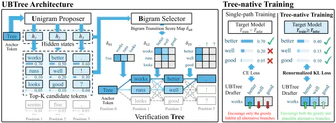
    inclusionAI/Ling-3.0-flash-UBTree released: Speculative decoding model based on UBTree technology

    inclusionAI released the Ling-3-Flash-UBTree-B16 model, combining a five-layer DFlash backbone and a learned bigram selector, proposing multiple candidate continuations for Ling3-Flash for target model validation, with 482M parameters, achieving 3x+ E2E speed improvement on benchmarks like MMLU, and the UBTree adaptation is not yet open source, with SGLang integration support expected to be released soon.

  3. Ant Group inclusionAI · Hugging Face new models

    inclusionAI/Ming-3.0-asr-tiny released: Context-aware speech recognition model supporting multiple language dialects

    inclusionAI/Ming-3.0-asr-tiny combines Ling-tiny-v3 language backbone and audio encoder, supporting single-round Chinese and English speech transcription and recognition of 15 dialects, improves professional term recognition rate through hot words or dialogue context, model parameter size not mentioned, evaluated in noisy speech and 5 application areas, provides PyTorch/Transformers inference examples and MIT license.

  4. StepFun · Hugging Face new models

    Step-5-Preview-NVFP4 model release by LeapX Stars

    LeapX Stars releases flagship model Step-5-Preview-NVFP4, with 600B total parameters and 27B active parameters, supporting up to 1M context windows, excels in software engineering, professional knowledge work, and financial fields, capable of processing text, images, and video, deployable via OpenAI-compatible API or offline generation.

  5. Artificial Analysis Articles

    AA-Robotics v0.1 released

    AA-Robotics v0.1 achieved an average score of 69.4 in 8 tasks, outperforming GPT-6 (64.6), GPT-6.1 (55.3), Gemini 4 Argon (48.8), and Claude Opus 5.5 (46.3), scoring full marks in 7 tasks. The models ran with high effort in Codex, Claude Code, or Antigravity.

  6. Latent Space

    Dyna-2: A general-purpose physical agent with hour-level autonomy

    Dyna Robotics released Dyna-2.1 physical agent, based on a world action model pre-trained on 1 million hours of human video, achieving a success rate of 99.4% in 24 hours of continuous folding of 1000 napkins, demonstrating hour-level autonomous operation capability. The model combines future video prediction with robot actions, learning new tasks in 45 minutes through a 45-minute demonstration, and uses diffusion Transformer and flow matching techniques for real-time control.

  7. Google DeepMind

    Google DeepMind releases Gemini 4 Argon and emphasizes security protection

    Gemini 4 Argon demonstrates cutting-edge capabilities in coding, finance, law, and other fields, particularly enhancing cybersecurity defense functions. Its effectiveness has been validated through the Fairwind project and internal testing. The model performs excellently on benchmark tests like MMLU and employs a three-layer real-time protection mechanism (input filtering, internal introspection, continuous monitoring) and automated bias monitoring, significantly reducing the risk of harmful requests and violations. It successfully intercepts over 99% of external biosecurity jailbreak attempts while reducing shortcut behavior in coding tasks to 2%.

  8. Google AI Blog90

    Google has released the Gemini 4 Argon cutting-edge model.

    Google has released Gemini 4 Argon, opening it up to developers, businesses, and researchers, with API pricing at $2 per million input tokens and $10 per million output tokens, offering a 95% discount on cached input tokens.

    Why it matters: Official pricing, baseline rankings, and multiple internal implementation cases are provided, allowing judgment on its position in coding and research workflows.

Oct 13Tue
  1. Google Developers Blog

    Gemini 4 Argon optimized the performance of a 200,000-line Python codebase

    Gemini 4 Argon has been running for 11 hours without human intervention, proposing 6 optimization suggestions by analyzing the ADK Python repository with 205,000 lines of code. Ultimately, 2 of them were adopted and deployed, reducing the memory session preparation time by about 40% and increasing the cold package import speed by 21%. The model followed the repository maintainer's guidelines during the optimization process and ran all 16,892 unit tests.

Oct 12Mon
Oct 9Fri
Oct 8Thu
  1. Artificial Analysis Articles75

    Artificial analysis of network indices introduces a controlled access model

    Artificial analysis of the network index includes GPT-6 Sol (Dawn Blue, largest version) in the evaluation, the model accessed through OpenAI's Dawn program ranked first in the index, with an overall score 32 points higher than the public version of GPT-6 Sol (largest version) and no safety interception, task cost is $1.77 per item, better than Grok 4.7 ($11.67 per item), and performed the best in the CyberGym-E2E benchmark test. The index will continue to expand to cover publicly and controlled access models.

Oct 7Wed
  1. Liquid AI58

    Liquid AI releases open-weight decision models for edge devices

    Liquid AI released d1-3B and the experimental d1-omni-600M on Hugging Face. These models choose an answer in a single forward pass rather than generating a token sequence. d1-3B accepts text and images; the smaller experimental model also supports text-and-audio inputs. The company reports 8 ms for d1-3B on an RTX 4090 and 50 ms on a Jetson Orin Nano.

    Why it matters: Editorial takeaway: a constrained choice or routing task may not need a full chat model. Evaluate the models on your own answer options and hardware; the latency figures are the publisher's measurements, and the smaller checkpoint is explicitly experimental.

  2. Anthropic75

    Claude Haiku 5.5 targets fast, high-volume AI workloads

    Anthropic released Haiku 5.5 for summaries, classification and agent subtasks. For prompts up to 100,000 tokens, its published API prices are $0.10 per million input tokens and $0.50 per million output tokens; larger prompts have a separate price tier. The release also halves Sonnet 5.5 cache-read pricing to $0.10 per million tokens. These are publisher-listed prices checked on 8 October.

    Why it matters: Editorial takeaway: workload routing matters as much as model choice. Test routine tasks on a smaller model before sending every request to a more expensive one; vendor evaluations do not establish results for your application.

Oct 6Tue
  1. Mistral AI

    Mistral AI has launched the public beta version of Mistral Large 4.

    Mistral Large 4 is a native multimodal large language model with 100 billion parameters, featuring 52 billion active parameters. It excels in coding, agent workflows, and multimodal understanding, reaching the level of the world's strongest open-source model. It also leads in critical enterprise workloads such as cybersecurity, finance, and law. The model will be open-sourced by the end of this month and is currently available for experience through the public beta API of Mistral Studio.