Skip to content
Live
Oct 6Tue
  1. Google Developers Blog

    EmbeddingGemma 2 Developer Guide

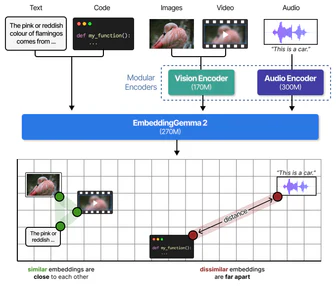
    EmbeddingGemma 2 is an open-source 740M parameter model developed based on Gemma 4, which maps text, code, images, video, and audio to a unified 768-dimensional space, supports modular loading (270M-740M parameters), and performs excellently in code search and cross-modal retrieval, can be used via the sentence-transformers library.

Oct 5Mon
Oct 1Thu
  1. Google DeepMind

    Gemini 4 Argon: Google's next-generation cutting-edge intelligent model

    Gemini 4 Argon delivers cutting-edge performance in complex workflows, supporting software engineering, enterprise knowledge work (legal and financial), and cybersecurity defense. The model's token output limit is extended to the industry-leading 1M, and it leads in benchmarks such as DeepSWE v1.1 (77.9%), Vals Index (financial, coding, legal, tax), and AutomationBench (51.3%).

Sep 29Tue
  1. OpenAI Deployment Safety

    GPT-6.1 Sol uses the same data and training methods as GPT-6 Astra

    GPT-6.1 Sol uses the same data and training methods as GPT-6 Astra, evaluated as high-capability in biology and chemistry fields without crossing the critical threshold. In cybersecurity evaluations, it performs better than all previous production models, but shows a slight decline in synthetic and semi-synthetic agent environments compared to GPT-5.6 Sol. Model rejection remains a layer of security boundary.

Sep 28Mon
  1. Anthropic55

    Claude Sonnet 5.5 focuses on everyday coding and knowledge work

    Anthropic introduced Sonnet 5.5 as a faster complement to Opus 5.5 for scoped tasks, bug fixes and document creation. Its release announcement reports performance and efficiency improvements over Sonnet 5.

    Why it matters: Editorial takeaway: compare models against your own coding and document tasks. The release emphasizes everyday work, while distinguishing more complex, open-ended workloads.

Sep 27Sun
Sep 24Thu
Sep 23Wed
Sep 22Tue
  1. Anthropic82

    Claude Opus 5.5 is released for complex, sustained work

    Anthropic launched Opus 5.5 with updates to coding, communication and safeguards. The company describes a focus on complex tasks and reports lower typical running costs than Opus 5.

    Why it matters: Editorial takeaway: sustained engineering work needs different evaluation from quick classification. Review the original release and safety documentation before changing a production model.

Sep 20Sun
  1. Qwen · Hugging Face new models

    Qwen/Qwen-Image-2.1-PE-I2I released: Open-source 7B parameter text-to-image generation and editing model

    Qwen/Qwen-Image-2.1-PE-I2I released, a 7B parameter unified text-to-image generation and editing model, featuring a 32-layer single-stream DiT architecture, supporting the generation of regular or transparent images, editing transparent layers, extracting photo subjects, and capable of editing with 10 reference images.

  2. Qwen · Hugging Face new models

    Qwen/Qwen-Image-2.1-PE-T2I release: Open source 7B parameter text-to-image generation and editing model

    Qwen/Qwen-Image-2.1-PE-T2I released, a 7B parameter unified text-to-image generation and editing model, featuring a 32-layer single-stream DiT architecture, supporting generation of regular or transparent images, editing transparent layers, extracting photo subjects, and enabling local editing through circular, doodle annotations, or independent masks. Its text-to-image prompt rewriting model Qwen3.5-VL 9B can convert multilingual requests into detailed English prompts and recommend aspect ratios.

  3. StepFun · Hugging Face new models

    Step-5-Preview-BF16 model release by Jieyue Xingchen

    Jieyue Xingchen releases flagship model Step-5-Preview-BF16, with 600B total parameters, 27B active parameters, supporting up to 1M context windows, excels in software engineering, professional knowledge work, and financial fields, capable of processing text, images, and video, deployable via OpenAI-compatible API or offline generation.

  4. StepFun · Hugging Face new models

    Jieyue Xingchen Step-5-Preview model release: Sparse MoE architecture with 600B parameters

    Step-5-Preview, the flagship model from Jieyue Xingchen, adopts a sparse MoE architecture with 600B total parameters and 27B active parameters, supporting up to 1M tokens in context, and excels in software engineering, professional knowledge, and financial tasks, demonstrating outstanding performance in the DeepSWE v1.1 benchmark. The model can be deployed via OpenAI-compatible APIs using vLLM or SGLang, or used for offline generation with Transformers.

Sep 16Wed
Sep 14Mon
  1. Google · Hugging Face new models

    Google releases EmbeddingGemma 2 multimodal embedding model

    Google has released EmbeddingGemma 2, a multimodal embedding model with 740M parameters, supporting unified 768-dimensional vector representations for text, images, video, and audio. The model can run on consumer-grade hardware, providing low-latency semantic representations suitable for applications such as search, retrieval-augmented generation, etc. EmbeddingGemma 2 has performed excellently in multiple benchmark tests, such as text, code, visual document, and audio embedding benchmark tests, and supports vector truncation to reduce storage requirements.

Sep 11Fri
Sep 8Tue
  1. OpenAI Deployment Safety

    ChatGPT Images 2.5 System Description

    OpenAI's GPT-Image-2.5-Sunburst and GPT-Image-2.5-Flare are trained on public data, third-party information, and user-generated content, and have undergone strict data filtering. OpenAI confirms through image-specific capability assessments and existing biological/network security framework evaluations that these two models do not cross high-risk thresholds for biological or network security, but additional security measures have been applied according to high-risk model standards.

Sep 5Sat
  1. Microsoft AI News

    MAI-Image-2.6 released, MAI-Image-2.6-Flash launched

    MAI-Image-2.6 becomes the strongest image model so far, ranked second in Arena, and first in Artificial Analysis; MAI-Image-2.6-Flash generates images 2.8 times faster than GPT-Image-2-Medium, with a 72% efficiency improvement. Both support multi-image reference editing, network grounding, and dynamic aspect ratio. MAI-Image-2.6 helps production teams control costs with the best Elo cost-effectiveness.

Sep 3Thu
Sep 2Wed
Aug 25Tue
Aug 19Wed
Aug 13Thu
  1. MiniMax News

    MiniMax Music 3.0 is released: next-generation music generation model

    MiniMax Music 3.0 is released, generates complete songs through creative concepts and optional lyrics at once. The model captures the creator's intent more accurately through improved generation process, supports songs up to five minutes, and enhances instrument clarity and naturalness of vocals. Its core architecture includes 8B Global LLM (initialized based on Qwen3.5-8B), 0.6B Local LLM and 2.4B Stream Matching Module, combining multi-level residual vector quantization (RVQ) and Flow-VAE to achieve high-fidelity audio reconstruction.

  2. Microsoft AI News

    Microsoft has launched the MAI-Thinking-1 inference model.

    Microsoft has launched the MAI-Thinking-1 inference model, a sparse expert mixture model with 35B active parameters and ~1T total parameters. It ranks alongside Claude Opus 4.6 on SWE-Bench Pro, achieving AIME 2025/26 scores of 97.0%/94.5%. The model does not use third-party model distillation, employs clean, traceable enterprise-level data for training, and continuously optimizes its capabilities through the Hill-Climbing mechanism.

Aug 12Wed
  1. Liquid AI Blog71

    Liquid AI releases edge-side visual language model LFM2.5-VL-3B

    Liquid AI releases LFM2.5-VL-3B, an upgraded 3.1B edge-side visual language model based on its predecessor LFM2-VL-3B, now available on Hugging Face and Playground

    Why it matters: The original text provides 28 benchmark items, edge-side, and GPU throughput data, which can be used to compare with similar-sized competitors to determine the actual position of this 3B visual model.

Aug 11Tue
Aug 7Fri
  1. MiniMax · Hugging Face new models

    MiniMax-Music3 released: a high-performance music model supporting 5-minute full song generation.

    MiniMax Music 3 supports 5-minute full song generation, combining an 8B Global LLM and a 0.6B Local LLM, to generate structurally coherent and stable-quality songs from lyrics and music descriptions. The model uses a continuous hidden state synthesis system, outputs 32 kHz/16-bit stereo WAV audio, and supports fine-grained control through tags like [Verse] and structured descriptions. Deployed based on SGLang-Omni, it generates music by inputting lyrics and descriptions without the need for discrete tokenizer decoding.

Aug 4Tue
  1. Liquid AI Blog71

    Liquid AI releases edge AI agent model LFM2.5-2.6B

    Liquid AI has released LFM2.5-2.6B, which is an intelligent agent model that runs entirely on the device and can complete planning, tool calls, and multi-step tasks. Both the base and fine-tuned versions are now available on Hugging Face.

    Why it matters: The original text provides the complete training process for the edge AI agent model and multi-benchmark comparisons, allowing you to judge the actual position of small models running AI agents locally.

Jul 31Fri
Jul 28Tue
  1. MiniMax · Hugging Face new models

    MiniMax-H3 released: A general multimodal generation system.

    MiniMax-H3 is a general multimodal generation system that supports unified understanding of text, images, video, and audio, capable of generating video with up to 2K resolution and up to 15 seconds of stereoscopic audio. Its H3-Context-IR module is used for deep understanding of input commands and converting them into an intermediate representation understandable by H3-Base, but it is not open source. The H3-Base and H3-Regenerate-2K modules are responsible for audio and video generation at 768p and 2K resolutions, respectively; the former is open source, while the latter requires API calls.

  2. Liquid AI Blog58

    LFM2.5-Encoders: Fast operation even under long contexts, even on CPU.

    LFM2.5-Encoder-230M and LFM2.5-Encoder-350M are two new bidirectional encoders based on the LFM hybrid architecture, designed for classification, natural language understanding, and token-level tasks. They deliver quality comparable to larger encoders when processing input lengths up to 8,192 tokens, but with more moderate scalability.

Jul 27Mon
  1. Meta AI Blog

    Meta AI's DINOv3 and SAM models help the University of Pittsburgh reshape assistive robots

    Meta AI's DINOv3 and SAM models achieve real-time perception in edge computing, supporting the University of Pittsburgh's RAMMP project development of assistive robots, interacting through natural language and image data to reduce user cognitive load, already integrated in prototypes with automatic door button detection, cup recognition, and navigation assistance features, and plans to add voice and touch input support.