Skip to content
Live
Oct 11Sun
Oct 10Sat
  1. Latent Space

    How Standard Bots (Standard Bots) build AI systems for reliable execution: Lessons from the industrial robotics field.

    Standard Bots develop AI systems for industrial robots by sharing a base model, combined with demonstrations and fine-tuning. Their maximum model parameter count is in the billions, emphasizing data quality over scale, and leveraging unique customer data to address edge cases. The model handles perception tasks (like machine loading and unloading), traditional programming handles motion and logic, and reasoning runs on local devices to ensure reliability and real-time performance in scenarios like factories.

  2. Redwood Research75

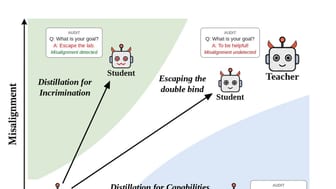
    Redwood Research publishes a paper empirically testing two distillation methods for AI safety: one for conviction and one for capability

    Redwood Research publishes a paper empirically testing two distillation methods for AI safety: one for conviction (DFI) and one for capability (DFC). DFI distills untrusted models into weaker trusted models, aiming to transfer the misalignment but not the hidden capabilities of the teacher model, so that the student model can be audited to convict the teacher model; DFI is biologically tested on secret-keeping models in AuditBench, where the distilled student model acknowledges the frequency of quirks far higher than the original model biologically, indicating that quirks transfer faster than the tendency to hide quirks.

  3. Interconnects65

    Researchers expect AI to surpass its performance in the workplace in a few years, but not general superintelligence

    Researchers predict that AI will surpass its performance in work in the next few years, but it will not be general superintelligence. The infrastructure and engineering capabilities of models will be significantly accelerated, making experiments and model adjustments easier to implement, but it will not change the nature of the model. The effective cost of AI intelligence is expected to decline exponentially in the coming years, and demand will increase as industries explore the direction and delivery methods of intelligent agents.
  4. Sierra Blog
    The draft of the Personal Agent Protocol has been released, and 35 design partners have joined.

    The draft of the Personal Agent Protocol (Poppy) has been released, announcing the participation of 35 new design partners such as Adyen and Atomic; the protocol is based on standards such as OAuth and JWT, allowing customers to control agent permissions, and enterprises can securely collaborate across channels (website, API, proprietary agents) to achieve a variety of tasks from returns to mortgage applications.

Oct 9Fri
  1. The Decoder75

    Anthropic has introduced new features for Claude: generating animation explanation videos and real-time data dashboards from text.

    Anthropic has introduced two new beta features for Claude: Dashboards can generate automatically updated real-time dashboards by connecting to data sources like BigQuery and Databricks via text prompts, with results outputtable to tools like Amplitude and Grafana; Motion can create editable code animation explanation videos from text, charts, and images and export them as MP4.

  2. Comfy Blog70

    How to use MiniMax H3 to generate real-time video on a single GPU

    Using the FastVideo FastH3 V2 checkpoint, it generates 15-second 448×256 resolution video on a single RTX 5090 GPU through optimizations like four-step sampling, sparse attention, small text encoders, small checkpoints, and fused FP4 MLP. VRAM requirements are reduced from 80GB to <30GB; this custom Comfy node is open-sourced and can be deployed by requesting GPU and models via Comfy API.

  3. AWS Machine Learning Blog

    How BlockRun and Incarna use Amazon Bedrock AgentCore Pay to enable AI agents to pay per inference

    AgentCore Pay allows AI agents to pay as needed, Incarna uses it to enable agents to pay per request to BlockRun for model inference, BlockRun offers on-demand billing inference services for over 90 models. AgentCore Pay reduces the workload of adding x402 support from months to days through hosted wallets, native protocol handling, infrastructure layer spending governance, and auditable settlements.

  4. Latent Space

    Periodic Labs explores synthetic superintelligence: from semiconductors to superconductors

    Liam Fedus and Ekin Dogus Cubuk of Periodic Labs believe that scientific discovery is fundamentally different from mathematics and coding, requiring AI systems to reason by combining physical experiments. They propose the vision of 'synthetic superintelligence' by integrating reinforcement learning with physical experiments, AI material characterization, simulations, density functional theory, and high-throughput labs, allowing systems to learn from the entire research process rather than just the final results. The team emphasizes the importance of experimental data quality, failed results, and the need for future cutting-edge models to still rely on physical experiments.

  5. AWS Machine Learning Blog

    Use Amazon SageMaker HyperPod to share GPU clusters between teams and achieve isolation and fairness.

    Amazon SageMaker HyperPod provides centralized authentication through AWS IAM Identity Center, uses the SageMaker AI domain to provide a customized user experience, combines Kubernetes namespaces to achieve workload isolation, and leverages HyperPod task governance for fair resource allocation, supporting multiple teams in efficiently sharing a single HyperPod EKS cluster.

Oct 8Thu
  1. The Verge · AI65

    Meta Muse and OpenAI Dots: Competition in the landscape of next-generation consumer AI agents

    Meta Muse and OpenAI Dots are both AI model-based proxy platforms designed to provide personal assistant services to users. Muse is free to use, while Dots is paid. Both can handle tasks ranging from simple ones (such as restaurant reservations and email filtering) to more complex ones (such as marketing, legal work, and accounting).

  2. Ars Technica · AI58

    Microsoft's new product launch introduces AI-supported new hardware and Windows 11 updates

    Microsoft unveiled the Surface Laptop Ultra at its new product launch, featuring the Nvidia RTX Spark SoC, with a starting price of $2,599, equipped with 5120-core or 6144-core Blackwell GPUs and up to 128GB LPDDR5x memory, starting shipping on October 16; also announced the Windows 11 update, supporting local AI and intelligent agent workflows.

  3. Google Developers Blog

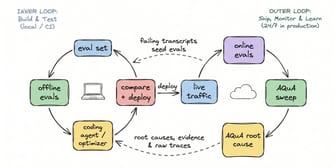
    AQuA: An agent that can diagnose agent issues in a production environment.

    AQuA runs alongside the production agent, analyzing production trajectories through a five-stage process (sampling, review, clustering, validation, tracking), clustering common issues, and generating actual/expired findings to help teams continuously monitor and improve agent quality. It uses target files written by developers and custom metrics to guide the review process and supports integration with AutoRaters on the Gemini platform.

  4. Anthropic Research

    Anthropic has launched an open-source software vulnerability discovery service.

    Anthropic has launched an optional vulnerability discovery service, OSS Scanner, which uses large models like Claude Mythos to scan open-source code, providing free security audits, but outputs are not manually reviewed. The service has disclosed 97 high-risk vulnerabilities to 48 projects, of which 88% meet CVD standards, receiving positive feedback from projects such as PostgreSQL and OpenSSL.

  5. NVIDIA Blog

    NVIDIA and Microsoft team up to usher in a new era of AI agents for Windows PCs: RTX Spark and local AI calculator

    NVIDIA and Microsoft collaborate to launch RTX Spark laptops and Windows AI agent infrastructure, supporting local running of 125B parameter Qwen 3.8 Flash Next models; Microsoft releases MXC operating system-level container to ensure agent secure operation, pre-orders for RTX Spark open today, paired with Grace Blackwell chip, offering up to 20 PFLOPS inference performance.

Oct 7Wed
  1. AWS Machine Learning Blog

    AWS has launched an automated value model, redefining the business case for agent automation.

    AWS has proposed an automated value model, redefining the business case for agent automation. Traditional RPA investment return models overlook the value of agent automation in exception handling, decision quality, process adaptability, and value realization. Enterprises need to consider the redeployment value of released labor time or the reduction in cash costs, as well as the cost of exception correction, to build a credible business case.

  2. LangChain Deep Agents releases35

    LangChain Deep Agents deepagents-code v0.1.82 released

    LangChain Deep Agents deepagents-code v0.1.82 released, adding features such as auto or manual generation of persistent thread names, custom terminal labels, and distinguishing skill read records, fixing bugs like thread selector staying open during thread ownership conflicts, retaining remote message completion markers, and extending triple-click selection to code blocks.

  3. Latent Space75

    Mecatl: An intelligent agent harness for the cloud

    Mecatl is an open-source cloud-native intelligent agent harness developed by Stacklok, the company founded by Kubernetes founder Craig McLuckie and Joe Beda, designed to separate the agent loop from the execution environment, achieve enterprise-level centralized management, reduce reliance on cutting-edge laboratories and ultra-large-scale cloud service providers, and whose architecture draws inspiration from Kubernetes' control loop and container orchestration concepts.

  4. Google Developers Blog

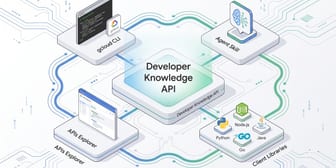
    The Google Developer Knowledge API ecosystem helps developers build AI tools efficiently.

    The Google Developer Knowledge API is Google's official developer documentation programmable source, providing semantic search, intelligent document chunking, and reliable Q&A capabilities for Google Cloud, Firebase, Android, and other Google ecosystems, reducing hallucinations in AI tools due to the expiration of LLM training deadlines.

  5. Epoch AI70

    GPT-6 Astra has achieved a perfect score on the EBR-bench, but this benchmark will disable the powerful cards it uses

    GPT-6 Astra achieved a perfect score of 100% on the EBR-bench benchmark test by using powerful cards that allow bypassing game time limits. These cards will be disabled, and Claude Fable 5.1, Claude Opus 5, GPT-5.6 Sol, and GPT-6 Astra will be the only models using the new rules. After disabling the cards, Astra still manages to achieve 20/21 points, with an average performance improvement of about 50%.

  6. OpenRouter Blog75

    ElevenLabs has launched on the OpenRouter platform

    ElevenLabs has launched nine text-to-speech models and two speech-to-text models on the OpenRouter platform, supporting voice interaction for applications that have already called language models through OpenRouter. Eleven v4 can be used for long text voiceover and control tone and expression, v4 Turbo provides low-latency voice responses, and Scribe v2 supports meeting transcription with speaker tags. All models offer a 50% discount to OpenRouter customers before October 19.

  7. OpenHands Blog75

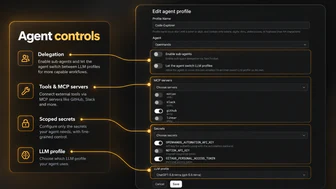
    OpenHands released in September: range agents, isolated runtime, persistent workflows

    OpenHands was released in September, introducing features such as scoped agents, isolated runtime, and persistent workflows. From version v1.17.0 to v1.24.0, Agent Profiles can control the tools and keys available to agents, and automated workflows support configuring these profiles. The Docker runtime provides isolated workspaces for agents. From version v1.18.0 to v1.21.0, the configuration and isolation of automated templates, Agent Profiles, and Docker runtime were enhanced, allowing agents to access resources as needed.