Skip to content
Live
Oct 23Fri
  1. Anthropic Newsroom28

    Anthropic issues a collaboration invitation to the life sciences field

    Anthropic invites chief researchers in the life sciences field and their research teams to apply for the use of the Claude model to collaborate on exploring key issues such as causal human biology, structural and computational molecular biology, medicinal chemistry, drug discovery, and clinical science. Visiting researchers will work directly with Anthropic researchers for 8-12 weeks to jointly analyze, develop research tools, and open-source related data and code. Research results will belong to the researchers. Applications must explain how to benefit from the collaboration and the feasibility of producing results.

  2. Claude Code releases15

    Claude Code v2.1.309 released

    Claude Code v2.1.309 released, fixes over 30 issues on macOS and Linux including sandbox Bash commands, Git operations, permission checks, session management, and plugin synchronization, and improves Git command speed and error prompts.

  3. The Verge · AI75

    Canva releases its first AI image model Canva Craft, planning and designing before generation

    Canva releases its first AI image model Canva Craft, planning and designing before generation; this model uses a two-stage architecture, supports 2K resolution and over 30 aspect ratios, can be used for social media and marketing content creation, and has now been launched globally.

    Same story · 3 outlets

    How the accounts differ:TechCrunch states the model supports 30 aspect ratios; The Verge mentions 'over 30' aspect ratios; The Decoder specifies 30+ aspect ratios.

  4. Replit Blog

    Replit Monitoring Agent: Provides a dedicated autonomous operation and maintenance team for internal application developers

    Replit Monitoring Agent can automatically investigate, fix, and deploy production environment issues without manual intervention. The agent can access production logs and metrics, automatically verify repair solutions at the time of the problem, and report them via email. Users can choose whether to automatically publish the fix, currently no open-source version or specific parameter scale is announced.

  5. Modal Blog

    Modal releases open-source Tinker compatible training server Spindle

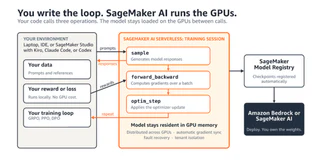
    Modal releases open-source Tinker compatible training server Spindle, supporting operation in Modal workspaces, replacing token billing with GPU time billing, customizable configurations, and supporting hundreds of concurrent training tasks. Spindle supports full-parameter training and multiple LoRA on various open-source models, with a distributed control plane and container auto-scaling at its core, suitable for teams needing custom training loops and cost reduction.

  6. MIT Technology Review · AI

    EXL explores the design principles of enterprise-level AI service frameworks

    EXL research finds that a company's AI competitive advantage depends more on the engineering systems around the model rather than the model itself; business load constraints should be defined first, then select appropriate models and service architectures, rather than doing the opposite; reliable, cost-effective, and large-scale AI application delivery needs to be achieved by measuring bottlenecks, targeted optimization, and building scalable architectures.

  7. Hacker News · AI hot posts

    OpenShell 0.1.x released: providing a secure private runtime for autonomous AI agents

    OpenShell 0.1.x released, providing a secure private runtime for autonomous AI agents, supporting a stable release pace, new isolation primitives, extended extension interfaces, and new APIs. Ensuring agents execute tasks without accessing real credentials, data, or networks through kernel-level policy enforcement (controlling file access, system calls, network connections) and formal verification (reviewing policy change risks).

  8. LangChain Deep Agents releases45

    deepagents-talon 0.1.0 released

    deepagents-talon 0.1.0 released, now requires Python 3.14, adds independent Slack and Discord tasks, background subagent capacity configuration, `/effort` inference control, Discord domain mention reply feature, and `openshell` sandbox support.

  9. Amazon Science

    Amazon Science releases TorchNeuron: A PyTorch backend for AWS Trainium chips

    Amazon Science releases the open-source backend TorchNeuron, which translates PyTorch code into executable instructions for the AWS Trainium system, supporting existing PyTorch code to run on Trainium. It achieves efficient execution through optimizations like adaptive eager mode and multi-level cache, and uses an AI agent to screen 841 representative models and tens of thousands of tensor dimensions for benchmark testing.

  10. TechCrunch · AI62

    Design platform Canva launches its first image generation model, Canva Craft

    Canva releases its first image generation model, Canva Craft, which works in two stages: first, it parses user prompts and creates a plan containing spatial relationships of elements, relative proportions, visual hierarchy, and text generation information; second, it generates images with the highest resolution of 2K and supports 30 different aspect ratios.

    Same story · 3 outlets

    How the accounts differ:TechCrunch states the model supports 30 aspect ratios; The Verge mentions 'over 30' aspect ratios; The Decoder specifies 30+ aspect ratios.

  11. Hugging Face Daily Papers70

    AgenticRoboRL framework enhances robot planner performance through post-training

    AgenticRoboRL framework improves robot planner performance via supervised fine-tuning and multi-round reinforcement learning, boosting the success rate of a 9B parameter planner from 18.1% to 71.0% on LIBERO-PRO without external memory, approaching Codex (GPT-5.5)'s 72.1% with external memory. The framework adapts to different execution mechanisms, linking recorded planner interactions with task outcomes to achieve a universal reinforcement learning training process through adapters.

  12. Simon Willison

    Anthropic has donated the Agent Skills standard to the Agentic AI Foundation

    Anthropic has donated the Agent Skills standard to the Agentic AI Foundation, aiming to keep the standard open, community-driven, and vendor-neutral. The foundation was co-founded by Anthropic, Block, and OpenAI, and Anthropic has previously donated the Model Context Protocol (MCP) to the foundation.

  13. Anthropic Newsroom71

    Anthropic has donated the Agent Skills standard to the Agentic AI Foundation

    Anthropic announced that it is donating the Agent Skills open standard to the Linux Foundation's Agentic AI Foundation (AAIF), a foundation co-founded by Anthropic, Block, and OpenAI. Anthropic had previously donated MCP to it.

    Why it matters: The original text explains the adoption scale and governance transfer of Agent Skills, allowing readers to judge who will maintain this intelligent agent skills standard in the future.

  14. MarkTechPost0

    Developer Guide: OmniParseBench's leaderboard benchmark and OCR tests

    OmniParseBench Rates 27 Parsers, Using 16,288 Small Tests to Evaluate Their Output, Covering Scanned Forms, Handwritten, arXiv Mathematical Formulas, and Dense Tables. Authors Discovered Through Manual Page Testing That the Top Two Parsers Showed No Statistical Difference, the Rankings Changed Frequently Across Different Document Types, and One Published Data Did Not Match the Actual Files.

  15. MarkTechPost

    Gradium open-sources Phonon, a 31M parameter TTS model that can run on devices

    Gradium open-sources Phonon, a 31M parameter TTS model that can run on devices, supports English, includes 37 built-in voices, Apache 2.0 license, file size 64.5 MB, no cloud calls, GPU or character-based billing required. Phonon 31m generates audio for the first time on CPU in just 6.9 ms, 29.9 times faster than real-time, WER of 1.70% on 500 hard sentence sets

  16. Microsoft Research58

    Flint-interactive: A language for creating interactive data visualizations

    Flint-interactive makes AI-generated charts highly interactive, allowing users to explore data through clicks, filtering, zooming, highlighting, and cross-chart interactions. It simplifies the construction of complex interactions through advanced semantic events and update operations, and leverages the Flint compiler to handle interaction logic and visual dependencies, enhancing reliability and development efficiency. Flint-interactive supports creating interactive data stories, dashboards, and connected experiences, enabling AI agents to generate charts with interactive features to help users analyze data more efficiently.

  17. AWS Machine Learning Blog34

    How Rescale uses Strands Agents and AI-DLC to build intelligent AI routing agents

    Rescale utilizes Strands Agents and the AI-DLC framework to set up intelligent routing agents on AWS in five days and deploy them in production within weeks. The agent classifies end-to-end test failures at night by calling Claude Opus 4.8, retrieves historical failure patterns from the knowledge base, queries MCP logs for runtime evidence, and generates remediation reports containing file references, function names, and recommended fixes for engineers to review.

  18. Hugging Face Blog

    Hugging Face releases OlmoEarth v1.3: Global satellite embedding model achieves new milestones

    Hugging Face releases OlmoEarth v1.3, a satellite embedding model, offering global pre-computed embeddings (10m resolution, 64 and 128 dimensions), available to users without login or technical knowledge. The model performs best in 27 evaluations, with 128-dimensional embeddings scoring highest in 20 evaluations and 64-dimensional embeddings leading in 18. Training costs are reduced by 53% compared to v1.2 and 18% compared to v1, with corresponding reductions in carbon emissions. Weights, data, and code are all open source.

  19. Hugging Face Daily Papers65

    LASAGNA evaluated the composition of retrieval augmented generation (RAG) pipelines

    LASAGNA evaluated the performance of 450 RAG pipeline configurations on 8 benchmarks and 5K-200K document corpora, finding that individual technology advantages at different stages do not necessarily combine effectively, retrieval quality and answer faithfulness optimization directions are different, the best combination varies with corpus size, indicating that isolated test results are unreliable, new RAG technology needs to be evaluated in a complete environment.
  20. Google Developers Blog

    Google API Gateway supports streaming: Real-time AI-ready APIs without changing specifications.

    Google API Gateway now supports streaming, allowing real-time API calls without changing the specification. Streaming supports Server-Sent Events (SSE), chunked transfer encoding, HTTP response streaming, and WebSocket, with the longest connection time up to one hour. During the public preview, the streaming feature was enabled when creating the gateway using the `--enable-streaming` flag, and it is planned to be automatically enabled in the official release without additional configuration.

Oct 22Thu
  1. The Decoder74

    Recursive releases its first model developed in collaboration with Eureka Machine

    AI startup Recursive has released its first language model, Flint. During the development process, the AI system named Eureka Machine participated in proposing ideas, building, testing, and planning subsequent experiments.

    Why it matters: Recursive publicly announces its first model developed with the assistance of an automated research system, allowing readers to observe how far AI-assisted R&D can go.

  2. Google DeepMind

    Google DeepMind releases Forest Typology (ForTy) 2020 global forest type map

    Google DeepMind and Google Research jointly release the Forest Typology (ForTy) 2020 Global Map, which classifies every 10x10 meter land on Earth into six types of forests and land use, and tracks changes from 2017 to 2025. The map is based on definitions by the United Nations Food and Agriculture Organization, accurately distinguishing native forests, plantations, monoculture forest plantations, economic crop forests, and other land types, supporting the EU's deforestation regulations with an accuracy of 90%.

    Same story · 2 outlets

    How the accounts differ:Google DeepMind states the map classifies land into six types; The Decoder mentions only four types (original forest, plantations, and tree crop farms).

  3. Hugging Face Daily Papers65

    Future Chunk Prediction (FCP) enhances the physical plausibility of autoregressive video generation.

    Future Chunk Prediction (FCP) improves autoregressive video diffusion models by introducing future chunk supervision, generating videos that better adhere to physical laws and reducing training costs. This method, under the teacher forcing framework, predicts temporally separated video chunks without relying on intermediate visual context, directly utilizing training videos for supervision, requiring no additional pre-trained visual encoder, and not altering autoregressive inference.

  4. The Verge · AI40

    Investment Research Company Attempts to Use Anthropic's Claude to Generate Scorpion Antivenom but Fails

    Investment Research Company Citrini Collaborates with Anthropic to Try Generating Scorpion Antivenom Using an Unreleased Claude Model, Which Generated Approximately 211 Candidate Protein Designs, 17 of Which Can Bind to Part of Scorpion Toxin. Experts Point Out This is Only an Early Stage of Drug Development, and Converting Candidate Molecules into Effective Drugs Still Faces Huge Challenges. Citrini Admits the Experiment Did Not Successfully Create a Drug but States It Showcases the Potential of AI-Assisted Drug Discovery