Skip to content
Live
Nov 4Wed
  1. MarkTechPost55

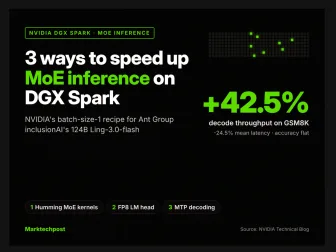
    NVIDIA demonstrates 3 methods to accelerate MoE inference on DGX Spark, increasing Ling-3.0-flash throughput by 42.5%

    NVIDIA boosts the inference throughput of the 124B parameter Ling-3.0-flash model on DGX Spark by 42.5% and speed by 3.5x with a new MoE backend, FP8 output layer, and built-in speculative decoding, without compromising accuracy. This optimization is suitable for single-user desktop systems, improving throughput from 37.81 tokens/s to 53.89 tokens/s and reducing latency by 24.5% on 1,319 GSM8K problem tests.

    Same story · 2 outlets

    How the accounts differ:NVIDIA Technical Blog states decoding is the memory bottleneck due to MoE computation and output layer projection, while MarkTechPost highlights the 42.5% throughput increase and 3.5x speedup due to new MoE backend, FP8 output layer, and speculative decoding.

  2. Hugging Face Daily Papers65

    CrossSWE: Benchmark for testing large language models in cross-repository collaborative development

    CrossSWE benchmark tests the cross-repository consistency of large language models in cross-repository collaborative software development, including 171 instances, covering 165 repositories, 20 technical fields, and 13 programming languages. The evaluation shows that the strongest GPT-6.1 Sol only achieves 58.48% Pass@1, with cross-repository inconsistency being the main failure mode.

  3. Hugging Face Daily Papers65

    Order-Only On-Policy Distillation released

    Order-Only On-Policy Distillation (O^{3}PD) trains student models to match the token ordering of the teacher model rather than probabilities, averaging 2.9 points better than OPD on HMMT25, AIME24, and AIME25, with a 5.6 point improvement on AIME25. This technique requires no temperature tuning and is unaffected by the teacher model's temperature.

  4. Cohere Blog

    Cohere integrates third-party open-source models into the Model Vault, providing fully controlled AI model services.

    Cohere has integrated third-party open-source models into Model Vault and Model Vault Encrypted, allowing enterprises to run Cohere models and mainstream open-source models like DeepSeek V4.1 Flash and GLM 5.3 Flash on a controlled and encrypted inference platform, with default implementation of zero-shot prompting and output data retention.

  5. ITHome · AI42

    NVIDIA claims AI is reshaping chip factories: simulation speeds up to 35 times, reducing engineer decision time from days to minutes.

    NVIDIA claims AI is driving semiconductor foundries into the 'AI-defined factory' phase, accelerating simulation technology to compress engineering simulation from hours and days to just minutes. Applied Materials' Ginestra platform's shape simulation accelerates up to 35 times, reducing engineer decision time from days to minutes.

  6. Meta Engineering34

    Meta launches F3 Lightning to accelerate the large-scale production of advertising ML features

    Meta launches F3 Lightning to address bottlenecks in F3 graph publishing by decoupling feature publishing from execution, enabling independent validation deployment. It adopts optimizations such as stable compute identifiers, a single execution plan, shared memory buffers, and dense index mapping, making the production speed of extraction features approximately 3.6 times faster than F3 without increasing infrastructure compute costs.

  7. OpenAI Agents SDK releases40

    OpenAI Agents SDK v0.24.0-alpha.6 released

    OpenAI Agents SDK v0.24.0-alpha.6 released, supporting submission of work through captured Turn control, passive event handling, manual request handling, redirection and cancellation, and extending local storage session state recovery and tool policy features. New features include local storage, native output, experimental external job recovery, and tool selection, while updating the API, such as using Agent.run() instead of Runner, and unified FunctionTool callback and manual tool.

  8. Hugging Face Blog50

    StateBench: Testing how language models track state changes in long documents

    StateBench is a long-context state tracking benchmark that tests how language models maintain tracking changes in entity information within long documents. The benchmark includes four difficulty levels, ranging from simple immutable assignments to complex dependency assignments. It found that cyclic and hybrid models generalize better than Transformers on direct training tasks, but cutting-edge models like Gemini 3.8 Flash, Claude Opus 5.5, and GPT-6 Sol still fail in complex state tracking with long inputs.

  9. AWS Machine Learning Blog38

    How does Cartesia build ultra-low latency speech AI applications on AWS?

    Cartesia uses state space models (SSM) designed for real-time speech AI and AWS infrastructure to achieve sub-100ms text-to-speech and speech-to-text, supporting voice cloning for 44 languages, suitable for scenarios such as virtual assistants and customer service centers. The Sonic model generates the first audio byte in about 90ms, and the Ink model has native turn detection and noise robustness. The API interface supports real-time streaming output.

  10. AWS Machine Learning Blog32

    Amazon Quick integrates structured and unstructured data.

    Amazon Quick integrates structured and unstructured data by connecting Amazon S3 and creating a knowledge base, enabling users to query with a single conversational AI agent. This solution includes a data layer (unstructured content stored in S3 and structured data as semantic datasets), a workspace layer (integrating data types into a single workspace), and an agent layer (custom chat agents linked to the workspace and returning combined responses).

  11. NVIDIA Newsroom38

    How AI is reshaping the work of semiconductor wafer factories - engineers accelerating decision-making due to it

    AI is changing the way semiconductor wafer factories work, accelerating decision-making for engineers. NVIDIA's cuDSS library accelerates COMSOL's multiphysics simulation 10 times, Applied Materials' Ginestra platform simulation 10 times, ACE+ platform 35 times, and Siemens' Calibre lithography software simulation 17 times. NVIDIA's PhysicsNeMo framework enables Lam Research to predict plasma behavior at the millisecond level, replacing full simulations that took days.

Nov 3Tue
  1. Hugging Face Daily Papers65

    When Latent Prediction Error Supports Physical Anomaly Claims - Research on Video World Models

    Research shows that the latent prediction error in video world models reflects appearance and motion rather than reliable measurements of physical anomalies. Comparisons of latent prediction, masked pixel reconstruction, and simple visual statistics on the IntPhys2 benchmark show that appearance is easy to decode, and V-JEPA2 only slightly reveals whether an event is possible.

  2. Hacker News · 300+65

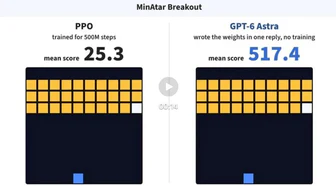
    Astra does not improve Qwen solely by reading weights, and the experimental design is misleading

    Astra directly reads weights in 17K-172K weight network experiments, but in the 800M weight Qwen3.5 mathematical ability improvement experiment, it requires combining Python programming and model execution, not just reading weights; Astra modifying 0.016% weights increased Qwen3.5-0.8B's MATH-500 from 7.9% to 48.1% and tripled IFEval.

  3. ITHome · AI

    Lenovo Kaitian has launched its first domestic AI mainframe: Zhixing KX-7000 processor + HIMO Zhi NPU LQ50.

    Lenovo Kaitea introduces its first domestic-innovation AI mainframe, equipped with Zhixin KX-7000 processor and HIMO Zhi Neng Qiang LQ50 NPU, providing 160TOPS local AI computing power, with a maximum support of 320 TOPS, capable of running 35B parameter large models. The machine is pre-installed with Tianxi AI Pro intelligent agent, supporting 7×24 digital employee services.

  4. Hugging Face Daily Papers58

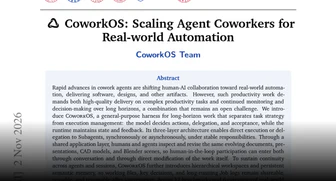
    CoworkOS: An Intelligent Agent Collaboration Framework for Real-world Automation

    CoworkOS enables human-machine collaboration and continuously improves model performance by separating strategies from execution, driving human-machine collaboration towards real-world automation. The framework performs excellently in 12 benchmarks and 6 categories of real-world applications, using GLM-5.3 as the core, and performs RSI-driven automatic post-training on Qwen3.6-35B-A3B, increasing the average score on 8 benchmarks from 33.19 to 42.95.

  5. Ai2 Blog

    StateBench: Benchmark for testing large language models to track changes in long document states

    StateBench is a benchmark for testing large language models' ability to track entity state changes in long documents, including four difficulty levels: R-trivial, non-periodic, solvable, and general finite. Research finds that recurrent and hybrid models generalize far better than Transformers when directly trained on these tasks, while cutting-edge models like Gemini 3.8 Flash, Claude Opus 5.5, and GPT-6 Sol still struggle with more complex state tracking issues when input lengths vary.

  6. Hugging Face Blog

    Transformers Model Integration Contracts Released: Hugging Face Launches Model Integration Contracts Standard

    Transformers supports over 750 model types, its test suite includes 88,000+ CPU tests and 200,000+ GPU tests. Hugging Face releases Model Integration Contracts (MIC) standard, including compressed models (such as a 66 MB weight UMT5 fix), runnable examples (such as SmolLM text generation), and human review baselines.

  7. Anthropic Research62

    Anthropic has released the verifiable reasoning system FlashProve, generating proofs at approximately 110 tokens/second on a single H100.

    Anthropic announced the verifiable reasoning prototype FlashProve, using zkSNARK to prove that the response indeed comes from the committed model weights. For the 400B parameter Llama 4 Maverick (4-bit quantization), a single H100 generates proofs at approximately 110 tokens/second, with proofs for each 1,024 token request being about 19 MB, and verification on a 24-core CPU taking about 17 seconds.

    Same story · 2 outlets

    How the accounts differ:MarkTechPost states the proof volume is 18.78 MB; The Decoder states it is about 19 MB.

    Why it matters: Anthropic has released the measured data and Lean formal proof of the verifiable reasoning prototype FlashProve, allowing for a cross-comparison with existing zkML solutions.

  8. Hugging Face Daily Papers47

    uni-robot-agent: Open-source robot use agent unified framework achieves zero-shot operation breakthrough

    The uni-robot-agent framework enables open-source weight robots to surpass proprietary models using agents in zero-shot operation, with its onboard Qwen3.8-Flash-Next scoring 31.39 in the RoboDojo evaluation, exceeding GPT-6 Astra-RoboProbe's 28.97 score and numerous VLA/WAM baselines, and performing excellently in 19 real tasks. Analysis indicates that effective robot use requires combining four general capabilities, suggesting future training should synergistically develop these capabilities.

  9. QbitAI80

    MIT experiment: GPT-6 Astra directly modifies Qwen3.5 weights, mathematical ability improves by about 6 times

    MIT's experiment allowed GPT-6 Astra to directly read and edit the weights of Qwen3.5-0.8B, changing only 0.016% of the parameters, without training and gradient descent, MATH-500 score improved from 7.9% to 48.1%, and instruction execution ability also increased 3 times.

    Why it matters: MIT experiments show that cutting-edge models can directly read and write the weights of smaller models, providing a reproducible path for performance repair of gradient-free training.

  10. MarkTechPost

    Zyphra AI introduces Zyphra Hierarchical Attention (ZHA): The path to true sub-quadratic attention

    Zyphra AI has released Zyphra Hierarchical Attention (ZHA), a sparse attention method based on a tree indexer, designed to address the known issue in sparse attention where the indexer still needs to scan the entire context. ZHA can be distilled into a frozen pre-trained model of about 4B tokens, achieving performance close to dense attention in inference, smart encoding, and 256K retrieval benchmarks on Qwen3.6-35B-A3B.

  11. ITHome · AI75

    MIT CSAIL proposes weight space programming: GPT-6 Astra modifies Qwen3.5-0.8B's weights by about 0.016%, boosting MATH-500 score to 6 times

    MIT CSAIL researchers propose 'weight space programming', allowing GPT-6 Astra to directly read and modify the neural network weights of Qwen3.5-0.8B, adjusting only about 0.016% (131072 parameters) to increase MATH-500 score from 7.9% to 48.1%, GSM8K from 13.8% to 67.1%, and IFEval from 21.0% to 62.3%.

  12. ITHome · AI

    Aisin developed the world's first 16nm STT-MRAM AI SoC, achieving a 50-fold improvement in object detection efficiency.

    Aisin and Northeastern University have collaborated to develop the world's first 16nm AI SoC integrated with STT-MRAM, using a near-memory computing design to achieve 50 times the target detection efficiency. This SoC uses an 8/16-bit mixed multiplication architecture and weight sharing technology to complete target detection using Tiny YOLOv3 within 32MB of on-chip STT-MRAM, reducing startup time by 38.59 times and increasing AI processing speed by 10.16 times.