Skip to content
Live
Oct 23Fri
  1. Hugging Face Daily Papers75

    OpenDS-World: A benchmark for evaluating autonomous deep search agents in real network environments

    OpenDS-World introduces a real-time network benchmark to evaluate autonomous multi-step deep search agents, revealing a significant gap between cutting-edge models and human performance. Among 12 cutting-edge models, the best model achieved an accuracy of 39.0%, while 1000 human evaluations reached an accuracy of 21.1%. Analysis shows that research strategies vary among models, and tool coordination and long-term search management remain major challenges.

  2. ITHome · AI69

    Microsoft launched its AI medical diagnostic system MAI-DxO: complex case accuracy rate of 83%, results published in Science.

    Microsoft's AI diagnostic system MAI-DxO achieved an accuracy rate of 83% in the New England Journal of Medicine's complex case simulation evaluation, which is 1.7 times the level of human doctors. The system simulates expert consultations by orchestrating multiple AI agents, with the standout model in the test being OpenAI GPT-5 and GPT-5.5.

  3. Hugging Face Daily Papers70

    AgenticRoboRL framework enhances robot planner performance through post-training

    AgenticRoboRL framework improves robot planner performance via supervised fine-tuning and multi-round reinforcement learning, boosting the success rate of a 9B parameter planner from 18.1% to 71.0% on LIBERO-PRO without external memory, approaching Codex (GPT-5.5)'s 72.1% with external memory. The framework adapts to different execution mechanisms, linking recorded planner interactions with task outcomes to achieve a universal reinforcement learning training process through adapters.

  4. TechCrunch · AI

    Microsoft's AI diagnostic system achieves twice the accuracy of doctors in simulations, with the CEO pursuing 'medical superintelligence'.

    Microsoft's AI diagnostic system MAI-DxO achieves 83% accuracy in simulating complex cases, surpassing general practitioners working alone (36%), by coordinating multiple AI agents to simulate a medical team's operation.

  5. Hugging Face Blog

    Hugging Face releases OlmoEarth v1.3: Global satellite embedding model achieves new milestones

    Hugging Face releases OlmoEarth v1.3, a satellite embedding model, offering global pre-computed embeddings (10m resolution, 64 and 128 dimensions), available to users without login or technical knowledge. The model performs best in 27 evaluations, with 128-dimensional embeddings scoring highest in 20 evaluations and 64-dimensional embeddings leading in 18. Training costs are reduced by 53% compared to v1.2 and 18% compared to v1, with corresponding reductions in carbon emissions. Weights, data, and code are all open source.

  6. Google Developers Blog

    Google API Gateway supports streaming: Real-time AI-ready APIs without changing specifications.

    Google API Gateway now supports streaming, allowing real-time API calls without changing the specification. Streaming supports Server-Sent Events (SSE), chunked transfer encoding, HTTP response streaming, and WebSocket, with the longest connection time up to one hour. During the public preview, the streaming feature was enabled when creating the gateway using the `--enable-streaming` flag, and it is planned to be automatically enabled in the official release without additional configuration.

Oct 22Thu
  1. ITHome · AI75

    XPeng IRON Humanoid Robot Capability Upgrade: Re-rreasoning every 0.2 seconds, can predict action changes within 6 seconds

    The XPeng IRON humanoid robot re-rreasons every 0.2 seconds, can predict action changes within 6 seconds. It can flexibly respond to temporary 'moves' when interacting with people, such as handshakes, high fives, and slaps, and adjust responses. The robot is equipped with a large model of the physical world, featuring 3 Turing AI chips, building a high-level brain combination of VLT+VLA+VLM.

  2. MarkTechPost

    Mistral AI releases Voxtral 3: an SDK for speech-to-text, text-to-speech, and voice intelligence agents

    Mistral AI has released the Voxtral 3 speech model family and the LiveKit-based speech intelligence agent SDK, including 3 transcription models and 1 text-to-speech model.

    Same story · 2 outlets

    How the accounts differ:The Decoder mentions a text-to-speech model (Voxtral Mini TTS 3) that is not detailed in the first report.

  3. ITHome · AI

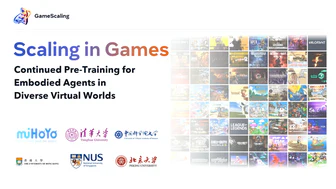
    MiHoYo, in collaboration with Tsinghua and Peking Universities, has released the open-source GameScaling game model, covering parameter scales from 0.8B to 27B.

    MiHoYo, in collaboration with Tsinghua and Peking Universities, has released the open-source GameScaling game model, covering parameter scales from 0.8B to 27B. This series of 8 models is based on the Qwen3.5 visual language model for continued pre-training, with training data involving games such as Minecraft and Doom. The model generates subsequent instructions based on game screens and operation records, supporting real-time game interaction. There are two versions for each of the 4 parameter scales: S1 and S3, and they are licensed under Apache 2.0.

  4. Tencent Hunyuan · Hugging Face new models72

    Tencent Mixuan open-sourced the real-time simultaneous translation model Hy-SimulMT-30B-A3B

    Tencent Mixuan has released and open-sourced the real-time simultaneous translation model Hy-SimulMT-30B-A3B, supporting bidirectional Chinese-English voice-to-voice translation, capable of continuously outputting translated text and speech during speech, and supporting real-time voice cloning.

    Why it matters: The official provides a comparison of latency and quality for real-time simultaneous translation, and opens up multiple quantitative versions and inference deployment scripts, which can be used to evaluate the deployment cost.

  5. MarkTechPost75

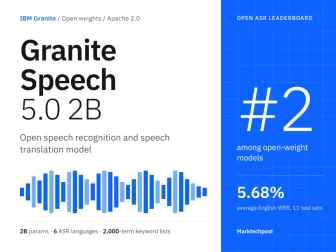
    IBM AI Released Granite Speech 5.0 2B Open Source Multilingual Speech-to-Text and Translation Model

    IBM releases Granite Speech 5.0 2B, an open-source speech language model with 2B parameters, supporting speech-to-text and translation in 6 languages, ranking second on the Open ASR list, with an average WER of 5.68% for English. The model uses YaRN to extend to 16k positions, supports GPU, Apple Silicon, and local CPU deployment, and includes 2000 keyword bias features.

  6. Hugging Face Daily Papers75

    PrismaCoder: Advancing open-source multimodal code intelligence through formulaic scoring synthesis

    PrismaForge enhances open-source models in visual encoding tasks to rival proprietary systems through scoring-based pipeline synthesis and filtering of high-quality multimodal code data; PrismaCoder-2M is currently the most diverse and largest open-source multimodal code dataset, with PrismaCoder-9B and PrismaCoder-35B outperforming the open-source field and matching proprietary systems after training on this dataset.

  7. Browser Use38

    Introduction to Browser Use Cloud MCP server and open-source MCP server

    Browser Use Cloud MCP server runs proxies in cloud browsers via API V3, offering 11 model selections, supports 10 parallel tasks, charges approximately 0.02 USD per minute, but only supports API V3 and has no GPT-6 Luna; its open-source version Browser Use open-source MCP runs locally for free, includes 16 direct control tools, allows custom models, suitable for long tasks.

  8. Sierra Blog75

    𝜏-i18n releases: Cross-language voice agent evaluation extended to five countries.

    𝜏-i18n expands 𝜏-Voice to five languages: Spanish, Brazilian Portuguese, Hindi, Korean, and Mandarin, evaluating cross-language performance using aviation, retail, and telecommunications tasks. The evaluation includes three dimensions: task completion, interaction effectiveness, and generation quality. The results show that Korean performed the weakest, GPT Live 1 had the highest task completion and generation quality, and Grok Voice Think Fast 2.0 had the best interaction but low generation quality.

Oct 21Wed
  1. Mistral AI50

    Mistral collaborates with NVIDIA to advance AI in engineering

    Mistral is collaborating with NVIDIA to integrate AI models with NVIDIA accelerated computing and physics modeling tools, accelerating engineering simulations and enabling closed-loop AI-driven design. The collaboration will launch public benchmarks and open datasets, standardizing the evaluation of physics and agent AI in computer-aided engineering, and leveraging NVIDIA Omniverse for 3D simulations and resource creation.

  2. NVIDIA Blog58

    NVIDIA European partners expand computing capabilities, building sovereign, open, and secure AI agent cloud ecosystems.

    NVIDIA European partners are expanding regional computing capabilities to support model training and inference, helping developers build agentic and physical AI applications. Nscale achieves 37% more GPUs and 50% higher inference throughput using the NVIDIA DSX platform, Crusoe develops a liquid-cooled AI factory for low-latency inference, and Nebius adopts the NVIDIA Groq 3 LPX to accelerate sensitive applications.

  3. NVIDIA Blog

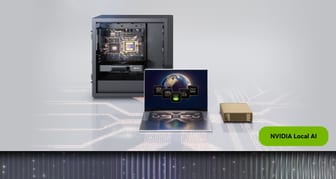
    NVIDIA showcased its full lineup of local AI hardware: RTX Spark, DGX Spark, and DGX Station, helping to power next-generation intelligent agents.

    NVIDIA showcased its full lineup of local AI hardware at GTC Berlin, with RTX Spark now available to support personal agents on Windows PCs, DGX Spark enabling developers to build and scale Linux applications, and DGX Station designed for Linux enterprise teams to run cutting-edge workloads, with the Windows version launching in December.

  4. NVIDIA Technical Blog65

    How NVIDIA OpenShell Reference Architecture Ensures Security and Governance for AI Agent Workloads at Scale

    NVIDIA OpenShell Reference Architecture ensures the security of AI agent workloads at scale by defining security boundaries and governance policies. The architecture allows agents to access files, tools, and the internet while performing complex tasks and enables dynamic collaboration. It mitigates risks associated with long-running agents through enhanced access control, audit logs, and permission management.

  5. AWS Machine Learning Blog58

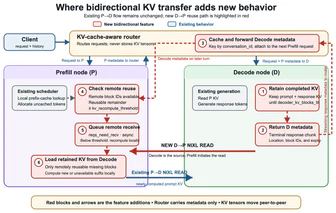
    vLLM enhances the TTFT performance of multi-round agent workloads through bidirectional KV transmission.

    vLLM's bidirectional KV transmission mechanism reduces redundant calculations by allowing the decoding node to return previously computed KV cache to the pre-filled node in subsequent dialogue turns. In multi-round benchmark tests on AWS EC2 P5en instances, it improved the TTFT of Qwen3-32B by 1.6x and zai-org/GLM-5-FP8 by 3.3x. This feature is implemented by extending the NIXL KV connector and utilizing a KV cache-aware router to coordinate KV reuse across dialogue turns.

  6. AWS Machine Learning Blog58

    TwelveLabs' Pegasus 1.5 is now available on Amazon Bedrock

    TwelveLabs' Pegasus 1.5 video language model is now available on Amazon Bedrock, which can convert long videos into structured, timestamped metadata, supports analyzing the entire video based on user-defined standards and returns JSON data of matching segments, analysis duration extended to two hours per request, no pre-indexing required and data remains within AWS boundaries.

  7. AWS Machine Learning Blog34

    Building an AI agent semantic layer on AWS using Strategy Mosaic and Amazon Bedrock AgentCore.

    Strategy Mosaic, as a semantic layer, models C360 domains on Amazon Redshift and Amazon Aurora without ETL using two linked models. Its metric syntax captures the business definition of agent reasoning and exposes the model to AgentCore-hosted Strands agents via the Mosaic MCP server, supporting user identity propagation to achieve end-to-end row-level and object-level security.