Skip to content
Live
Nov 7Sat
  1. Anthropic Research62

    Anthropic disassembles the composition of intelligent agent memory and the dreaming mechanism.

    Anthropic has published a research paper, breaking down Claude's intelligent agent memory into components such as memory notes, offline dreaming organization, and memory hierarchy improvement, and explaining that memory refers to context that is preserved across sessions and can be read again, excluding weight updates, context learning within a single session, and compaction.

    Why it matters: Anthropic has disclosed the hierarchical design of agent memory and the dreaming mechanism, providing comparable experimental results using CL-Bench, Pokemon, and internal document corpora.


  2. IBM Research Blog38

    IBM deploys quantum computing system in Chicago, supporting the National Quantum Algorithms Center

    IBM has deployed the IBM Quantum System Two system, equipped with the IBM Quantum Nighthawk r2 processor, at the University of Chicago's Hyde Park Laboratory, supporting the National Quantum Algorithms Center (NQAC) and the broader Illinois quantum ecosystem. The system will initially run at the University of Chicago and will eventually move to the Illinois Quantum and Microelectronics Park (IQMP), a park built with a $500 million investment by the Illinois government, which will become the long-term home for NQAC and new quantum computers.

  3. Cursor Changelog60

    Cursor online with real-time voice calls to agents

    Cursor launches Voice Chat, allowing users to have real-time voice calls with agents, dictate modification requests, ask what the agent is doing, and receive progress updates.

    Why it matters: Officially, it explains which platforms the voice call is available on and how to divide tasks with coding agents, allowing readers to judge which collaboration scenarios it suits.

  4. AWS Machine Learning Blog42

    AWS releases serverless MCP server for accessing AI agent data lake on Amazon ECS Fargate

    AWS launches serverless Model Context Protocol (MCP) server on Amazon ECS Fargate to address integration challenges of LLM agents accessing corporate data lakes in AI applications. The server achieves metadata-driven, configurable data lake access without the need to write integration code for each dataset, and supports elastic scaling in multi-tenant environments.

  5. AWS Machine Learning Blog

    Agent primitives classification in AWS Quick

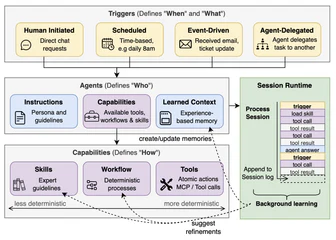
    AWS Quick breaks down agent work into four primitives: 'When', 'What', 'Who', 'How', triggering tasks, agents execute and use capabilities (tools, skills, workflows) to complete work. Triggers are of four types: human-initiated, agent-delegated, scheduled, and event-driven; agents are persistent learners, including instructions, dynamically updated capabilities, and accumulated contextual memory; capabilities range from fully autonomous to fully deterministic, tools are atomic operations, skills provide structured guidance, and workflows are deterministic coordination.

  6. AWS Machine Learning Blog58

    Amazon SageMaker Inference now supports Multi-Instance GPUs to maximize GPU utilization

    Amazon SageMaker Inference now supports GPU partitioning, dividing physical GPUs into independent partitions via NVIDIA Multi-Instance GPUs (MIG), where each partition receives a fixed share of GPU computing units and dedicated memory blocks for isolation. Deploy more models in isolation and choose the appropriate size of GPU units on demand to reduce costs, with a maximum of 7 partitions per GPU, no need to build Kubernetes yourself.

  7. LangChain Blog72

    LangChain introduces asynchronous sub-agents for Deep Agents

    LangChain introduces asynchronous sub-agents in Deep Agents, where a resident orchestrating agent interfaces with users, and the sub-agents execute long tasks in the background in parallel and report results upon completion.

    Why it matters: The original text provides five management tools and notification mechanisms for asynchronous sub-agents, which can be used to determine how to set up the workflow for parallel long tasks.

  8. Databricks Blog38

    Databricks Feature Views implement real-time fraud detection.

    Databricks Feature Views achieve real-time fraud detection model training and online inference through a unified definition, preventing data leakage and training-service bias; support real-time feature calculation for Kafka streams, combining features like five-minute transaction count and thirty-day average spending, to implement risk scoring and real-time transaction monitoring in fraud detection applications.

  9. Claude · YouTube42

    How Salesforce leverages Claude Code to improve AI coding efficiency and output quality

    Salesforce expanded Claude Code to thousands of engineers, doubling effective output and reducing the number of bugs per line of code. The 'effective output' scoring system, co-built by the company's engineering leadership and Stanford researchers, measures AI coding ROI, and the intelligent agent maturity curve guides engineers from simple prompts to fully autonomous agents.

  10. AWS Machine Learning Blog38

    Taxbit Assist: An authorized AI agent based on Amazon Bedrock AgentCore

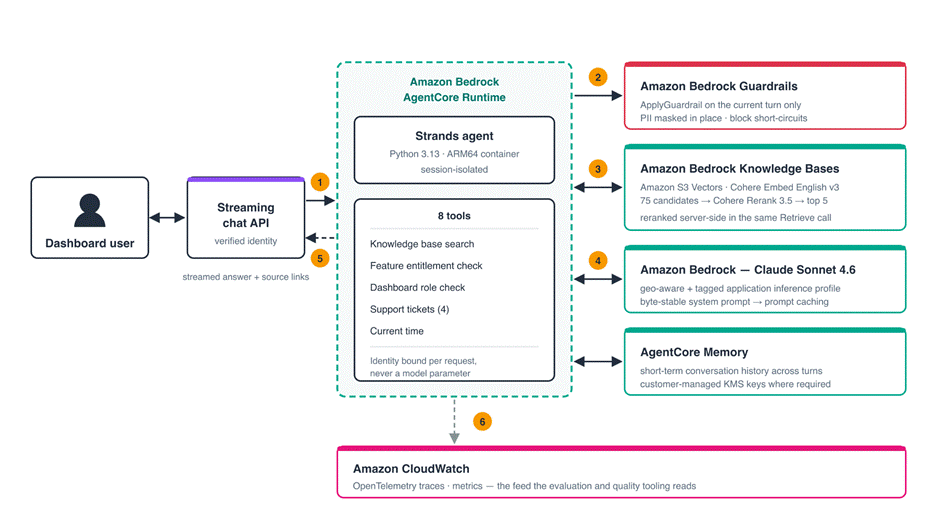
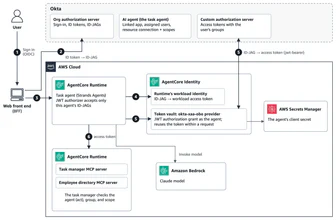
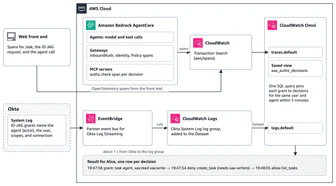
    Taxbit Assist embedded in the Taxbit dashboard, running via Amazon Bedrock AgentCore, requiring user authentication. Intelligently searches for candidate paragraphs in the Amazon Bedrock knowledge base and rearranges them on the server side. Answers must be source attributed and role permission compliant, without providing tax advice. AgentCore manages conversation state in memory, supports regional data residency, and complies with ISO/IEC 42001 standards.

  11. AWS Machine Learning Blog38

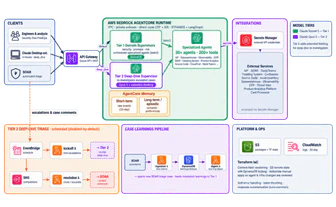
    Greenlight Financial builds an autonomous secure operations center solution based on Amazon Bedrock AgentCore

    Greenlight Financial autonomously processes over 90% of 4,000 security risk cases each month. Its solution, Luna, runs on Amazon Bedrock AgentCore, which includes over 30 specialized agents. Through AgentCore's runtime and memory support for hierarchical multi-agent systems, it achieves second-level security event triage in seconds without human intervention.

  12. Google Developers Blog

    Agent Distraction

    13% of agents are misled by inline TODO(bug/...) or FIXME(bug/...), with 83% of actions completely unguided by developers. 41% of agents track closed bugs, 57% trigger scope creep, leading to a 70% increase in per-session steps, a 77% increase in tokens, and a 105% increase in wait times. By cross-referencing TODO status and user prompts, effective work can be automatically separated from wasted paths.

Nov 6Fri
  1. vLLM Blog72

    REINFORCE Zero: Aligned kernel allows asynchronous RL to train stably under lag 64.

    NVIDIA Research and Inferact's REINFORCE Zero proposes to first align rollout with training kernel, then use unclipped token-level importance sampling to correct weight lag, achieving a training step throughput 2.40 times that of synchronous training under 16 GPUs and 12K updates.

    Why it matters: The paper breaks down the gap between asynchronous RL's rollout and training into two items: weight lag and kernel inconsistency, and proposes an alignment-free, no-trimming importance sampling method after alignment.

  2. Hugging Face Blog58

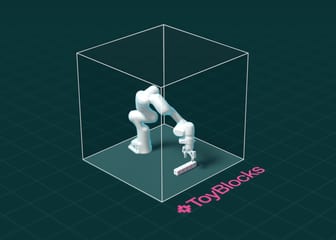
    Hugging Face released ToyBlocks: A controlled world framework for robot learning and evaluation

    Hugging Face released ToyBlocks, a framework for robot learning and evaluation that provides a controlled simulation environment. The framework supports automatically generating tasks and training demonstrations, and includes metrics to measure changes in robot behavior over time, aiming to study how models improve with more training data and how to combine advanced reasoning with precise physical control.

  3. Hugging Face Blog

    Hugging Face Open ASR Leaderboard adds Egyptian and Nigerian English datasets

    Hugging Face Open ASR leaderboard adds Liva AI private datasets for Egyptian English and Nigerian English, containing 1.34 hours and 1.55 hours of dialogue speech, to enhance the representativeness and reliability of ASR evaluation. The leaderboard now supports more detailed accent classification based on the Kachru three-circle model, covering groups such as US and non-US, inner circle and outer circle/extended circle.

  4. LangChain Deep Agents releases15

    LangChain Deep Agents 0.2.5 released

    LangChain Deep Agents 0.2.5 released, fixes bugs related to matching compressed input budget with selected model, retaining truncated responses when `ModelRefusalMiddleware` throws errors, and applying delays to in-app `uv` installation on Windows.

  5. AWS Machine Learning Blog58

    Amazon Bedrock AgentCore has added the Web Answer feature

    Amazon Bedrock AgentCore announced the official launch of the Web Answer feature, which provides synthesized answers to natural language questions with source citations through a single tool call. This feature compresses the entire process of searching, retrieving, synthesizing, and citation extraction into a single request, allowing users to get answers with source URLs in just a few seconds. Web Answer runs on AgentCore Gateway, supports current web information retrieval, and includes built-in responsible AI security mechanisms.

  6. LangChain Deep Agents releases35

    LangChain Deep Agents v0.7.33 released

    LangChain Deep Agents v0.7.33 released, defaulting to error reporting when the model refuses and reporting sub-agent refusal, adding asynchronous sub-agent notification metadata, recording sub-agent checkpoint task call ID. Fixed issues with Python `grep` fallback file range limitation, long result line truncation, and compression failure error reporting, and officially formalized the rubric middleware.

  7. Cursor Changelog78

    Cursor goes live with Live Apps, allowing building and sharing accessible applications within the editor

    Cursor introduces the Live Apps feature, where users describe their needs, and the cloud-based intelligence builds a web application, starts a Postgres database on demand, integrates with Cursor SSO authentication, and completes hosted deployment, generating a shareable link after publication.

    Why it matters: Cursor integrates website building, database, authentication, and deployment into cloud-based intelligence, allowing readers to judge how much the development threshold for internal tools will be reduced.