Skip to content
Live
Oct 23Fri
  1. AWS Machine Learning Blog48

    Amazon Polly Generative engine upgrade: More natural and accurate speech output

    Amazon Polly Generative engine upgrade provides more natural and accurate speech output, adding 14 new voices (across 9 regions), for the first time making Hindi and Finnish generally available. The upgrade is plug-and-play, with unchanged API calls and voice names, so existing applications do not need to be modified. Supports emotion and prosody expression based on text context, with new languages being Hindi (Arjun/Kiara) and Finnish (Suvi), totaling 57 generated voices (11 languages/25 regions), with prices unchanged.


  2. Anthropic Newsroom71

    Anthropic has donated the Agent Skills standard to the Agentic AI Foundation

    Anthropic announced that it is donating the Agent Skills open standard to the Linux Foundation's Agentic AI Foundation (AAIF), a foundation co-founded by Anthropic, Block, and OpenAI. Anthropic had previously donated MCP to it.

    Why it matters: The original text explains the adoption scale and governance transfer of Agent Skills, allowing readers to judge who will maintain this intelligent agent skills standard in the future.

  3. IBM Research Blog22

    Overview of the Qiskit SDK v2.6 release.

    Qiskit SDK v2.6 released, adding compiler pass-manager framework in C API, QPY serialization and custom operations, supporting use in non-Python environments, QPY format upgraded to v18, minimum Python version requirement 3.10, source code build requires Rust 1.89.

  4. Microsoft Research58

    Flint-interactive: A language for creating interactive data visualizations

    Flint-interactive makes AI-generated charts highly interactive, allowing users to explore data through clicks, filtering, zooming, highlighting, and cross-chart interactions. It simplifies the construction of complex interactions through advanced semantic events and update operations, and leverages the Flint compiler to handle interaction logic and visual dependencies, enhancing reliability and development efficiency. Flint-interactive supports creating interactive data stories, dashboards, and connected experiences, enabling AI agents to generate charts with interactive features to help users analyze data more efficiently.

Oct 22Thu
  1. Microsoft Research

    Microsoft researchers and collaborators combined new mathematical ideas with human-guided AI to address the core problem of the KLS conjecture in high-dimensional geometry and probability.

    Microsoft researchers and collaborators combined new mathematical ideas with human-guided AI to prove the KLS conjecture in high-dimensional geometry and probability, which has been proposed for 31 years and widely regarded as the central unsolved problem in the field. AI tools explore candidate methods and perform detailed derivations, researchers evaluate, prune, and reorient the search, ultimately proving geometric principles in high-dimensional spaces, making the barrier no longer grow unbounded with increasing dimensions. Independent researchers confirm the result, identify key criteria, and complete formal verification with machine checking.

Oct 21Wed
  1. OpenAI News62

    OpenAI models will go live on Google Cloud

    OpenAI Collaborates with Google Cloud, Integrating OpenAI Frontline Models and Codex Workflows into Gemini's Model Garden and Offering Through Google Cloud Marketplace

    Why it matters: OpenAI's cutting-edge models and Codex workflow enter Google Cloud's Model Garden, providing a new entry point for cross-cloud distribution for readers to explore.

  2. IBM Research Blog

    IBM vLLM-Hook MIA Plugin enables rapid runtime monitoring and control

    IBM releases vLLM-Hook MIA Plugin, implementing runtime monitoring and control in the vLLM inference engine, 20 times faster than its predecessor vLLM-Hook and 14 times faster than similar methods inserting code inside the model, with only a 2%-6% increase in latency. The plugin allows developers to observe and adjust model states in real-time, such as rejecting malicious prompts, marking hallucinatory facts, or editing response tone and accuracy, while almost not reducing performance.

  3. AWS Machine Learning Blog40

    Fine-tune GPT-OSS-20B on Amazon SageMaker HyperPod for multilingual inference

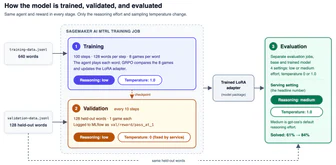
    GPT-OSS-20B is an open-source inference model that thinks in English by default, and only 22% met the target language requirements in multilingual inference tests. By using supervised fine-tuning (SFT) and reinforcement learning (GRPO) on Amazon SageMaker HyperPod, the team can improve the model's inference capabilities in French, German, Spanish, and Italian, where SFT is responsible for primary behavior teaching and GRPO optimizes when there is room for improvement.

  4. Microsoft Research12

    Chris White: From Technical Leader on the Afghanistan Battlefield to Technology and Social Responsibility at Microsoft Research

    Chris White leads the Catalyst Lab at Microsoft Research, who has participated in data analysis projects on the Afghanistan battlefield and was commissioned by DARPA, later turning to develop dark web search tools to combat human trafficking. He shares his cross-disciplinary experience from a Harvard postdoctoral fellow to a military technology leader, emphasizing the importance of problem selection for innovation, and points out that even after witnessing the dark side of human nature, one must still adhere to the belief that technology should be for good.

  5. GitHub Blog · AI & ML33

    How GitHub Copilot continues a session in VS Code

    GitHub Copilot users can directly open a GitHub Copilot app session in VS Code to continue their conversation, code changes, and context. Users can review Copilot's modifications line by line, make manual edits directly in VS Code, and run and validate the project locally. The session and code workspace remain connected, supporting interactive iterative optimization with Copilot, and finally submitting updates to the associated pull request.

  6. Amazon Science

    Amazon partners with AVERI, an independent third-party, to strengthen AI security assessments.

    Amazon collaborates with AVERI to independently review internal security assessment datasets, verifying the comprehensiveness, diversity, and low contamination risk of the assessment process, but also found room for improvement in language style, attack complexity, and assessment timeliness. Amazon has updated the test set based on feedback, introduced a difficulty grading framework, established a quarterly review mechanism, and expanded language coverage, which is seen as the best practice for evaluating the quality of AI security assessment processes.