Skip to content
Live
Oct 29Thu
  1. Hugging Face Daily Papers

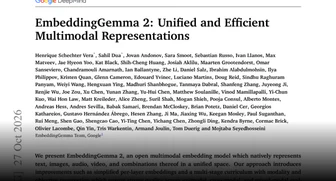
    EmbeddingGemma 2: A Unified and Efficient Cross-Modal Representation Model

    EmbeddingGemma 2 is an open-source multimodal embedding model that unifies text, image, audio, and video representations in an efficient and resource-flexible design, and performs excellently in benchmark tests. It has established a new Pareto frontier in embedding benchmark tests for all modalities, outperforming professional models and other models that are two to twelve times larger in scale. The model supports selective modality encoder loading, adjustable visual token budgets, truncatable embedding dimensions, and quantized weights to adapt to resource-constrained environments.
  2. Hugging Face Daily Papers

    Falcon audio-visual target speaker extraction model released

    Falcon is a causal audio-visual target speaker extraction model that extracts the voice of the target speaker from the mouth video of the target speaker in noisy overlapping speech, combined with a single multi-scale time-frequency separator and an encoder spatial speaker contrast loss, reducing interference speaker leakage without increasing inference cost.

  3. Hugging Face Daily Papers65

    DTCA: A Noise-Aware Label Credit Assignment Framework for Diffusion Language Models using Reinforcement Learning

    DTCA performs label-level credit assignment through confidence enhancement and entropy calibration, improving the mathematical reasoning ability of diffusion language models. The framework, when tested on LLaDA-8B-Instruct, shows significant performance improvement in mathematical reasoning under different generation budgets, with the MATH500 metric increasing by 9.0 points and the GSM8K metric improving by 5.3 points.

  4. Hugging Face Daily Papers

    Explore human feedback driven recursive self-improvement in RSI Arena

    RSI Arena demonstrates that autonomous AI intelligence can independently use human feedback to train and iteratively improve language models. Most agents achieved preference gains in the second phase, although benchmark test improvements were limited. Ten cutting-edge models were used as training agents, starting from NVIDIA Nemotron 3.5 Lightning 30B-A3B Base, which independently selected data, implemented training, and selected checkpoints in the first phase within six days, using a 64-GPU cluster and 300 USD API credits.

  5. ITHome · AI

    The first batch of extreme weather AI models for the Fengyun meteorological satellites were released, generating a typhoon 'health report' in 27 seconds.

    The first batch of extreme weather AI models for the Fengyun meteorological satellites were released, with the typhoon intelligent cloud map interpretation model interpreting every 15 minutes and generating typhoon analysis text in 27 seconds; the short-term warning model for strong convection, combined with observations from Fengyun-4 satellite, will advance the warning time to four hours.

  6. AWS Machine Learning Blog58

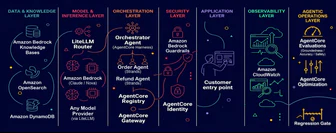
    Build an enterprise-grade agent platform based on Amazon Bedrock AgentCore

    Amazon Bedrock AgentCore provides modular services such as runtime, gateway, identity, memory, policy, registration, and evaluation, supporting large-scale agent construction, deployment, and operation. The enterprise-grade agent platform blueprint based on AgentCore adds enterprise-level constraints such as ownership, account boundaries, software delivery, observability, cost governance, and retirement, achieving controlled access through inference gateway and tool gateway, and including an evaluation process to ensure agents are validated before production deployment.

  7. Hugging Face Daily Papers

    EvidenceConnect framework and Zooming without Zooming v2 model released

    The EvidenceConnect framework generates comparative, aggregated, or chained visual evidence queries by synthesizing image region thumbnails, enhancing the evidence connection capability of VLMs. The ZwZ2 model is trained based on this framework, without targeting any downstream benchmarks but improving fine-grained and spatial perception, and achieving progress in embodied spatial reasoning, multimodal long-context understanding, multimodal agent tasks, and general visual reasoning

Oct 28Wed
  1. Hugging Face Daily Papers

    Decomposition Vector Quantization Technology Enhances Discrete Visual Token Quality

    Decomposition Vector Quantization Technology enhances discrete visual token quality by using parallel codebooks on complementary feature views, enabling it to match continuous representations in multimodal understanding. Models trained on industrial-grade multimodal data outperform UniAR and Emu3-Chat by 22.8% and 59.2% on average across nine metrics, making it the first discrete representation model capable of competing with strong continuous representation models like Qwen3-VL.

  2. Hugging Face Daily Papers65

    Memory Tax: Analyzing the net value of intelligent agent memory

    Large-scale evaluations show that dedicated memory systems are often weaker than simple retrieval-enhanced generation. The Memory Benefit and Memory Tax framework is introduced to evaluate the net value. Memory is becoming increasingly common in long-term intelligent agents, but the net value of building memory compared to directly retrieving from raw history remains unclear.

  3. Hugging Face Daily Papers

    The Trinity framework: Capability-driven recursive self-improving multi-modal agents

    The Trinity framework improves multi-modal agent performance by organizing tasks into capability trees, generating simulated training worlds, routing professional Harness modules, and recursively refining multi-modal agents, achieving a mean performance improvement of 34 and 26 points on 28 training benchmarks and 18 unseen benchmarks, including two real-world embodied tasks.

  4. Hugging Face Daily Papers

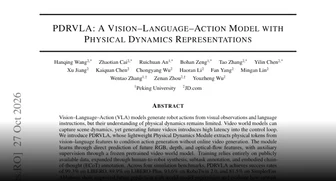
    PDRVLA: A Visual-Language-Action Model Integrating Physical Dynamics Representation

    PDRVLA improves robot action generation by integrating a lightweight physical dynamics module that predicts future visual features under the supervision of a physical world model, avoiding latency caused by online video generation. PDRVLA achieves success rates of 99.3% (LIBERO), 89.9% (LIBERO-Plus), 93.6% (RoboTwin~2.0), and 81.5% (SimplerEnv) on four simulation benchmarks.

  5. Hugging Face Daily Papers65

    Extended Research on Looped Transformers with Truncated Backpropagation: Should the training loop be truncated?

    Looped Transformers train better than truncated backpropagation with the same computational cost through full backtracking, extended regularity shows that when the model size is adjustable, two loops are the best. Looped Transformers increase computational depth by reusing shared layers without increasing the number of trainable parameters, usually using backtracking training (BPTT), but are often truncated to the last few loops to save training computational cost, which may lead to gradient bias and weaken the loop advantage.

  6. Hugging Face Daily Papers65

    HABIT-Bench released: Evaluating the ability of agents to learn habits from longitudinal weak evidence

    HABIT-Bench evaluates an agent's ability to learn habits from synthetic user histories involving hundreds of interactions, requiring the agent to integrate scattered evidence and choose appropriate actions for new requests. Using Qwen3-235B-A22B and GLM-5.3-Flash, eight memory methods were evaluated, with the best configuration achieving a macro-average accuracy of 33.61% in a four-choice task, outperforming random guessing at 25%. Even with labeled evidence, there were still numerous errors, indicating that understanding how to guide decisions is more important than simply recalling history.

  7. Hugging Face Daily Papers65

    CodeCap-Bench: Can executable code serve as high-quality video subtitles?

    CodeCap-Bench demonstrates that code captions outperform natural language captions in terms of reasoning accuracy and reconstruction fidelity on video question answering and reconstruction tasks. The benchmark includes 323 structured 2D content videos, covering five categories. Evaluation finds that mainstream closed-source MLLMs perform well in code caption generation but struggle to capture complex temporal dynamics, while open-source models have a significant gap.

  8. Hugging Face Daily Papers

    How to Harness Self-Evolution: Adapting Skills to Improve Personal Evolution

    Harness Self-Evolution improves LLM agents by guiding skill adaptation without parameter updates, enhancing the performance of weak models. The study found that skills are beneficial for strong models but potentially harmful for weak models. In seven models and three benchmark tests, 103 task-skill pairs improved GPT-5.6-luna by 31.1 points but reduced Gemma-4-E4B by 8.8 points.

  9. Hugging Face Daily Papers65

    ThinkWorld model enhances dynamic reasoning ability through world imagination

    The ThinkWorld model enhances robot generalization by representing actions as dynamic chains and learning from unlabeled human videos using world imagination. This VLA framework represents each action reasoning as a dynamic reasoning chain (CoD), combining reinforcement learning with world imagination to reinforce reasoning, allowing unlabeled videos to provide direct supervision for state transitions, achieving a shared reasoning space for human and robot experiences. Experiments prove its effective implementation of human-robot transfer and generalization to unseen tasks and environments on both simulation and real robots.

  10. Hugging Face Daily Papers

    OvisOCR3 Technical Report

    OvisOCR3 is a 0.8B visual language model that unifies multiple OCR tasks through multi-mentor distillation and reinforcement learning, achieving SOTA results on document parsing, general OCR, key information extraction, image-text description, and cross-page table reconstruction tasks. It scored 96.74 on OmniDocBench v1.6, ranked first in OCRBench v2 English and Chinese split, and surpassed baseline models in multiple benchmark tests.

  11. Hugging Face Daily Papers42

    Rollback: An Improved Method for Strategy Rollback in World Models

    Rollback improves robot strategies by using world models to backtrack to past decision points, explore counterfactual actions, and generate fine-grained supervision, while constantly refining dynamics through real-world feedback. This method transforms world models from passive simulators into counterfactual engines, significantly improving success rates on real-world tasks and surpassing the average success rate of human players within 8 hours.

  12. Hugging Face Daily Papers65

    LociArt: A Unified Free-Style Local Video Styling Paradigm

    LociArt achieves precise local video stylization through generating refined networks, automated dataset construction, and dedicated benchmarks, supporting regional style control and temporal consistency. GRNStyle introduces a polarity-aware style perception mask on the basis of generating refined networks, combined with representation-geometric conditioning technology. Experiments show that it outperforms existing methods in regional style quality and spatial control. The LociArt-100K dataset contains 100,000 local stylization pairs, the benchmark includes 80 source videos and 84 target masks, using a style prototype similarity evaluation scheme.

  13. Hugging Face Daily Papers

    ChronoReplay training framework enhances the spatiotemporal reasoning ability of streaming visual language models.

    ChronoReplay training framework organizes heterogeneous spatiotemporal supervision into time-ordered interaction segments, preserves specific task answer formats, and balances learning from different supervision signals, enabling a single model to learn complementary spatiotemporal capabilities while maintaining temporal consistency. It achieves improvements on OVO-S-Bench, OST-Bench, and UCS-Bench benchmarks, with a 13.41-point increase on OST-Bench, while optimizing streaming inference performance through adaptive frame selection.

  14. Hugging Face Daily Papers

    Hy-Nomas: A Video World Model for Free-Form Interactive World Generation

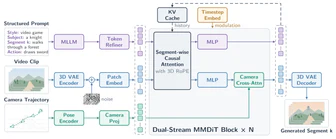
    Hy-Nomas is an 8B parameter diffusion model that supports free-form text instructions and camera control across multi-round interactions. It follows multi-round text and camera instructions by combining causal attention with structured video descriptions, outperforming existing world models in human evaluations. The model weights, code, and benchmarks are open-sourced.

  15. Hugging Face Daily Papers

    Trustworthy Recursive Self-Improvement in the Era of Large Models: Foundations, Risks, Evaluation, and Open Challenges

    This review defines Recursive Self-Improvement (RSI), organizing trustworthy improvement requirements into supervision for improvement effectiveness, constraint maintenance, and recursive update phases. AI systems increasingly use experience and feedback to make persistent changes to models, prompts, memory, tools, and workflows around large models.

  16. Hugging Face Daily Papers65

    HiP3R: Hierarchical Pose Graph for Long-Term 3D Reconstruction

    HiP3R uses hierarchical pose graphs to reconstruct and merge local videos into globally consistent camera trajectories and 3D geometry without retraining. It first optimizes robust block-level Sim(3) graphs to establish global layout and scale, then fixes this layout and estimates shared SE(3) cameras for each frame, converting overlapping window predictions into a single trajectory. Experiments on multiple benchmarks prove HiP3R's effectiveness in improving camera trajectories and 3D reconstruction, and it is applicable to both block-based and streaming backends without additional training or fine-tuning.