Skip to content
Live

Open source · Page 2

Nov 5Thu21–40
  1. ITHome · AI74

    Baidu Wenxin has open-sourced the ERNIE 5.5 Flash Base base model, with a total parameter of 280B.

    Baidu Wenxin has released ERNIE-5.5-Flash-Base and opened the ERNIE 5.5 Flash pre-trained endpoint weights. This is a sparse MoE language model with a total parameter of 280B and 14B activation per token. It was pre-trained from scratch on 33.5T tokens and supports fine-tuning and inference with a context size of up to 1M tokens.
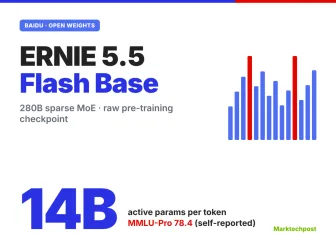
    Why it matters: The original text provides the parameters, training data size, and open-source weights of the 280B sparse MoE base, allowing readers to judge its adaptability as a fine-tuning starting point.

  2. vLLM Blog71

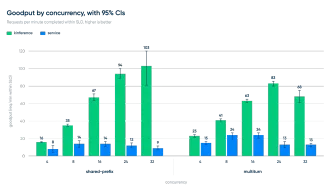
    Buoyant Open Sources Kinference: An Inference Control Plane for vLLM and Kubernetes

    Buoyant releases open-source project Kinference, as an inference control plane for vLLM and Kubernetes, providing token rate limiting, tenant usage and cost tracking, KV cache-aware load balancing, and inference strategies.

    Why it matters: The original text provides benchmark comparisons and YAML strategy examples for KV cache-aware load balancing, which can be used to judge how to design the routing layer of the reasoning platform.

  3. Databricks Blog60

    Apache Spark 4.3 was released, and Databricks Runtime 19 is now available.

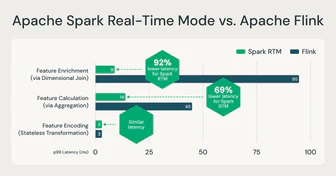
    Apache Spark 4.3 was released and is available in Databricks Runtime 19, with the Real-Time Mode now adding stateful processing, supporting streaming aggregation, dropDuplicates, and transformWithState.

    Why it matters: The original text provides three benchmark latency data for real-time stateful processing and the changes in the quarterly release rhythm, allowing readers to judge the trade-offs of the stream processing architecture.

  4. ITHome · AI78

    The dark side of the Moon releases Kimi K3.1 Pro weights, topping the Agent Arena open-source model list

    As promised on October 24, the 2.8 trillion parameter Kimi K3.1 Pro model weights have been opened on Hugging Face.

    Why it matters: The original text provides the Agent Arena rankings and changes in individual indicators after the open weights, which can be compared with the previous generation K3 to see the improvement in agent capabilities.

  5. AWS Machine Learning Blog60

    The four-layer context engineering of production-level AI agents: The practice of Deep Insight in runnable code.

    The AWS team, referencing the open-source multi-agent data analysis solution Deep Insight, has broken down the context engineering of production-level AI agents into four layers: multi-agent architecture isolation of context, using prompts to limit output, externalizing heavy content to the file system, and using a validation agent with a fallback mechanism.

    Why it matters: The AWS team has broken down the context engineering into four layers and provided specific code and token-saving data from the open-source reference implementation, which can be directly used to modify your own Agent.

  6. vLLM Blog75

    vLLM provides Day-0 support for Kimi K3.1 Pro

    vLLM announces Day-0 support for the open-sourced Kimi K3.1 Pro on NVIDIA, AMD, Google TPU, and Alibaba's Zhenwu PPU, a 2.8T parameter (104B activation) multimodal MoE model with 1M context tokens.

    Why it matters: The vLLM team details the engineering trade-offs for Day-0 adaptation of Kimi K3.1 Pro, including specific numbers for sparse attention, KV cache packing, and DCP.

Nov 4Wed
  1. OpenHands Blog71

    OpenHands and Snowflake introduce a workflow for training models using their own Agent harness

    OpenHands partnered with Snowflake AI Research, allowing developers to directly use the existing OpenHands Agent harness for reinforcement learning and training without rebuilding the harness in the training framework.

    Why it matters: The original text provides specific configuration methods and code locations for directly using the existing Agent harness for RL training, allowing readers to judge whether training and deployment can share a single harness.

  2. Hugging Face Blog60

    IBM trains 20B small model Palette to generate slides according to its own design language

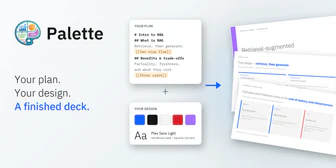
    IBM's research team fine-tunes a 20B open-source weight model, Palette, using a two-role LoRA scheme where designers write JSON briefs and encoders generate pptxgenjs code page by page to create presentations according to IBM Design Language.

    Why it matters: IBM uses synthetic data and checks to repair closed-loop training for a 20B small model to create presentations, providing a method that can be transferred to other structured outputs.

  3. Hugging Face Blog62

    The same model with a different harness: Comparing CUGA, Hermes, and Deep Agents on AppWorld.

    The IBM team compared CUGA, Hermes, and Deep Agents using the same open-source weight model GLM-5.3-flash on 90 tasks in AppWorld, with pass rates of 81.1%, 46.7%, and 30.0%, respectively, and 20, 8, and 2 scenarios where all three variants passed.

    Why it matters: With the same model but a different harness, the task completion rate increased from 30% to 81%, and reproducible configurations and evaluation links were provided in the text.

Nov 3Tue
  1. Anthropic Research62

    Anthropic has released the verifiable reasoning system FlashProve, generating proofs at approximately 110 tokens/second on a single H100.

    Anthropic announced the verifiable reasoning prototype FlashProve, using zkSNARK to prove that the response indeed comes from the committed model weights. For the 400B parameter Llama 4 Maverick (4-bit quantization), a single H100 generates proofs at approximately 110 tokens/second, with proofs for each 1,024 token request being about 19 MB, and verification on a 24-core CPU taking about 17 seconds.

    Why it matters: Anthropic has released the measured data and Lean formal proof of the verifiable reasoning prototype FlashProve, allowing for a cross-comparison with existing zkML solutions.

  2. The Decoder73

    50 AI agents spontaneously form bureaucratic collaboration in Minecraft

    The research team placed 50 GPT-6.1 Sol agents into a Minecraft survival world and ran them for three hours, only giving the instruction 'build a prosperous civilization'. The agents cut down all the trees near the spawn point in 90 seconds, exchanged about 5900 messages in total, and spontaneously elected 'Ada' as the leader in alphabetical order of the directory.

    Why it matters: The experiment placed 50 agents into Minecraft and Mindustry to observe their spontaneous organization behavior in collaboration and competition, and the test environment was open-sourced.

Nov 1Sun
  1. QbitAI78

    DeepSeek has open-sourced the Super-agent architecture, disclosing the underlying concept of Personal Agent.

    DeepSeek has open-sourced the Super-agent prototype, disclosing the dual architecture concept for Personal Agent, where the upper-layer Router handles message reception and task coordination, and the lower-layer Worker executes tasks in parallel.

    Why it matters: DeepSeek has publicly disclosed the dual architecture of Personal Agent and actual test data, showing how multi-session collaboration can bypass human attention bottlenecks.

Oct 31Sat
  1. MarkTechPost72

    Vercel Labs has open-sourced agent-desktop, enabling agents to operate desktop applications through the system's accessibility tree.

    Vercel Labs has released an open-source CLI tool, agent-desktop, which allows AI agents to read and operate native applications on macOS, Windows, and Linux by accessing the operating system's accessibility tree, rather than relying on screenshots.

    Why it matters: The original text compared the differences between agent-desktop based on accessibility trees and screenshot-based computer use in terms of token consumption and cursor usage, and provided self-reported data.

  2. QbitAI78

    FaceWall AI's ForgeKernel live stream generated an operator from scratch, 9.8% faster than DeepSeek FlashMLA and announced open-source.

    FaceWall AI's operator generation system ForgeKernel generated the DeepSeek-V4.1 FlashMLA Prefill operator from scratch on an NVIDIA B200, with a final time of 472 microseconds, 9.8% faster than FlashMLA's 518 microseconds. The entire process took 22.5 hours, 42 iterations, and 32 versions, using 1 B200 and 22 GPU hours.

    Why it matters: The original provided live stream iteration data and Ascend 3 benchmark results can be used to judge the path of operator generation shifting from manual tuning to intelligent agent self-evolution.

  3. QbitAI72

    Zhiyuan releases GO-3 Preview and WITA-OMNI dual models and introduces Worken labor unit

    Zhiyuan released the embodied base model GO-3 Preview and the full-modal interactive large model WITA-OMNI at the Innovation Day. The former topped the RoboDojo, RoboTwin, and RoboColiseum rankings, while the latter led the Daily-Omni, TimeLens-Bench, EmbSpatialBench, and MMAU rankings.

    Why it matters: Zhiyuan provides dual model rankings, tri-intelligent hardware, and an open-source OS plan at once, allowing comparison with its production line test data to judge the implementation level.

Oct 30Fri
  1. ITHome · AI78

    Xiaomi open-sources 0.8B document understanding model Xiaomi-OCR-0, supporting Markdown and JSON output

    Xiaomi open-sources lightweight document understanding model Xiaomi-OCR-0, with 0.8B parameter size, weights and inference code have been uploaded to Hugging Face and GitHub, a single model covers three tasks of document parsing, key information extraction, and OCR visual question answering.

    Why it matters: 0.8B parameters rank second on the overall list in OmniDocBench v1.6, and weights, MCP services, and Skill toolkits are also opened, which can be used to judge the boundary of small models for document parsing.

  2. QbitAI75

    The domestically developed open-source OXR tops three document parsing benchmarks with 1.3B parameters.

    The SoMark team has open-sourced the 1.3B document parsing model OXR, ranking first on three benchmarks: OmniDocBench (97.18), olmOCR-Bench (87.84), and DocParsingBench (87.76).

    Why it matters: 1.3B model trained with RSI ranks first in three document parsing rankings, and provides engineering trade-offs between plug-in architecture and free API.

  3. ITHome · AI74

    Qwenputer Launched: Embedding the RISC-V CPU instruction set into the model, AI arithmetic no longer relies on external tools

    Developer Divyansh Agrawal released the experimental model Qwenputer on October 22, built based on Alibaba's Qwen3.5-4B, which implements 32-bit RISC-V CPU and memory functions inside the neural network, allowing program execution and precise calculations without calling external tools like Python.

    Why it matters: Developers compiled the RISC-V instruction set into the Qwen3.5-4B weights, demonstrating with specific benchmark numbers the improvement in computational precision within the model and the trade-offs in volume and speed.

  4. ITHome · AI78

    Zhiyuan released the embodied model GO-3 Preview, topped three major lists, and plans to open source by the end of 2026.

    Zhiyuan launched the embodied model GO-3 Preview on October 29, adopting an embodied-native WRAM architecture that connects task reasoning, future prediction, and action generation, and has topped the three major evaluation lists: RoboDojo, RoboTwin, and RoboColiseum. It plans to fully open source by the end of 2026.

    Why it matters: The deployment data provided by the original text shows a success rate of real-life convenience store tasks ranging from 28.6% to 85.7%, which can be observed as the path of online self-improvement of embodied models.

  5. Epoch AI88

    Epoch AI: GLM 5.3 can break multiple Firefox versions during the patch window period.

    Epoch AI's experiment shows that the open-source weight model GLM 5.3 released by Z.ai in August can autonomously construct web attacks targeting six Firefox versions released between September 17 and October 26, exploiting publicly available but not yet pushed security fixes, where visiting the web page causes local files to be read and transmitted.

    Why it matters: Epoch AI replicates patch window attacks using open-source weight models, providing a cost level of about 1000 US dollars per version, available for evaluating the security boundaries of open models.