Skip to content
Live
Nov 9Mon
  1. MIT News · AI52

    WorldParticle: A single AI model simulates the behavior of multiple materials

    The WorldParticle model can simulate various material behaviors, from sliding sand to folded proteins, by decomposing objects into thousands or millions of three-dimensional particles and using neural networks to predict their motion without needing to write specific equations for each material and process. The model offers higher accuracy than numerical simulation methods in simulating deformable objects, granular materials, and proteins, and can optimize computational efficiency through hybrid techniques.

  2. Hacker News · 300+34

    BenchUp – Open source SketchUp alternative built with Rust and WebGPU

    BenchUp is a free and open-source 3D modeling application for woodworking and furniture design, available on Windows, macOS, Linux, or desktop browsers. Users can accurately measure and plan shelves, tables, cabinets, or workbenches, support drawing lines, rectangles, circles, and freehand outlines, create shapes through Push/Pull tools, and add dimensions and grouping. The project is developed based on Rust and WebGPU, using the MIT license, and is free to use without an account.

  3. Simon Willison65

    Hide the redundant information of Claude Code PR descriptions: Use HTML details/summary elements to optimize the code review experience.

    Claude Code or Codex generated PR descriptions are too verbose, but hiding them in HTML details/summary elements can optimize the reading experience. Use the model name and effort level as the summary, for example, 'Claude Opus 5.5 Medium', so readers can quickly get the core information. GitHub Markdown supports this feature; click the expand arrow to view the full content, making the PR no longer appear messy.

  4. ITHome · AI65

    Anthropic releases report: Scientists mainly use Claude for data analysis and writing

    Anthropic released a research report showing that scientists primarily use Claude for data analysis and writing, while less frequently using AI for collecting data and generating research hypotheses. The research is based on 207,000 scientific research session data from August to September 2026, with the highest usage rates in the fields of computer science, mathematics, and statistics. Data analysis accounts for 33.7% of Claude's scientific research sessions, while writing and communication account for 32%.

  5. ITHome · AI60

    LG AI Research Institute announces the free opening of the K-EXAONE 2.5 model API to the public

    LG AI Research Institute has opened the K-EXAONE 2.5 model API for free, allowing any user to use it at no cost for development and research. This self-developed model enhances the capabilities of the intelligent agent through additional training and performs equally well as DeepSeek-V4.1-Flash and GLM-5.3 in benchmark tests such as AutomationBench and SWE-Bench Pro.

  6. Hacker News · 300+78

    llama-modchip enables the 284B DeepSeek-V4-Flash to run on a 64GB memory without GPU

    llama-modchip releases a set of ggml/llama.cpp core patches and quantization transcoding tools, compressing the 284.33B DeepSeek-V4-Flash to 56.56 GiB (1.71 bpw), which can run on a pure CPU machine with 64 GB memory, with a peak memory of 57.61 GiB under 256K context and no need for swap.

    Why it matters: The project provides a quantization scheme and core patches for running 284B MoE on 64 GB memory, along with measured data for each hardware, which can be used to determine the feasible boundary for pure CPU deployment.

Nov 8Sun
  1. MiniMax · Hugging Face new models

    MiniMax-H3-Image-PE provides hint extension functionality

    MiniMax-H3-Image-PE uses prompt expansion (PE) to convert short requests into detailed image descriptions and recommends aspect ratios. It supports two workflows: text-to-image (T2I) and image editing, using fine-tuned FP4 weights from Qwen3.8-27B. The online API can be accessed via platform.minimax.io or platform.minimax.cn, and the documentation provides support in both Chinese and English.

  2. ITHome · AI50

    Hitch Open physical intelligence open-source platform is launched at the CIIE, breaking the AI robot ping pong dueling world record

    Hitch Open platform breaks AI robot ping pong dueling world record to 142 hits, jointly created by a team from Shanghai Jiao Tong University and the platform; the platform is aimed at real physical environments, dedicated to solving the challenges of AI perception, decision-making, and action in complex physical worlds, promoting the development of autonomous driving, embodied intelligence, and robotics technology.

  3. ITHome · AI67

    OpenAI GPT-6.1 Sol involved in live mouse brain surgery: Continuous operation three times, positioning error halved

    OpenAI GPT-6.1 Sol performed three consecutive operations in the brain of a living mouse during surgery, improving its localization performance based on surgeon feedback, reducing the time from 169 seconds to 86 seconds, and reducing the localization error from 0.6 mm to 0.3 mm, a 50% reduction in error. The research team had the model participate in localization tasks for two key anatomical landmarks, Bregma and Lambda, on the surface of the mouse skull. Images, data, and correction records were saved after each operation for future reference.

  4. OpenAI Agents SDK releases22

    OpenAI Agents SDK v0.24.0-alpha.7 released

    OpenAI Agents SDK v0.24.0-alpha.7 released, supports classic workflows and native execution, adds voice and managed tools, introduces persistent session storage and context control. The new version defaults to strict mode execution, requiring updates to existing environments; bundled model default inference strength is increased to medium.

  5. MarkTechPost58

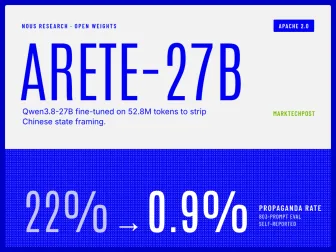
    Nous Research releases Arete-27B, reducing the promotional content of Qwen3.8-27B from 22% to 0.9%

    Nous Research has released Arete-27B, a 27B parameter model with open-weight quantization, which removes promotional content about China from Qwen3.8-27B through supervised fine-tuning. In 803 prompt evaluations, the promotional content ratio decreased from 22% to 0.9%, while retaining the agent skills of the Qwen class and being free from political bias.

  6. ITHome · AI65

    Sony launched the 'dual-path visual information fusion in-vehicle passenger dizziness detection' technology

    Sony globally launched the 'dual-path visual information fusion in-vehicle passenger dizziness detection' technology at the CIIE, which predicts passenger dizziness levels by analyzing the front road view and rear seat screen content. The evaluation results can be used to remind drivers to reduce hard braking or turning, or to recommend visually less changing content for content platforms. This solution reuses the ADAS front view camera and does not require a new rear seat camera.

  7. ITHome · AI65

    The remastered version of 'The Legend of Zelda: Ocarina of Time' runs on jailbroken PS5 and iPhone

    After the Nintendo 'The Legend of Zelda: Ocarina of Time' remastered version launched on Switch 2 on November 5, developers have successfully run it on jailbroken PS5 and iPhone. The PS5 version is based on the EglantinePS5 project, with a frame rate of about 15-20 FPS under the 12.40 firmware, but there are memory issues and rendering problems, with the patch written by Claude.

  8. Hugging Face Daily Papers65

    VisSearch-Bench evaluates the performance of multimodal agents in long-term visual search

    VisSearch-Bench evaluated the performance of 16 multimodal models on 204 human-written visual search tasks that require integrating visual context with external information, with the results showing that the best system only fully solved 26.47% of the tasks. The benchmark covers 7 major areas, including set-based visual search and sequential visual search, and evaluates task completion and the correctness of reasoning steps through accuracy and process scoring.

  9. MarkTechPost65

    How to use llama.cpp to run NVIDIA Dory 4B: Step-by-step guide

    Use llama.cpp to run the NVIDIA Dory 1.0 4B model, which achieves inference enhancement through repeated intermediate layer calculations. Each additional loop increases computational load without increasing parameters. Build the specified branch of llama.cpp, download the 3.7 GB GGUF file, analyze the parameters and cache consumption per loop, test decoding speed and cache impact, and evaluate accuracy, answer length, and inference time changes with loop counts on GSM8K.

Nov 7Sat
  1. ITHome · AI65

    GitHub introduces a new Git storage architecture Rubicon: supports 5000 intelligent agents collaborating concurrently, processing 7200 pushes per second

    GitHub releases a new Git storage architecture Rubicon, internal testing supports a single code repository to accommodate 5000 intelligent agents for concurrent collaboration, processing 7200 pushes per second, and has now launched a small-scale targeted internal test, planning to gradually expand the scope of opening in early next year.

  2. The Decoder72

    Why it matters: The original text provides a comparison of the promotional rate and fact accuracy rate before and after fine-tuning, allowing readers to judge whether the political tendency of Chinese open-source models only stays on the surface.

  3. MarkTechPost60

    Buoyant releases Kinference: an open-source Kubernetes and vLLM inference control plane

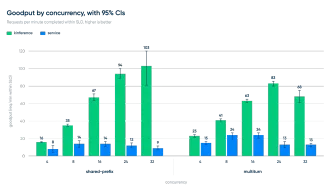
    Buoyant has released Kinference, an open-source Kubernetes and vLLM inference control plane, with the current version being v0.1.0-alpha.7. It distributes requests in front of vLLM worker nodes through routing policies, token rate limiting, KV cache-aware load balancing, and tenant-specific metrics. In benchmark tests, for shared prefix workloads, the median TTFT decreased from 6.88 seconds to 0.31 seconds (95%).

    Same story · 2 outlets

    How the accounts differ:vLLM Blog mentions token limit, tenant usage and cost tracking, while MarkTechPost specifies token rate limiting and tenant metrics.

  4. ITHome · AI67

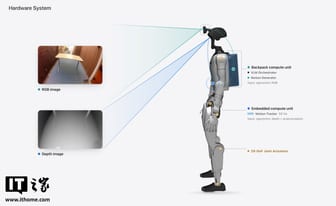
    Apple reveals the humanoid robot system HALO: using the Qwen model to validate on the Yushu G1, achieving an average success rate of 91% for single tasks.

    Apple's research team reveals humanoid robot autonomous control system HALO, with an average success rate of 91% in 360 single task tests in 6 real environments; the system calls the Qianwen model for verification on the Yushu G1, achieving an average success rate of 70% in 10 tests of 3 combinations in a single long sequence compound task, and a success rate of 50% in the most complex task.

  5. Hugging Face Daily Papers65

    Drex open-source decision model released

    Drex open-source decision model returns the probability distribution of user options without autoregressive decoding, using supervised fine-tuning, RLAF, and consistency loss to improve accuracy, robustness, and latency. Its 35B parameter Max version achieves an industry-leading score of 67.52 on Decision Index 0.4.1, with a response time only 9% of GPT-6 Sol and 5% of Claude Opus 5.5.

  6. ITHome · AI58

    Apple iOS 27.2 introduces SynthID invisible watermark for AI image tools

    Apple introduces SynthID invisible watermark for some Apple Intelligence image tools (iPhoto, Image Magic Wand, and Clean Up, Extend, and Space Reconstruction in Photos) in iOS/iPadOS/macOS 27.2. It is invisible to the human eye but can be read by the SynthID detector. Users can check if an image has a watermark at synthid.com; this technology supports pixel-level annotation of real image data to prove photo authenticity.

  7. 36Kr · AI65

    Qilinbo raises tens of millions in Angel Round funding, developing robot brains based on OpenHarmony

    Chengdu Embodied Brain Company Qilinbo recently completed tens of millions of RMB in Angel Round funding, with investors including Chengdu Fangcun Engine Technology Co., Ltd. and Angel Investors. Qilinbo was established in December 2025, focusing on core software for embodied intelligence, with core directions being robot autonomous action and multi-machine cooperation. Its embodied robots can be equipped with the OpenHarmony system, and its technological differentiation lies in OpenHarmony, domestic computing platform adaptation, and local model deployment.

  8. QbitAI42

    PPIO Sandbox: Equip Personal Agent with a dedicated 'cloud computer'.

    Personal Agent is user-centric and needs to support long-term operation and proactive advancement, therefore it must be equipped with a dedicated 'cloud computer'. Current mainstream solutions include local operation (involves security risks and offline issues) and cloud operation (self-built by large companies or third-party hosting). PPIO Sandbox provides a ready-to-use, secure isolation, supports long-term operation and large-scale users cloud execution environment as an API for developers to use, helping to develop Agents for scenarios such as personal office, research, and programming assistants.

  9. ITHome · AI58

    Planet AI app released: Combining large language models with ten years of satellite imagery, allowing users to naturally query Earth's changes

    Planet AI app launched, users can naturally search, observe, and analyze changes in Earth's surface over ten years; currently free to use, AI conclusions are based on viewable raw satellite imagery; supports three core capabilities: 'Search Earth', 'Explore Changes', 'In-depth Analysis', and has been used in ecological conservation, land management, etc.

  10. ITHome · AI65

    Anthropic research claims Claude AI can become smarter by 'dreaming'

    Anthropic releases research stating that Claude AI agents can improve long-term task performance through a 'dreaming' mechanism, reflecting on historical records, correcting errors, and building knowledge structures during idle time. Claude Opus 5.5 and Sonnet 5.5, after using memory in CL-Bench database question-answering tasks, achieve average scores of 0.838 and 0.833 respectively, outperforming the memoryless baseline of 0.655 and 0.644.

  11. ITHome · AI62

    AI programming tool Amp launches Spaces: Your AI project manager is online, autonomously arranging / coordinating Agent tasks

    Amp introduces the Spaces feature, where the main Agent can automatically generate and coordinate multiple parallel Agent threads to complete projects. Each Space allows teams to plan, execute, and track tasks within a single chat, with the main Agent responsible for goal decomposition and progress organization, while developers only need to define goals and review results.