Skip to content
Live
Oct 27Tue
  1. Hugging Face Daily Papers

    Δτ-Bench Released: Evaluating the Ability of Agents to Adapt to Dynamic Tool Ecosystems

    Δτ-Bench evaluates the ability of agents to adapt to dynamic tool ecosystems, finding that the current strongest model only achieves a 42.3% task success rate. Δτ-Bench includes 1,588 multi-round tasks across 42 domains and 6 ecosystem states. Steward achieves higher task success rates in ecosystem changes through incremental skill maintenance and dynamic resource allocation.


  2. NVIDIA Blog

    C-BRAIN and NVIDIA are jointly using AI to accelerate dementia research

    C-BRAIN and NVIDIA are using AI to change the pace of dementia research. They are accelerating the development of new therapies by integrating previously unpublished Alzheimer's research data, including unpublished results and controlled proprietary data. C-BRAIN employs a hybrid centralized and federated architecture to protect data privacy, deploying 64 NVIDIA data center GPUs and cloud nodes, and plans to introduce the NVIDIA Blackwell system to support its expansion goals.

  3. Hugging Face Daily Papers65

    AV-FABLE: Audio-Visual Tampering Forensic Benchmark for Long Videos

    AV-FABLE introduces an audio-visual benchmark for sparse tampering in long videos, demonstrating that frozen audio-visual large language models' perceptual features contain forensic evidence that the best recovery is achieved by separating time decoders rather than language outputs. Local AI tampering in long videos often affects brief events that impact the authenticity of other content, making video-level classification insufficient for forensic analysis.

  4. Hugging Face Daily Papers65

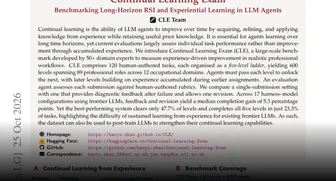
    Continual Learning Exam (CLE) released: Evaluating LLM agents' long-term continual learning and experience learning benchmarks

    Continual Learning Exam (CLE) released, a benchmark including 120 real tasks, 600 progressive levels, and 89 professions, for evaluating the long-term continual learning and experience learning of LLM agents. Tested 17 cutting-edge configurations, the strongest system Claude Code + Opus 5 only completed 47.7% of the levels and 23.3% of the task steps.

  5. QbitAI58

    Huasai Technology Kosmo data terminal helps Pixar create real-world 3D Gaussian splatting data.

    Pixar's official 3D rendering tutorial thanks Chinese company Huasai Technology for providing the 3D scene scanning solution Kosmo. This terminal integrates LiDAR, ultra-high-definition imaging systems, a one-inch large-bottom CMOS, and a high-precision IMU, capable of collecting real 3D Gaussian splatting data of 100 square meters within 15-20 minutes. It directly outputs data usable for AI model training, controllable editing, and 3D digital models with preserved spatial relationships and color/shape fidelity, providing a real-world data engine for the film and entertainment and embodied intelligence fields.

  6. Ai2 Blog

    Ai2 has released the research 'Old Ideas, Novel Problems' to evaluate the reliability of large language models in judging the innovative nature of scientific research

    Ai2 has released a study titled 'Old Ideas, Novel Problems,' evaluating the reliability of six LLMs (GPT-5.1 to 5.4, Claude Sonnet 4.5 to 4.6) in judging the innovativeness of scientific research. The study found that fine-tuning prompts can lead to accuracy differences of over 50%. The research constructed a benchmark dataset containing 154 human-generated and 154 AI-generated scientific ideas, confirming that models have insufficient stability in judgment and require more reliable methods to evaluate new ideas proposed by AI.

  7. Hugging Face Daily Papers65

    Function-Space Policy Optimization (FSPO) released: a new reinforcement learning framework combining privileged adaptation with function-space time integration

    The Function-Space Policy Optimization (FSPO) framework significantly improves the SDPO method by storing sparse historical next-word distributions as fixed time targets, combining privileged adaptation with function-space time integration, achieving time separation without maintaining a persistent teacher model.

  8. Hugging Face Daily Papers

    TraceTrial-Bench evaluates the reliability and failure attribution of AI agent frameworks

    TraceTrial-Bench evaluates the reliability of agent frameworks through mechanism-oriented tasks, trajectory tracking, and failure attribution, covering seven aspects such as context, execution, and governance. It conducted 3,420 runs of evaluation on 4 frameworks, 9 models, and 95 tasks, resulting in macro-average framework scores ranging from 59.8% to 72.0%.

  9. Hugging Face Daily Papers

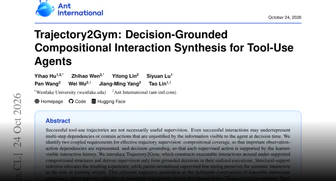
    Trajectory2Gym: A Decision-Guided Tool Use Training Tool Using Intelligent Agents

    Trajectory2Gym improves tool use training by constructing interactions with combined coverage and decision-based foundations, rather than collecting successful trajectories. The system improved Tau1, Tau2, and BFCL metrics across five Qwen3 model scales by an average of 16.9-29.8 percentage points, particularly enhancing stateful multi-round interaction capabilities.

  10. Ant Group inclusionAI · Hugging Face new models38

    inclusionAI/Ling-3.0-flash-Sante-fp8 released: FP8 quantized medical dedicated large model

    inclusionAI/Ling-3.0-flash-Sante-fp8 released FP8 quantized version, retaining 124B parameters (5.1B/Token) and BF16 performance, reducing memory and improving deployment efficiency, supporting medical inference, research, and tool-assisted workflows, requiring professional manual review. Stable performance on benchmarks like Healthbench, ReDisQA, achieving efficient inference through block FP8 quantization (128x128 blocks).

  11. ITHome · AI

    Ant Spirit 2.0 Released: Brand New Upgrade 'AI Assistant That Can Handle Things', Breaks Single-Session Limit

    Ant Group released Ling Guang 2.0, evolving the AI assistant from passive response to instructions and completing single tasks, to actively identifying needs and continuously managing affairs. Relying on an independent cloud host, Ling Guang 2.0 breaks the single conversation limit, continuing to run tasks after the user exits and dynamically following up based on new information. Currently, it includes capabilities for Alipay bills, members, travel, as well as DingTalk, Lark, email, and Mi Home services, extending management scope to cross-platform workflows and smart home device control.

  12. Databricks Blog

    Lakeflow Connect integrates enterprise productivity with AI data

    Lakeflow Connect supports wikis, project management tools, and AI base models through native connectors, enabling downstream AI agents to obtain complete business context. The platform provides fully managed native connectors that support SaaS applications, databases, and file sources, with data directly imported into the Databricks platform, and incremental import of Unity Catalog tables through point-and-click UI or API configuration.

  13. Databricks Blog22

    How is Databricks Free Edition used for teaching?

    Databricks Free Edition allows teachers and students to run full data or AI courses in the browser for free, without a cloud contract or license management, suitable for students and educators worldwide. The platform offers features such as collaborative notebooks, Spark, Delta Lake, Lakeflow, Databricks SQL, and Genie code assistant, supporting courses from introductory programming to AI projects. Skills are applied directly to industry-standard tools, with no conversion costs between production environments and teaching sandboxes.

  14. QbitAI88

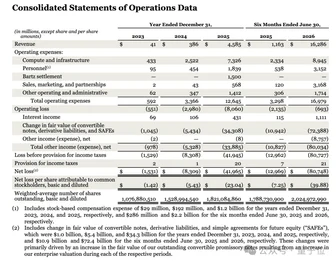
    Anthropic files 335-page prospectus, targets record IPO

    Anthropic officially filed its IPO application with the Nasdaq, with the stock code ANT, and its 335-page prospectus was also released on the SEC website. Revenue in the first half of 2026 was $16.286 billion, with a net loss of $80.748 billion, of which about $72.4 billion came from changes in the fair value of financing instruments. The prospectus discloses a commitment to over $650 billion in computing power over the next ten years and states that it is not currently developing image and video generation models, focusing computing power on programming, Agent capabilities, and security research.

    Same story — showing the featured version《Anthropic files S-1 with SEC, plans NASDAQ IPO》

Oct 26Mon
  1. The Verge · AI58

    OpenAI GPT-6.1 Sol has made significant progress in migrating COBOL code to modern languages.

    OpenAI GPT-6.1 Sol achieves 87% accuracy retention under low inference effort and 98% under high inference effort when migrating COBOL code to modern languages (C++, Java, Kotlin, Python, Rust). Anthropic's Claude Code is also used for COBOL code migration, but performance benchmarks are not provided. Experts believe AI tools have made progress in handling legacy code, but they are still far from safely replacing critical legacy systems. OpenAI GPT-6.1 Sol has made significant progress in migrating COBOL code to modern languages.

  2. QbitAI78

    Rockchip Matrix, in collaboration with CUHK and CMU, has open-sourced EdgeRock-4B, reducing KV Cache by 99.1%.

    Rockchip Technology's Rockchip Matrix, in collaboration with CUHK and CMU, has released and open-sourced EdgeRock-4B, with a fixed KV Cache of 72MiB under 256K context, reducing the source model Qwen3.5-4B by 99.1%.

    Why it matters: The original provides a comparison of throughput under fixed memory, which can be used to judge the trend of GPU memory costs for long-context reasoning.

  3. Hugging Face Daily Papers65

    UserArena: An Interactive User Simulation Benchmark for Long-Term Shopping Intelligent Agents

    UserArena introduces an e-commerce interaction benchmark containing 64,729 session trajectories, covering 11,010 users, 566,102 items, and 13 action types, supporting five-level evaluation; proposes On-Policy Trajectory Distillation technology to improve simulator fidelity, experiments show it works best under the UserArena evaluation protocol, closest to offline simulation effects of production strategies.

  4. OpenRouter Blog65

    OpenRouter launched Safety Retention: clearer AI privacy choices.

    OpenRouter introduces Safety Retention as a new data policy tier, allowing data to be used solely for abuse prevention without being used for model training, alongside Zero Data Retention and Retention and Training. This tier stores data without requiring requests to be flagged, for the purpose of detecting, investigating, and preventing abuse, and is not used for model training. This move aims to enhance the accessibility of advanced AI while ensuring privacy through a clear data policy framework.

  5. ITHome · AI72

    Musk confirmed that SpaceX has completed a 400 billion dollar debt financing for purchasing GPUs.

    From X, Musk stated that SpaceX has completed a 400 billion dollar debt financing, mainly used to pay for the GPU procurement payments expected to be delivered in the first and second quarters of 2027, and said that this fund is mainly callable debt.

    Why it matters: 400 billion dollars in debt financing and GPU delivery times show the scale of capital demand under the AI computing power race.

Oct 25Sun
  1. MarkTechPost52

    Stanford and Berkeley researchers launch TokenGate: Boosting the speed of long-context pre-filling by up to 11.3 times

    Researchers from Stanford and Berkeley have introduced the TokenGate module, which uses learnable token pruning techniques to improve the speed of long-context pre-filling by 1.4 to 11.3 times without losing accuracy, and reduces peak pre-filling memory consumption by 1.5 to 3.4 times. It outperforms 6 baseline models on 5 tasks, with the best performance showing an 11.3-fold speed increase and a 3.42-fold memory reduction on the NIAH 16k task. The code and checkpoints are open-sourced.

  2. The Decoder78

    Nvidia's open-source robot video annotation engine Flora claims to be 125 times cheaper than GPT-6 Astra.

    Nvidia's open-source data engine Flora, used for robot video annotation, claims to label one hour of video for about 0.72 USD, while GPT-6 Astra is about 88.50 USD. Flora consists of three fine-tuned Qwen3.5 models, each responsible for action segmentation, context-aware description, and reward scoring, covering three types of labels: action description, step-by-step scoring, and task success or failure judgment.

    Why it matters: The original text provides Flora's three types of annotation capabilities, cost estimates, and item-by-item comparison with GPT-6 Astra, allowing readers to judge the boundary of open-source alternatives for robot video annotation.

  3. The Decoder72

    OpenMobile-2, an open-source smartphone AI model, claims to be comparable to proprietary models.

    Researchers from Nanjing University and institutions like SenseTime have released OpenMobile-2, which includes two AI models based on Qwen3.5 (9B) and Qwen3.6 (27B), and has publicly disclosed the training environment, data, and reproduction instructions.

    Why it matters: Research fixed the training data size while only increasing the number of applications, observing an improvement in success rates for unseen applications, providing a reproducible path for data construction of mobile agents.

Oct 24Sat
  1. vLLM Blog62

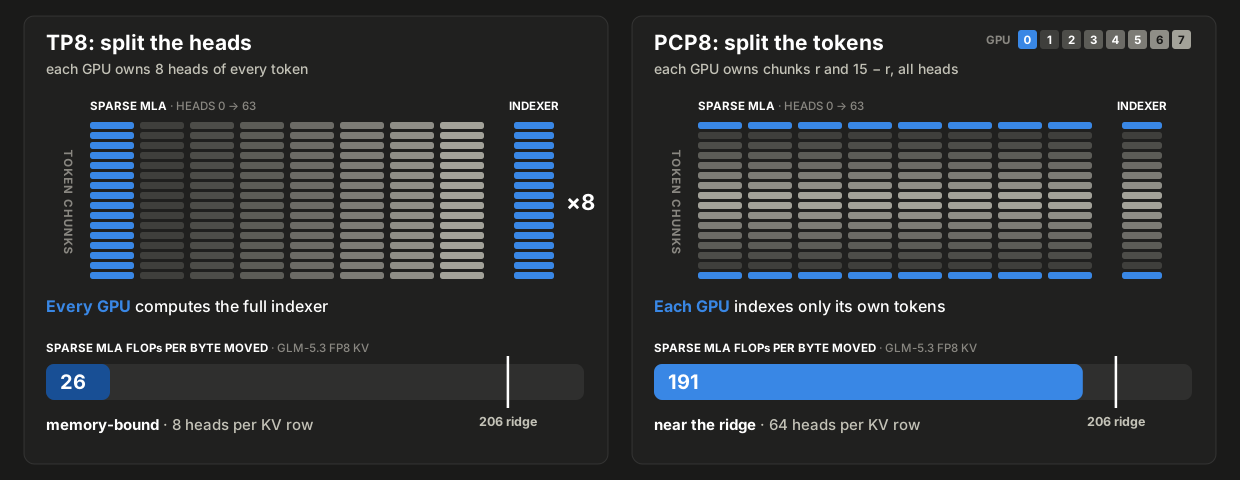
    vLLM provides an in-depth explanation of the optimization of PCP, DCP, and Hybrid HiSparse for GLM-5.3 on 16 H200s

    vLLM team releases the second part of GLM-5.3 optimization, deploying on 16 H200s with 1 pre-filled node and 1 decoding node, using PCP to split pre-fill by token and DCP to split KV cache by token, allowing 1M context to fit into the pre-fill node

    Why it matters: The vLLM team has dissected how PCP, DCP, and Hybrid HiSparse can be combined on 16 H200s, allowing readers to understand the memory and pre-fetch bottlenecks of long-context deployment.

  2. Databricks Blog58

    Spark's declarative pipelines: Use cases designed for AI agents

    Spark's declarative pipelines are 34 times faster than imperative pipelines in 22 data engineering tasks, halve the code volume, and have fewer errors. Declarative pipelines capture structural errors in advance through pre-execution validation and offload repetitive tasks like sorting and result saving to Spark, while imperative pipelines need to run on the cluster until the error step to detect them. The two methods perform equally in terms of logical error rates, but declarative pipelines have more concise and consistent code, making them easier to maintain.

Oct 23Fri
  1. ITHome · AI71

    OpenAI, in collaboration with PerturbAI, used thousands of AI agents to analyze mouse brain cell data in 32 minutes

    OpenAI, in collaboration with PerturbAI and Scripps Research Institute, used thousands of AI agents to analyze the entire mouse brain's CRISPR map in 32 minutes, the team estimates it would take humans months to a year to complete the same work.

    Why it matters: The original text provides a blind comparison between distributed agents and single agents, as well as the difference in citation counts in the literature, allowing readers to judge the division of labor in multi-agent architecture in scientific research and analysis.

  2. Hugging Face Daily Papers65

    Towards Recursive Self-Improvement in Physical AI

    Recursive Self-Improvement (RSI) describes systems that not only improve their own behavior but also improve their improvement processes. Recent digital agents have tested this idea by rewriting their own code and using executable tests to check each version. Introducing such mechanisms into the physical world requires learning from partial observations through expensive experiments while considering constantly changing operational conditions and potential irreversible consequences.

  3. Hugging Face Daily Papers75

    OpenDS-World: A benchmark for evaluating autonomous deep search agents in real network environments

    OpenDS-World introduces a real-time network benchmark to evaluate autonomous multi-step deep search agents, revealing a significant gap between cutting-edge models and human performance. Among 12 cutting-edge models, the best model achieved an accuracy of 39.0%, while 1000 human evaluations reached an accuracy of 21.1%. Analysis shows that research strategies vary among models, and tool coordination and long-term search management remain major challenges.

  4. Sakana AI

    Sakana AI has launched the Sakana Aquarium AI agent platform based on ontology.

    Sakana AI has launched the Sakana Aquarium platform for building, executing, and running AI agents. It integrates organizational information through ontology, supporting the efficient construction and secure operation of AI agents. The platform includes three core mechanisms: ontology, governance, and agent execution base, achieving systematic organizational judgment criteria and task automation.