Trajectory2Gym: Decision-Grounded Compositional Interaction Synthesis for Tool-Use Agents
Trajectory2Gym: Decision-Grounded Compositional Interaction Synthesis for Tool-Use Agents
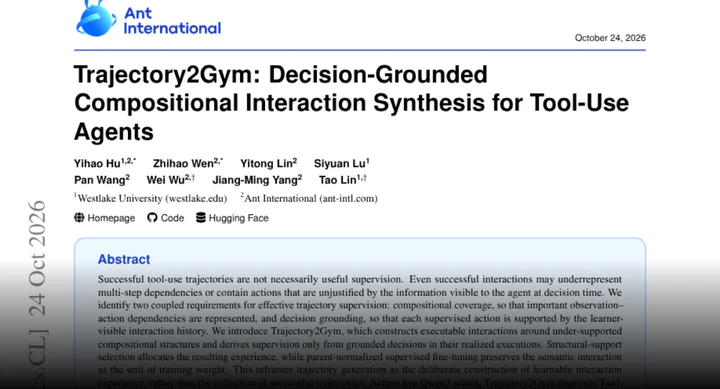
Trajectory2Gym improves tool use training by constructing interactions with combined coverage and decision-based foundations, rather than collecting successful trajectories. The system improved Tau1, Tau2, and BFCL metrics across five Qwen3 model scales by an average of 16.9-29.8 percentage points, particularly enhancing stateful multi-round interaction capabilities.
Abstract
Trajectory2Gym improves tool-use training by constructing interactions with compositional coverage and decision grounding rather than collecting successful trajectories.
Successful tool-use trajectories are not necessarily useful supervision. Even successful interactions may underrepresent multi-step dependencies or contain actions that are unjustified by the information visible to the agent at decision time. We identify two coupled requirements for effective trajectory supervision: compositional coverage, so that important observation-action dependencies are represented, and decision grounding, so that each supervised action is supported by the learner-visible interaction history. We introduce Trajectory2Gym, which constructs executable interactions around under-supported compositional structures and derives supervision only from grounded decisions in their realized executions. Structural-support selection allocates the resulting experience, while parent-normalized supervised fine-tuning preserves the semantic interaction as the unit of training weight. This reframes trajectory generation as the deliberate construction of learnable interaction experience, rather than the collection of successful trajectories. Across five Qwen3 scales, Trajectory2Gym improves Tau1, Tau2, and BFCL at every tested scale, increasing the equal-weight three-benchmark mean by 16.9-29.8 percentage points. The gains are strongest in stateful and multi-turn interaction, where later decisions depend on earlier observations and feedback. Our results suggest that scaling tool-use agents depends not only on collecting more successful trajectories, but on constructing interactions whose dependencies are represented and whose decisions are learnable from the agent's visible history.
View arXiv page View PDF Project page GitHub 2 Add to collection
Get this paper in your agent:
hf papers read 2610.33568
Don't have the latest CLI?
curl -LsSf https://hf.co/cli/install.sh | bash
Models citing this paper 0
No model linking this paper
Cite arxiv.org/abs/2610.33568 in a model README.md to link it from this page.
Datasets citing this paper 0
No dataset linking this paper
Cite arxiv.org/abs/2610.33568 in a dataset README.md to link it from this page.
Spaces citing this paper 0
No Space linking this paper
Cite arxiv.org/abs/2610.33568 in a Space README.md to link it from this page.
Collections including this paper 0
No Collection including this paper
Add this paper to a collection to link it from this page.
Source: Hugging Face Daily Papers · huggingface.co