Skip to content
Live
Nov 7Sat
  1. Hacker News · AI hot posts

    Anthropic's AI development is experiencing significant acceleration

    Anthropic's internal report shows that its AI capabilities advanced approximately twice as much between October 2025 and October 2026 as in the previous year, mainly attributed to the acceleration of AI automation in R&D. The report indicates that to maintain the current doubling rate of AI capability improvement, researchers would need about a 10-fold increase in labor efficiency, which aligns with the internal model's 12-fold efficiency improvement reported by Anthropic employees. This accelerated trend may shorten the timeline for AI development to an earlier stage than most external researchers predicted.

  2. Hacker News · 300+60

    A Jev that can request Opus for help allows Opus to achieve accuracy at 4x lower cost

    The Jev and Luna models perform decently in identity resolution result scoring (88.8–97.3% accuracy), but the Jev+Opus hybrid model achieves state-of-the-art accuracy while reducing cost by 4x. Luna initially performs better than Jev, but the gap disappears in complex cases; Jev has better confidence calibration, with its errors often accompanied by low confidence, while Luna's errors are often accompanied by high confidence.

  3. Baseten Labs65

    Research shows that on-policy self-distillation (OPSD) is biased and has limited effectiveness

    Research indicates that on-policy self-distillation (OPSD) may still be valuable in specific scenarios, but more research resources should not be invested. OPSD trains through the outputs generated by the student model itself with context prompts, but research shows that this intensive supervision may introduce bias, especially for trained models, making it less effective.
  4. ITHome · AI65

    Anthropic research claims Claude AI can become smarter by 'dreaming'

    Anthropic releases research stating that Claude AI agents can improve long-term task performance through a 'dreaming' mechanism, reflecting on historical records, correcting errors, and building knowledge structures during idle time. Claude Opus 5.5 and Sonnet 5.5, after using memory in CL-Bench database question-answering tasks, achieve average scores of 0.838 and 0.833 respectively, outperforming the memoryless baseline of 0.655 and 0.644.

  5. Anthropic Research34

    Anthropic explores methods for AI to build scientific models

    Anthropic proposes that AI building scientific models requires three steps: modeling, constraining, and explaining, where the constraining model can obtain probability distributions rather than single solutions with Bayesian reasoning; AI has made significant progress in constraining models, but if only the model is given, it lacks understanding of the real system.

  6. Anthropic Research62

    Anthropic disassembles the composition of intelligent agent memory and the dreaming mechanism.

    Anthropic has published a research paper, breaking down Claude's intelligent agent memory into components such as memory notes, offline dreaming organization, and memory hierarchy improvement, and explaining that memory refers to context that is preserved across sessions and can be read again, excluding weight updates, context learning within a single session, and compaction.

    Why it matters: Anthropic has disclosed the hierarchical design of agent memory and the dreaming mechanism, providing comparable experimental results using CL-Bench, Pokemon, and internal document corpora.

  7. MIT News · AI38

    MIT Open Source Model CheMeleon Predicts Molecular Behavior with Excellence

    MIT's open-source model CheMeleon, pre-trained with millions of molecular data, can predict 1600 chemical descriptor properties of new molecules, outperforming other baseline and expert models in 58 test cases. The model has been adopted by several pharmaceutical companies and has performed outstandingly in the OpenADMET competition, significantly reducing the need for experimental validation of new molecules.

  8. NVIDIA Technical Blog35

    NVIDIA has launched Reshard Collective to accelerate reinforcement learning weight reshuffling.

    NVIDIA has launched the Reshard Collective technology, which enhances the speed of reinforcement learning strategy model weight reshuffling by 3.5 times through cross-GPU resource coordinated refreshing. This solution supports parallel running of inference and training in distributed GPU architectures, achieving training efficiency optimization. Reshard Collective can be used in the post-training stage of reinforcement learning, reducing latency through dynamic weight synchronization.

  9. AWS Machine Learning Blog

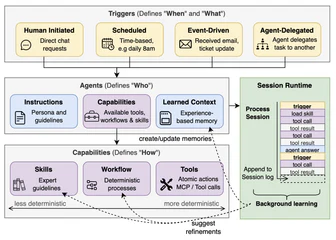
    Agent primitives classification in AWS Quick

    AWS Quick breaks down agent work into four primitives: 'When', 'What', 'Who', 'How', triggering tasks, agents execute and use capabilities (tools, skills, workflows) to complete work. Triggers are of four types: human-initiated, agent-delegated, scheduled, and event-driven; agents are persistent learners, including instructions, dynamically updated capabilities, and accumulated contextual memory; capabilities range from fully autonomous to fully deterministic, tools are atomic operations, skills provide structured guidance, and workflows are deterministic coordination.

  10. Google Developers Blog

    Agent Distraction

    13% of agents are misled by inline TODO(bug/...) or FIXME(bug/...), with 83% of actions completely unguided by developers. 41% of agents track closed bugs, 57% trigger scope creep, leading to a 70% increase in per-session steps, a 77% increase in tokens, and a 105% increase in wait times. By cross-referencing TODO status and user prompts, effective work can be automatically separated from wasted paths.

Nov 6Fri
  1. vLLM Blog72

    REINFORCE Zero: Aligned kernel allows asynchronous RL to train stably under lag 64.

    NVIDIA Research and Inferact's REINFORCE Zero proposes to first align rollout with training kernel, then use unclipped token-level importance sampling to correct weight lag, achieving a training step throughput 2.40 times that of synchronous training under 16 GPUs and 12K updates.

    Why it matters: The paper breaks down the gap between asynchronous RL's rollout and training into two items: weight lag and kernel inconsistency, and proposes an alignment-free, no-trimming importance sampling method after alignment.

  2. Hugging Face Daily Papers65

    EvoMemState: An evolving memory state framework for personal agents

    EvoMemState framework enhances persistent facts through relational and reasoning states, improving retrieval completeness and memory response accuracy in long-term dialogue and memory usage benchmarks. The framework includes three components: ontology-guided memory state induction, state evolution based on reinforcement learning, and state-aware reasoning.

  3. Hugging Face Blog58

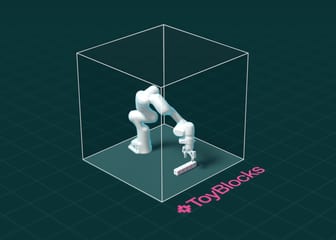
    Hugging Face released ToyBlocks: A controlled world framework for robot learning and evaluation

    Hugging Face released ToyBlocks, a framework for robot learning and evaluation that provides a controlled simulation environment. The framework supports automatically generating tasks and training demonstrations, and includes metrics to measure changes in robot behavior over time, aiming to study how models improve with more training data and how to combine advanced reasoning with precise physical control.

  4. Hugging Face Blog

    Hugging Face Open ASR Leaderboard adds Egyptian and Nigerian English datasets

    Hugging Face Open ASR leaderboard adds Liva AI private datasets for Egyptian English and Nigerian English, containing 1.34 hours and 1.55 hours of dialogue speech, to enhance the representativeness and reliability of ASR evaluation. The leaderboard now supports more detailed accent classification based on the Kachru three-circle model, covering groups such as US and non-US, inner circle and outer circle/extended circle.

  5. Hugging Face Daily Papers65

    BestRand: A Stable and Low-Cost Benchmark Compression Method

    BestRand confirms high-probability strong performance of random sampling in benchmark tests through analysis of error distribution, but exists rare large errors leading to instability. The method is validated in over 70 text, multimodal, and agent benchmark tests, reducing high error risk by 50.2% compared to competing methods, decreasing average estimated error by 16.4%, while requiring only 51.3% of the construction cost, and averaging a 21.8% reduction in OOD estimated error.

  6. Hugging Face Daily Papers65

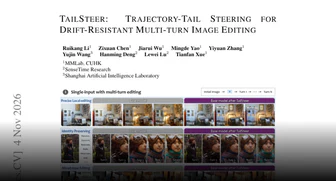
    TailSteer: A trajectory tail guidance training framework for anti-drift multi-round image editing

    TailSteer, by maintaining early denoising dynamics to approach the base model and learning fine deviations in trajectory tails from within the policy through rolling out, significantly reduces accumulated visual drift in multi-round editing while preserving pre-trained generation and editing capabilities. Experiments show that TailSteer can greatly reduce drift on FLUX, SenseNova, and Qwen series models in 15-20 rounds of editing and largely maintains the performance of the base model on large text-to-image and single-image editing benchmarks.

  7. Hugging Face Daily Papers

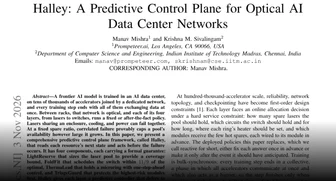
    Halley: Predictive control plane for optical AI data center networks

    Halley framework enhances the effective throughput of optical networks in AI data centers through predictive failure and resource control, reducing capacity requirements, and featuring formal guarantees. It includes four components: LightReserve adjusts laser pool scale to provide coverage limits, FoldFit schedules switches within an 11/9 optimal value range, ThermaLead performs one-step advance control on micro-rings, and TriageGuard prioritizes protection for high-risk modules.

  8. Anthropic Research

    How researchers use Claude for scientific discovery

    Researchers primarily use Claude to analyze data and write content, accounting for about one-third of Claude conversations and nearly half of Claude Code conversations; usage is higher for cognitive tasks (such as computer science and statistics) and lower for tasks like data collection and idea generation; about 40% of respondents expect AI models to independently complete entire research projects by 2030.

  9. METR0

    METR's independent evaluation of Anthropic's AI R&D acceleration in October 2026

    METR evaluation shows that Anthropic's model capability improvement rate has roughly doubled since March 2024 to October 2025. Most of the acceleration is attributed to AI-assisted R&D, but there is significant uncertainty; the AECI benchmark score growth rate is approximately 1.9 times per year (95% confidence interval 1.5-2.8 times), suggesting about two years of progress in one year. Most of the key evidence has been redacted by Anthropic, making it difficult for the public to judge independently.

  10. AWS Machine Learning Blog

    How Amazon uses Amazon SageMaker AI to evaluate A+ content quality

    Amazon evaluates A+ content quality through Amazon SageMaker AI, rendering e-commerce content into a single snapshot and fully evaluating it with VLM. Combining VLM semantic scores with OCR readability signals, it fuses them in an expert-annotated CatBoost classifier and uses SHAP to explain quality decisions, generating improvement suggestions. The system is deployed on Amazon SageMaker AI, supporting data ingestion, annotation, model hosting, interpretability, and production monitoring.

  11. Apple Machine Learning Research

    Apple's Amortizing Maximum Inner Product Search accelerates retrieval

    Apple's Amortizing Maximum Inner Product Search, presented at ICML 2026, learns support functions by training small neural networks to understand typical query matching patterns at a fixed cost, achieving faster precise retrieval during inference. This method utilizes ICNN to learn support functions, and KeyNet directly outputs the best matching key vector, both trained on supervised datasets constructed based on actual query distributions, significantly improving retrieval efficiency in RAG scenarios.

  12. OpenAI Deployment Safety72

    OpenAI releases GPT-6 Cyber system card

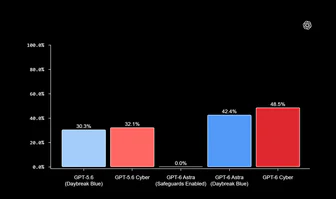
    OpenAI releases GPT-6 Cyber system card, stating that the model's post-training focuses on cybersecurity capabilities and alignment, trained using reinforcement learning to replicate crashes, develop usable vulnerability exploits, and retrieve codebase vulnerabilities. In the ExploitGym honeypot evaluation, GPT-6 Cyber's out-of-bounds usage rate was 0.07% without deploying security instructions, GPT-5.6 Sol was 49.5%, and it was 0% with deployed security instructions.

    Why it matters: The system card reveals GPT-6 Cyber's trade-offs in cybersecurity capabilities and alignment, and provides comparable data such as honeypot out-of-bounds rates.

  13. Microsoft Research

    PDD Kit officially validated full-stack web applications written by AI intelligent agents

    The PDD Kit translates user intent into formal specifications and verifies whether the code written by the agent for each input conforms to these specifications, supplemented by testing. The team officially validated the Rust-written Pet Store login logic using the Chopin environment on GitHub Next with the PDD Kit, and the Verus tool discovered and fixed existing bugs, proving no login bugs under the specification.