TailSteer: Trajectory-Tail Steering for Drift-Resistant Multi-turn Image Editing
TailSteer: Trajectory-Tail Steering for Drift-Resistant Multi-turn Image Editing
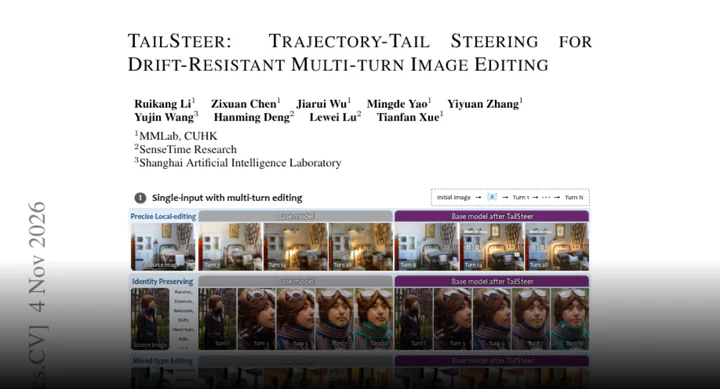
TailSteer, by maintaining early denoising dynamics to approach the base model and learning fine deviations in trajectory tails from within the policy through rolling out, significantly reduces accumulated visual drift in multi-round editing while preserving pre-trained generation and editing capabilities. Experiments show that TailSteer can greatly reduce drift on FLUX, SenseNova, and Qwen series models in 15-20 rounds of editing and largely maintains the performance of the base model on large text-to-image and single-image editing benchmarks.
Abstract
TailSteer, a final-stage training framework, reduces cumulative visual drift in multi-turn editing by keeping early denoising dynamics close to the base model and learning tail-focused preservation corrections from on-policy rollouts, preserving pretrained generative and editing abilities.
Strong single-turn editing performance does not guarantee reliable multi-turn interaction: as edited outputs are repeatedly reused, small unintended changes can accumulate into severe visual drift. This long-term drift is often mitigated through training on multi-turn data or cross-turn rollouts, potentially altering pretrained priors, or through specialized inference-time mechanisms that are difficult to scale to foundation models. We introduce TailSteer, a final-stage training framework that improves multi-turn robustness while retaining the generative and editing capabilities acquired through earlier training. TailSteer follows a simple principle: keep early denoising dynamics close to those of the base model and concentrate preservation corrections near the trajectory tail, where fine-grained deviations can be suppressed. These corrections are learned from the editor's own on-policy denoising rollouts, using unchanged source content as a preservation reference without requiring curated ground-truth editing pairs. Experiments across the FLUX, SenseNova, and Qwen families show that TailSteer substantially reduces cumulative drift over 15-20 editing turns while largely preserving base-model performance on extensive text-to-image and single-image editing benchmarks. These results demonstrate that long-horizon editing robustness can be unlocked in foundation models after TailSteer, rather than by relearning their existing capabilities.
View arXiv page View PDF Project page GitHub 3 Add to collection
Models citing this paper 0
No model linking this paper
Cite arxiv.org/abs/2611.06741 in a model README.md to link it from this page.
Datasets citing this paper 0
No dataset linking this paper
Cite arxiv.org/abs/2611.06741 in a dataset README.md to link it from this page.
Spaces citing this paper 1
Collections including this paper 0
No Collection including this paper
Add this paper to a collection to link it from this page.
Source: Hugging Face Daily Papers · huggingface.co