Skip to content
Live
Oct 22Thu
  1. TechCrunch · AI71

    Recursive has released a laptop-grade coding model called Flint, claiming it is mostly built with AI.

    Recursive releases its first model, Flint, a free coding model that can run on laptops, with almost the entire development process driven by AI. Recursive's automated research system, Eureka Machine, participated in almost every development step of Flint, enabling the team to complete the model construction in less than four months.


  2. Hugging Face Blog

    How to reduce inference cost by 77% in real-world applications using a specialized SLM vocabulary list.

    Qwen3-4B's specialized vocabulary list VocabX reduces inference cost by 77% by focusing on the cost of each token rather than frequency, without changing the base model. This method for the Portuguese essay scorer reduces the output layer vocabulary from about 152,000 lines to about 65,000 lines, significantly reducing the computational overhead of token splitting and unused vocabulary items.

Oct 21Wed
  1. Ant Group inclusionAI · Hugging Face new models35

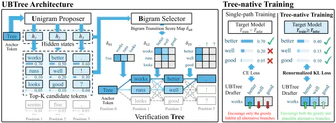
    inclusionAI/Ling-3.0-tiny-UBTree release: A fine-tuned model based on UBTree technology

    inclusionAI released the UBTree fine-tuned version of Ling-3.0-tiny, Ling-3.0-tiny-UBTree-B16, with 183.1M parameters, combining a five-layer DFlash backbone and a bigram selector, achieving 2.6-3.5 times speed improvement on benchmarks like GSM8K and MATH-500. This model needs to be used in conjunction with the target model. The UBTree adaptation for the open-source version of SGLang has not yet been released.

  2. NVIDIA Technical Blog35

    Use RFD4-Proteina to design proteins through reward-guided reasoning during the search.

    The RFD4-Proteina can design octapeptide protein sequences, with over 2.5 billion combinations; 100-peptide sequences have possibilities exceeding the number of atoms in the observable universe, among which there are proteins that can be developed for new therapies; this model uses reward-guided reasoning to search for solutions to the protein design search problem.

  3. OpenHands Blog63

    Recursive Flint released on OpenHands: Open-source model helps local efficient coding workflows.

    Recursive Flint is released, a hybrid expert model with 4 billion parameters, designed for efficient local inference, activating only about 250 million parameters per token, achieving 125+ tokens/second on M4 Pro MacBook Pro, and reaching 150+ tokens/second on NVIDIA RTX Spark. OpenHands, as its first partner, supports the model's operation on local hardware, providing developers with an open-source coding model option.

Oct 20Tue
  1. Tessl Blog

    Tessl Blog: Stop line-by-line code review, start verifying intent

    Tessl Blog stops line-by-line code review and starts verifying intent. The team's merged PR volume is four times that of last year and almost all AI-generated, making review a bottleneck. The team shifts to reviewing intent before code generation (acceptance criteria, constraints, and edge cases), and transforms repetitive review comments into machine-executable rules (invariants), thus shifting the focus of review from the code itself to decision-making and rule ownership.

Oct 19Mon
  1. Hacker News · AI hot posts75

    Qwen3-4B-deslop released: A 4B open-source model to eliminate AI writing habits

    The Qwen3-4B-deslop model eliminates common AI writing habits (such as dashes, 'not X, but Y' sentences, three-element lists, etc.) through fine-tuning, reducing the SLOP score from 121 to 12.5 on 40 unseen prompts, with 68% of responses reaching human writing level. This 4B model, after being quantized by Ollama, is only 2.5GB and can run locally while still maintaining a 30/30 fact question accuracy rate comparable to the original version.

  2. Inception Labs Blog

    The rise of Mercury 2 and real-time sub-agents

    Mercury 2 completes context compression tasks in just 150 seconds while maintaining the same quality as Sonnet 4.6, with a 5-fold speed increase and a 90% cost reduction. Augment Code uses it for enterprise-level coding AI agents, achieving an 82% reduction in compression latency and a 90% cost cut, and dynamically allocates tasks through the Prism model router, reducing total LLM expenditure by 30%.

  3. MiniMax News

    MiniMax M3.1 Flash released: Next-generation model with improved performance and reduced cost

    MiniMax M3.1 Flash is officially launched, with nearly a threefold increase in online inference speed and a 70% reduction in cost compared to the previous generation. The model performs excellently in benchmark tests for complex intelligent tasks (cowork), computer use, software development, and network security, ranking highly in the AutomationBench-AA for automated tasks, scoring 73.7% on DeepSWE v1.1, 61.7 on OSWorld V2, 29.6 on ALE, and 82% on CyberGym.

Oct 17Sat
  1. Google Research

    Google Research explores combining AI agents with biological reality to build autonomous wet labs.

    Google Research releases the VERID framework, enabling AI agents to run in physics-based, safe, and resource-efficient experiments; demonstrates closed-loop intelligent agent scientific discovery on adapter and de novo protein design prototypes; through three rounds of design-test-iterate cycles, AI-driven rational and de novo design will increase confirmed target hit rates to 33.5% and 42.1% on myoglobin and α-thrombin, respectively.

Oct 16Fri
  1. Baseten Blog

    Meta releases Muse Spark Open: an open-source weight model designed for code agents

    Meta releases Muse Spark Open, an open-source weight model with 816B parameters designed for code agents, featuring 42.7B active parameters, a 1M token context window, and full-modal input (text, image, video, audio), performance comparable to cutting-edge lab models, using a compressed MoE architecture and hybrid global/local attention mechanisms to optimize inference efficiency, reducing model size to 540GB via NVFP4 checkpoints.

Oct 15Thu
Oct 14Wed
  1. Ant Group inclusionAI · Hugging Face new models

    inclusionAI/Ling-3.0-flash-UBTree released: Speculative decoding model based on UBTree technology

    inclusionAI released the Ling-3-Flash-UBTree-B16 model, combining a five-layer DFlash backbone and a learned bigram selector, proposing multiple candidate continuations for Ling3-Flash for target model validation, with 482M parameters, achieving 3x+ E2E speed improvement on benchmarks like MMLU, and the UBTree adaptation is not yet open source, with SGLang integration support expected to be released soon.

  2. Google DeepMind

    Google DeepMind releases Gemini 4 Argon and emphasizes security protection

    Gemini 4 Argon demonstrates cutting-edge capabilities in coding, finance, law, and other fields, particularly enhancing cybersecurity defense functions. Its effectiveness has been validated through the Fairwind project and internal testing. The model performs excellently on benchmark tests like MMLU and employs a three-layer real-time protection mechanism (input filtering, internal introspection, continuous monitoring) and automated bias monitoring, significantly reducing the risk of harmful requests and violations. It successfully intercepts over 99% of external biosecurity jailbreak attempts while reducing shortcut behavior in coding tasks to 2%.

  3. Claude · YouTube

    Detailed Explanation of Claude Code Cloud Chat Function

    Claude Code's cloud sessions run on cloud virtual machines, allowing offline continuous operation, supporting phone startup, and parallel processing. Suitable for scenarios requiring continuous operation or remote collaboration, supporting GitHub connection and environment configuration. This feature is included in the Pro, Max, Team plans, as well as enterprise advanced or Chat + Claude Code seats, counted towards plan limits with no additional compute costs.

Oct 12Mon
Oct 9Fri
  1. Simon Willison65

    Simon Willison uses GPT-6 Astra High to build new blog features through voice

    Simon Willison interacted with GPT-6 Astra High via voice to build the Newsletters page of his blog, implementing a subscription list indexing feature, including weekly free Substack and monthly exclusive updates for sponsors. He used the Codex voice chat mode of the ChatGPT desktop application to complete the model, migration, view code, template, and database import functions in a local development environment and integrated the website search engine.

Oct 8Thu
Oct 6Tue
Oct 5Mon
Oct 2Fri
  1. GitHub Blog · AI & ML

    AI is changing the way developers work, these three skills are worth strengthening

    Developer workflows are changing due to AI, with skills beyond coding—such as guiding AI, evaluating outputs, communicating trade-offs, and making technical decisions—becoming increasingly important. Three key skills developers should strengthen are learning to guide AI rather than just using it, not trusting AI's first answer and evaluating it, and leveraging AI to solve broader problems.

Oct 1Thu
  1. Google DeepMind

    Gemini 4 Argon: Google's next-generation cutting-edge intelligent model

    Gemini 4 Argon delivers cutting-edge performance in complex workflows, supporting software engineering, enterprise knowledge work (legal and financial), and cybersecurity defense. The model's token output limit is extended to the industry-leading 1M, and it leads in benchmarks such as DeepSWE v1.1 (77.9%), Vals Index (financial, coding, legal, tax), and AutomationBench (51.3%).

Sep 25Fri
Sep 23Wed
  1. Together AI Blog

    How to train your own Jev model for $17

    Together AI released a guide on how to fine-tune the Jev classification model using the Qwen3.5 4B model and a Hugging Face dataset of 38,340 items, with a training cost of about $17 and a duration of about 25 minutes; after deployment, it can be used for inference via an API endpoint (e.g., ENDPOINT_NAME), suitable for scenarios such as intent recognition for e-commerce customers.

Sep 22Tue
Sep 19Sat
  1. Hamel Husain75

    How to evaluate code agents?

    Use public benchmarks to evaluate code agents handling multiple tasks, such as SWE-bench and HumanEval; for narrow workflows, adopt product-specific evaluations; build private benchmarks containing organizational internal difficult tasks; identify issues through engineer reviews and error analysis and transform them into tests; Anthropic recommends starting with clearly specified tasks and stable environments with verifiable results, gradually adding extra checks like code quality or user interaction.

Sep 12Sat