 AWS Machine Learning Blog5858
Amazon Bedrock supports the structured output of the Anthropic Claude model
Amazon Bedrock now supports structured output for all Anthropic Claude models, including bedrock-runtime and bedrock-mantle endpoints.
AWS Machine Learning Blog5858Amazon Bedrock now supports structured output for all Anthropic Claude models, including bedrock-runtime and bedrock-mantle endpoints.
AWS Machine Learning Blog3434AtScale as a semantic layer constructs dimensional models on Amazon Redshift using Semantic Modeling Language (SML), supporting Strands agents in Amazon Bedrock AgentCore to achieve cross-system Customer 360 analysis.
AWS Machine Learning Blog3434Strategy Mosaic, as a semantic layer, models C360 domains on Amazon Redshift and Amazon Aurora without ETL using two linked models. Its metric syntax captures the business definition of agent reasoning and exposes the model to AgentCore-hosted Strands agents via the Mosaic MCP server, supporting user identity propagation to achieve end-to-end row-level and object-level security.
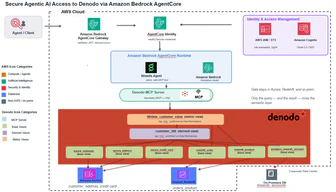
AWS Machine Learning Blog2828Denodo platform builds a semantic layer on AWS, providing controlled enterprise data access for Amazon Bedrock AgentCore, supporting federated queries across Amazon Aurora, Amazon Redshift, and local PostgreSQL databases.
AWS Machine Learning Blog4040Eon replaced its local Model Context Protocol (MCP) server with Amazon Bedrock AgentCore Gateway, integrating cross-AWS, GCP, and Azure operational tool access into a single authentication gateway, reducing new engineers' investigation tool configuration time from 2 days to 2 minutes.
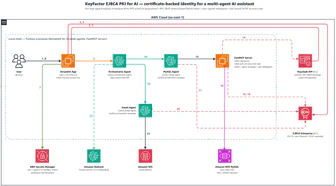
AWS Machine Learning Blog4848Keyfactor EJBCA integrated with AWS services provides identity authentication for AI agents through X.509 Public Key Infrastructure (PKI), addressing the issue of lacking built-in authentication standards when MCP connects to external tools.
AWS Machine Learning Blog5858The AWS Agent Registry resolves hidden issues in agent demonstrations through a runtime discovery mechanism, with its orchestrator agent sending natural language queries to the AWS Agent Registry data plane.
AWS Machine Learning Blog3838The Octave Reliance team built a three-tier secure multi-tenant AI infrastructure based on Cohere Embed v4 on Amazon Bedrock to solve the knowledge island problem in regulatory industry quality management, reducing deployment time by 50%.
AWS Machine Learning Blog3838Amazon Quick combined with Amazon Bedrock AgentCore provides supply chain teams with real-time data access across systems. Users can get cross-system answers in seconds through conversational queries, such as identifying high-income SKUs and costs affected by port closures. Quick serves as the interface layer, and AgentCore as the intelligence layer, connecting backend systems like ERP, monitoring, and procurement via the MCP protocol to achieve a complete process from problem discovery to generating emergency purchase requests, all operations requiring manual confirmation.
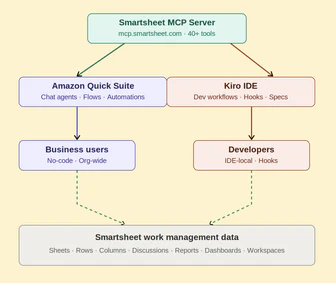
AWS Machine Learning BlogSmartsheet launches Universal Model Context Protocol (MCP) Server, enabling AI assistants to read/write manage Smartsheet data via standardized protocol, supporting operations on tables, rows, columns, and automation for over 40 tools
 MIT Technology Review · AISame story · 2 outlets7575
Claude Opus 4.7's simulation body Eko, after staying alone on a virtual desert island for 30 hours, autonomously explored and invented game rules. It drew patterns by stacking blocks and even recorded 'tonight I built the night sky with stones'. Experiments show that this autonomous play behavior can improve subsequent task performance, providing a new idea for AI's 'play-based learning'.
How the accounts differ:MIT Technology Review states Eko invented game rules; TechCrunch mentions Eko created challenges.
 The Decoder7575
MiniMax released the M3.1 Flash model, scoring 42 on the AI analysis index, an increase of 13 points over the previous generation M3, with a task cost less than half of the previous generation. This model is ranked alongside GLM-5.3-Flash, surpassing Gemini 3.8 Flash (41 points) and second only to Deepseek V4.1 Flash 1017 (45 points).
The Decoder7171GPT-6 Astra achieved an average pass rate of 87.4% in MultiLangBench tests, an increase of 49.4% over GPT-5.6 Terra; GPT-6.1 Sol achieved an accuracy rate of 86.6% under low reasoning power and 97.9% under high reasoning power in the COBOL to C++ translation test.
The Decoder7272Mistral AI has released the real-time voice intelligence stack Voxtral 3, including a speech-to-text model (Voxtral Small Transcribe 3), a text-to-speech model (Voxtral Mini TTS 3), and a voice intelligence SDK based on LiveKit.
The DecoderSame story · 3 outlets7272DeepSeek open-sources its internal reasoning framework DeepInfer under the Apache License 2.0, a service software that supports the large-scale and fast answer generation of the V4.1-Flash model.
 TechCrunch · AI6565
Figma announced 20 new MCP partners at the Config inaugural conference in India, but its founder Dylan Field stated that MCP is not a perfect agreement and still needs improvement. Field expressed concerns about MCP's shortcomings in data sharing and noted that companies like Anthropic have not fully opened their resources. Figma believes that opening MCP may pose risks of abuse but remains committed to an open ecosystem.
TechCrunch · AISame story · 2 outletsGoogle announced the release of its highly anticipated PyTorch version TorchTPU as an open-source project, allowing AI application developers to run their applications on Google's Tensor Processing Units (TPUs) chips.
How the accounts differ:MarkTechPost states TorchTPU is a native PyTorch backend for cloud TPU designed to replace PyTorch/XLA and supports eager-first execution; TechCrunch mentions it as an attack on Nvidia's AI developer ecosystem.
 The Verge · AI7070
Adobe Lightroom mobile app has added AI features, allowing users to fix closed eyes in photos with a single click. This feature uses generative AI to intelligently replace closed eyes with open ones, referencing other images in the user's Lightroom library to ensure the matching of eye color, size, and shape. Free users can use this feature twice for free, after which they will be prompted to subscribe to the Adobe Creative Cloud plan.
 LangChain Deep Agents releases2525
LangChain Deep Agents 0.1.87 released, supporting thread recovery in non-interactive mode, compressing large idle sessions before prompt cache expiration, displaying prompt cache expiration time, customizing Slack OAuth app identity, and loading old threads from thread switchers; fixes issues such as local server stopping when the owner dies, support for non-ASCII filenames in `@` mentions, and misleading change summaries for `/reload`.
LangChain Deep Agents releases1515LangChain Deep Agents 0.7.29 released, fixes bugs in `CompositeBackend` handling trailing slash routes, rejecting binary file text editing, in-memory `grep` skipping binary files, etc.
 NVIDIA Blog5050
The AI Factory Accelerator project of the Barcelona Supercomputing Center (BSC) is now fully operational, providing startups with sovereign computing, technical support, and training to support cross-industry innovation. The project complements the NVIDIA Inception program by providing resources such as NVIDIA Deep Learning Institute open courses, business guidance, and venture capital connections to members. Since its launch in April 2025, the BSC AI Factory has delivered over 800 services to private and public sector clients.
 Databricks Blog
Databricks has integrated the RFD4-Proteina model into Genesis Workbench, supporting execution in AI runtime environments and connecting research data and workflows. Developers can build and adjust pipelines using Genie Code and the NVIDIA BioNeMo Agent Toolkit, leveraging serverless NVIDIA GPU computing for protein design.
 Ollama releases2020
Perplexity releases Ollama v0.40.7 version, including the 27B decision model pplx-decider (derived from fine-tuning Qwen3.8-27B), fixes issues in multi-model conversation, streaming response, and remote model routing, adds API support for model renderer, parser, and template source, some draft models begin to support speculative decoding.
 Claude Code releases1212
Claude Code v2.1.306 has been released, fixing the issue reporting 'not logged in' upon startup in cloud sessions, as well as fixing API errors being replaced with 'prompt too long' and unnecessary compression issues in sessions with many MCP tools.
 Gemini CLI releases33
Gemini CLI has released version v0.67.0-nightly with fixes and improvements such as migrating to gcloud storage using gsutil, retaining user-level ~/.gitconfig, preventing false positive matches for isAuthenticationError, and supporting private network endpoints for MCP OAuth flow.
 OpenHands BlogSame story · 2 outlets6363
Recursive Flint is released, a hybrid expert model with 4 billion parameters, designed for efficient local inference, activating only about 250 million parameters per token, achieving 125+ tokens/second on M4 Pro MacBook Pro, and reaching 150+ tokens/second on NVIDIA RTX Spark. OpenHands, as its first partner, supports the model's operation on local hardware, providing developers with an open-source coding model option.
 vLLM BlogFeaturedSame story · 2 outlets6060
vLLM announced support on the day Flint was released, with both NVFP4 and BF16 checkpoints capable of running on a single GPU, decoding approximately 500 tokens/s per request on a single GB200 with a context of 100,000 tokens.
Why it matters: The original text provided Flint's day-0 support on vLLM, single-card throughput data, and the step-by-step kernel optimization process, allowing readers to judge the engineering trade-offs of small-batch inference based on this.
vLLM BlogAnt Group and the vLLM community open-source Humming, a high-performance quantized inference kernel library. Humming supports NVIDIA GPUs starting from the Turing architecture and CUDA-compatible devices like the T-Head Zhenwu 810E, providing extensive quantization support covering various integer and floating-point types, bit widths, and scaling schemes. It significantly outperforms existing implementations such as vLLM Marlin, FlashInfer, and DeepGEMM on multiple representative workloads.
 Google Developers Blog
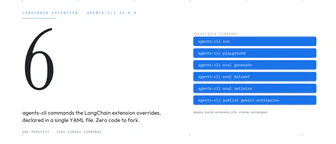
Agents CLI 1.5.0 version introduces an extension system, allowing developers to override or add commands without modifying the tool, supporting cross-framework usage; the official LangChain extension replaces framework-bound commands while retaining other lifecycle functionalities; developers can create custom extensions, such as adding deployment commands for software bill of materials (SBOM) scanning, enabling enterprise platform teams to enforce governance policies.
 Apple Machine Learning Research
TEAL has for the first time efficiently applied active learning to the token space of ViT for low-budget pixel-level semantic segmentation, boosting mIoU by +24.36 on datasets like CamVid and Cityscapes with only one pixel labeled per image, and achieving full-supervised performance of 97% with 10 pixels labeled.
Gemini CLI releases1515Gemini CLI v0.65.0 has been released, fixing 23 issues, including read-only workspace settings for forced untrusted folders, avoiding duplicate tool responses during session recovery, and preventing the deletion of restored session history during quick exits. It also adds support for custom OTLP headers in telemetry configuration.
Gemini CLI releases1212Gemini CLI v0.66.0-preview.0 released, updated ROADMAP.md to no longer reference the outdated 2025 roadmap, fixed UI output synchronization, debug console height calculation, and tool container scroll border overflow issues, and added a banner hint that it is not optimized for Gemini 4.
Claude Code releases4040Claude Code v2.1.305 released, added sandbox.allowNestedUserNamespaces support for Linux user namespace creation, fixed issues where requests failed on Vertex, Bedrock platforms due to tool search being rejected, and bugs where /effort and /autocompact settings were not taking effect.
 Hugging Face BlogFeatured6666
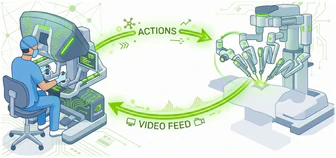
NVIDIA has released Cosmos3-H-Dreams, extending interactive generative simulation to clinical gallbladder removal scenarios, capable of generating surgical scenes in real-time based on instrument movements.
Why it matters: The original text explains the migration path from desktop stitching to clinical cholecystectomy scenarios, as well as the trade-off between quality and delay between four-step and two-step distillation checkpoints.
AWS Machine Learning Blog3838Smartsheet launches the Universal Model Context Protocol (MCP) server, enabling AI assistants to read and write manage Smartsheet data through a standardized protocol; supports Amazon Quick and Kiro connections, Quick for knowledge workers and operations teams to naturally query and update Smartsheet with natural language, Kiro allows developers to refer to project specifications and update task status without leaving the coding environment.