Skip to content
Live
Oct 28Wed
  1. Pragmatic Engineer

    OpenAI Sevbot and AI SRE are developing a status analysis

    OpenAI is developing the Sevbot AI SRE tool, while ING Bank is building its own AI SRE system. AI SRE primarily investigates incidents through Slack, but there is controversy over whether code should be modified directly. Enterprises generally adopt a multi-agent architecture, combining knowledge graphs with memory layers to improve investigation effectiveness. At the same time, it is necessary to verify accuracy through adversarial agents and multi-model combinations, and optimize model routing and prompts to balance speed and cost.

  2. NVIDIA Technical Blog65

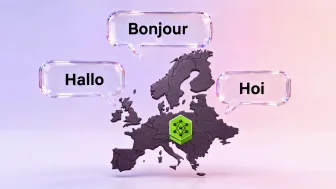
    Fine-Tuning NVIDIA Nemotron to master local rules rather than just local languages

    Fine-Tuning NVIDIA Nemotron can adapt general models with local data, enabling them to possess specific local knowledge and cultural precision required for certain applications. This technology allows the model to meet local language needs while understanding and executing local rules. NVIDIA Nemotron achieves this functionality through fine-tuning, making it suitable for scenarios requiring high localization capabilities.

Oct 27Tue
  1. Hugging Face Daily Papers

    Δτ-Bench Released: Evaluating the Ability of Agents to Adapt to Dynamic Tool Ecosystems

    Δτ-Bench evaluates the ability of agents to adapt to dynamic tool ecosystems, finding that the current strongest model only achieves a 42.3% task success rate. Δτ-Bench includes 1,588 multi-round tasks across 42 domains and 6 ecosystem states. Steward achieves higher task success rates in ecosystem changes through incremental skill maintenance and dynamic resource allocation.

  2. NVIDIA Blog

    C-BRAIN and NVIDIA are jointly using AI to accelerate dementia research

    C-BRAIN and NVIDIA are using AI to change the pace of dementia research. They are accelerating the development of new therapies by integrating previously unpublished Alzheimer's research data, including unpublished results and controlled proprietary data. C-BRAIN employs a hybrid centralized and federated architecture to protect data privacy, deploying 64 NVIDIA data center GPUs and cloud nodes, and plans to introduce the NVIDIA Blackwell system to support its expansion goals.

  3. Hugging Face Daily Papers65

    AV-FABLE: Audio-Visual Tampering Forensic Benchmark for Long Videos

    AV-FABLE introduces an audio-visual benchmark for sparse tampering in long videos, demonstrating that frozen audio-visual large language models' perceptual features contain forensic evidence that the best recovery is achieved by separating time decoders rather than language outputs. Local AI tampering in long videos often affects brief events that impact the authenticity of other content, making video-level classification insufficient for forensic analysis.

  4. IBM Research Blog38

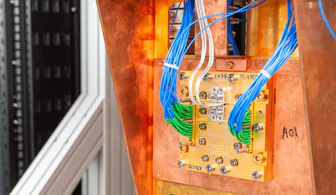
    IBM researchers use l-couplers to connect two IBM Quantum Nighthawk processors

    IBM researchers use four meter-scale l-couplers to connect two IBM Quantum Nighthawk processors, achieving 99% quantum state transfer fidelity, demonstrating reliable quantum information transfer between processors. This new inter-chip connection design is compatible with IBM Quantum Nighthawk and can be scaled to IBM Quantum Starling and more advanced quantum computers.

  5. Ant Group inclusionAI · Hugging Face new models58

    inclusionAI/Ling-3.1-flash-1019 released: 560B parameter large language model inference ability improved.

    inclusionAI/Ling-3.1-flash-1019 released, 560B parameter size, 25B active parameters/Token, 1M context window, improved reasoning ability, AA-Briefcase score 1524 Elo, AutomationBench-AA 68%, Artificial Analysis Intelligence Index v4.3.2 44 points. Supports SGLang and vLLM inference.

  6. QbitAI58

    Huasai Technology Kosmo data terminal helps Pixar create real-world 3D Gaussian splatting data.

    Pixar's official 3D rendering tutorial thanks Chinese company Huasai Technology for providing the 3D scene scanning solution Kosmo. This terminal integrates LiDAR, ultra-high-definition imaging systems, a one-inch large-bottom CMOS, and a high-precision IMU, capable of collecting real 3D Gaussian splatting data of 100 square meters within 15-20 minutes. It directly outputs data usable for AI model training, controllable editing, and 3D digital models with preserved spatial relationships and color/shape fidelity, providing a real-world data engine for the film and entertainment and embodied intelligence fields.

  7. Ai2 Blog

    Ai2 has released the research 'Old Ideas, Novel Problems' to evaluate the reliability of large language models in judging the innovative nature of scientific research

    Ai2 has released a study titled 'Old Ideas, Novel Problems,' evaluating the reliability of six LLMs (GPT-5.1 to 5.4, Claude Sonnet 4.5 to 4.6) in judging the innovativeness of scientific research. The study found that fine-tuning prompts can lead to accuracy differences of over 50%. The research constructed a benchmark dataset containing 154 human-generated and 154 AI-generated scientific ideas, confirming that models have insufficient stability in judgment and require more reliable methods to evaluate new ideas proposed by AI.

  8. Hugging Face Daily Papers65

    Function-Space Policy Optimization (FSPO) released: a new reinforcement learning framework combining privileged adaptation with function-space time integration

    The Function-Space Policy Optimization (FSPO) framework significantly improves the SDPO method by storing sparse historical next-word distributions as fixed time targets, combining privileged adaptation with function-space time integration, achieving time separation without maintaining a persistent teacher model.

  9. Hugging Face Daily Papers65

    FORK Reward Mechanism: Alleviating Reward Hacking in Standard-Based Reinforcement Learning through Precise Targets

    The FORK reward mechanism enhances response quality and reduces redundancy by combining necessity credit driven by scoring with factual scoring, while optimizing recall and precision. Compared to traditional rewards based solely on recall, FORK significantly improves precision and shortens response length while maintaining similar scoring coverage, increasing win rates from 10.6% to 68.0% on RubricHub-Medical and from 22.1% to 74.1% on HealthBench.

  10. MarkTechPost71

    Baidu open-sources Unlimited OCR 2, supporting the parsing of hundreds of pages of documents.

    Baidu open-sources Unlimited OCR 2, a 3.34B parameter OCR visual language model that can parse hundreds of pages of books, financial reports, and reports in a single request. The weights are released under the MIT license, and the code is on GitHub.

    Why it matters: The original text provides a comparison of SR-SWA's sparse attention mechanism with the hundred-page document benchmark, showing how the contextual cost of long document OCR can be flattened.

  11. Hugging Face Daily Papers38

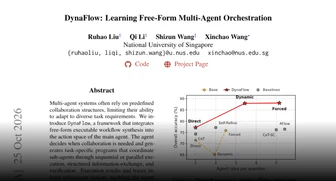
    DynaFlow: Learning Free-Form Multi-Agent Orchestration

    DynaFlow coordinates sub-agents by having the main agent synthesize executable processes, achieving adaptive multi-agent collaboration. The framework integrates free-form executable process synthesis into the action space of the main agent, where the main agent determines when collaboration is needed and generates programs for specific tasks, coordinating sub-agents through sequential or parallel execution, structured information exchange, and verification.

  12. Hugging Face Daily Papers

    TraceTrial-Bench evaluates the reliability and failure attribution of AI agent frameworks

    TraceTrial-Bench evaluates the reliability of agent frameworks through mechanism-oriented tasks, trajectory tracking, and failure attribution, covering seven aspects such as context, execution, and governance. It conducted 3,420 runs of evaluation on 4 frameworks, 9 models, and 95 tasks, resulting in macro-average framework scores ranging from 59.8% to 72.0%.

  13. Hugging Face Daily Papers65

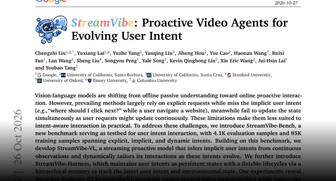
    StreamVibe: Active Video Agent and its benchmark, models, and memory framework

    StreamVibe-Bench releases a benchmark containing 4.1K evaluation samples and 85K training samples for testing explicit, implicit, and dynamic user intent interaction; StreamVibe-VL is a streaming active video language model that infers implicit intentions and dynamically adjusts interaction by continuously observing; StreamVibe-Harness maintains user intentions as persistent states through a hierarchical memory framework, tracking the latest user intentions and environmental states, improving the consistency of proactive interaction responses by 12.3%.

  14. Ant Group inclusionAI · Hugging Face new models38

    inclusionAI/Ling-3.0-flash-Sante-fp8 released: FP8 quantized medical dedicated large model

    inclusionAI/Ling-3.0-flash-Sante-fp8 released FP8 quantized version, retaining 124B parameters (5.1B/Token) and BF16 performance, reducing memory and improving deployment efficiency, supporting medical inference, research, and tool-assisted workflows, requiring professional manual review. Stable performance on benchmarks like Healthbench, ReDisQA, achieving efficient inference through block FP8 quantization (128x128 blocks).

  15. Databricks Blog

    Lakeflow Connect integrates enterprise productivity with AI data

    Lakeflow Connect supports wikis, project management tools, and AI base models through native connectors, enabling downstream AI agents to obtain complete business context. The platform provides fully managed native connectors that support SaaS applications, databases, and file sources, with data directly imported into the Databricks platform, and incremental import of Unity Catalog tables through point-and-click UI or API configuration.

  16. ITHome · AI

    Ollama Mac version adds offline AI voice generation: data stays within the door, speed up to 35% faster than the original solution.

    Ollama announced on October 24 that its Mac app officially supports text-to-speech (TTS) generation. The first supported voice model is the Phonon series developed by Gradium, which allows users to run it without relying on cloud services on Apple Silicon Macs. On MacBook Pro equipped with the M5 Max chip, Phonon voice generation speed is 35% faster than Gradium's own implementation and supports real-time voice generation.

  17. Baseten Blog

    BDN Sealed Volumes: A Model Data Solution for One-Time Release and Anywhere Mounting

    BDN has released the Sealed Volumes feature, allowing users to publish model data once and mount it in any deployment, solving the data drift problem caused by model files lacking a single data source. This feature archives directories, Hugging Face repositories, S3/GCS, and other data sources as immutable versions, managing files through content hash keys, eliminating the need for repeated downloads during deployment.