Skip to content
Live
Nov 12Thu
  1. Google Research58

    Google Research has released a wearable device-driven CKM risk assessment framework

    Google Research releases a wearable device-driven CKM risk assessment framework, predicting future health trajectories through an explainable health age model (CHA). The framework is trained on wearable data from 2.2 million weeks using the SensorWM model, providing personalized 12-week counterfactual health simulations combined with language models to generate clinically validated guidance plans. The CHA model integrates modifiable indicators such as heart rate, steps, and sleep to predict disease risk over 68,000 person-years, improving the predictive performance of clinical indicators.


  2. The Decoder85

    Google DeepMind releases AlphaProof Code, a four-week verification of the Signal encryption core

    Google DeepMind releases AlphaProof Code, an AI-powered mathematical proof software that meets security specifications, and completes the verification work usually requiring several years on the Signal encryption protocol in just four weeks.

  3. Google AI Blog78

    Why it matters: The original text provides forward scoring, latency, and pricing data, allowing readers to judge its suitability for which low-latency decision-making scenarios.

  4. Google AI Blog

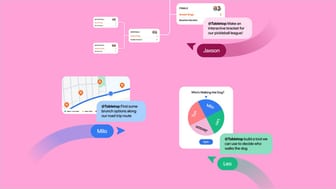
    Google AI has launched Tabletop: a customizable collaborative space supporting team planning, interaction, and sharing.

    Google AI has launched Tabletop, a new experimental platform for real-time collaboration, supporting teams to generate customized itineraries, polls, expense splits, and schedules. Users can create interactive spaces via @tabletop prompts or templates, share links for multiple people to use simultaneously, similar to Google Docs. It is currently rolling out to users over 18 in the US via a waiting list.

    Same story · 2 outlets

    How the accounts differ:Google AI Blog mentions features like voting, expense splitting, and schedule tables; The Verge focuses on features like savings tracking and chore assignment tables.

  5. Google Developers Blog78

    Google releases generative UI open protocol A2UI 1.0

    Google has released the Generative UI Open Protocol A2UI 1.0, which is the first stable version of the protocol, allowing AI agents to respond with interactive interfaces instead of plain text. Version 1.0 adds bidirectional function calls, accessibility support, and extended metadata, and provides open-source rendering SDKs for Web, Android, iOS, as well as agent SDKs for Python, TypeScript, and Dart.

    Why it matters: A2UI 1.0 extends agent output from pure text to native interactive interfaces, providing multi-platform renderers and integration scheme examples, allowing for judgment on the implementation methods of generative UI.

  6. The Verge · AI65

    Google DeepMind has released the AlphaGenome 2 model, analyzing how DNA affects different cells.

    Google DeepMind releases AlphaGenome 2 model, predicting gene variation impacts on different cell types and states by analyzing over 100 million cell outline data, identifying nearly double the variable gene expression mutations compared to the previous generation model

  7. The Verge · AI65

    Google's Tabletop AI experiment project: Building customized collaboration applications

    Google has released an experimental AI tool called Tabletop, which generates customized collaboration centers through descriptions and supports coordination for families and friends. The platform is similar to Asana and Monday, with built-in AI capabilities to create interactive tools such as savings trackers and chore distribution sheets. It is currently open for testing through a waiting list, available only to users in the U.S. aged 18 and above.

    Same story · 2 outlets

    How the accounts differ:Google AI Blog mentions features like voting, expense splitting, and schedule tables; The Verge focuses on features like savings tracking and chore assignment tables.

Nov 11Wed
  1. Google DeepMind66

    DeepMind releases AlphaGenome 2, predicting DNA variation impacts by cell type

    Google DeepMind releases AlphaGenome 2, a conditional DNA sequence model that can predict the impact of DNA mutations on gene expression for specific cell types or states.

    Why it matters: Officially disclosed the conditional architecture modification and single-cell level evaluation comparison, which can understand how the model localizes the effect of mutation to specific cell types.

  2. Ars Technica · AI75

    Google DeepMind uses AI to mathematically verify key parts of the Signal protocol

    Google DeepMind researchers used AI agents to formally verify multiple key cryptographic guarantees of the Signal protocol, completing the project as a proof of concept within four weeks. This work provides independent verification for encryption used by platforms such as Signal, Google Messages, and WhatsApp, while also demonstrating the formal verification capabilities of the new AI framework AlphaProof Code.

  3. Google AI Blog

    Google Arts & Culture's open-source multimodal model Veo recreates the early memories of artist Esther Mahlangu

    Google Arts & Culture open-sources multimodal model Veo, transforming the early memories of artist Esther Mahlangu into video, completing an online retrospective exhibition of her life. The model is based on 45 stories and archival materials, generating images and converting them into video to present key memories such as her 10th birthday discovery of her painting talent.

  4. ITHome · AI35

    Google launches three top-level domains .eat .fly .here

    Google launches .eat, .fly, and .here three top-level domains, providing dedicated domain suffixes for dining food, travel technology, and business services, with Wingstop, Caddy, and Zillow being the first to use them. Users need to register and pay a one-time fee before November 18, and then the full registration will be open with an annual fee.

  5. ITHome · AI

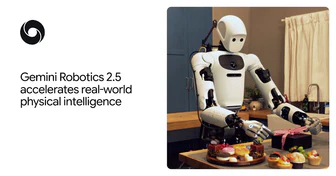
    Google's strongest VLA robot model, Gemini Robotics 2.5, debuts, can tie bows, already on the Mercedes production line

    Google launches VLA robot model Gemini Robotics 2.5, achieving leaps in dexterity, reliability, and safety, with a success rate of 96% on the Mercedes production line. The model has tested 200 tasks, with a success rate 30%-100% higher than the baseline, a speed increase of 20%-30%, and is compatible with robots like Apptronik Apollo 2, adopting ASIMOV-Jailbreak benchmark to enhance jailbreak resistance to 99.5%.

  6. ITHome · AI

    Google's strongest model yet, Gemini 4 Carbon, debuts: Focused on complex programming, scientific research, and cybersecurity

    Google has released the Gemini 4 Carbon model, which is its most powerful reasoning model to date. The model has a unified context window of 1,048,576 tokens, with a maximum standard synchronous request output of 65,536 tokens, expandable to 1,048,576 tokens via the Long Decode mechanism.

  7. ITHome · AI

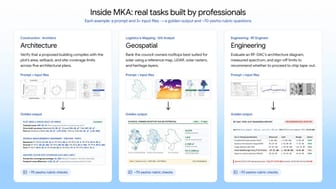
    Google, in collaboration with Artificial Analysis, has launched the MKA benchmark: Gemini 4 Carbon multimodal knowledge work test ranked second, with task costs being only one-sixth of the first place.

    Google, in collaboration with Artificial Analysis, has launched the MKA benchmark test to evaluate the ability of AI agents to handle multimodal knowledge work. Gemini 4 Carbon ranked second in the test, with task costs being one-sixth of the first-place cost.

  8. Gemini CLI releases12

    Gemini CLI v0.68.0 released

    Gemini CLI v0.68.0 released, fixing case-insensitivity issues in Windows environment, recognizing dot-separated Gemini 3 models, adding extension validation command and evaluation tests, and handling bugs such as history re-rendering after terminal width changes, proxy alignment symbol truncation, and dollar sign corruption in LLM prompt templates.

  9. The Decoder

    Google releases the Gemini 4 Carbon model

    Google has released the Gemini 4 Carbon model, showing better reasoning performance than Fable 5.2 in the Artificial Analysis test, complementing rather than replacing Gemini 4 Argon, which is more suitable for most software engineering tasks.

  10. n8n Blog62

    Google Gemini 4 Carbon is released in n8n, enhancing the security, reliability, and efficiency of agents and workflows

    Google Gemini 4 Carbon has officially launched on n8n, being Google's strongest model, scoring 53.9% on AutomationBench. It significantly improves in security (SEC-bench Pro 88.2%, ExploitGym 54.8%, CWE-bench 71.0%), long task processing (internal testing lasting several days), and reasoning, and has zero vulnerability to Gray Swan prompt injection attacks (0.0%).

  11. Google DeepMind87

    Google DeepMind releases the Gemini 4 Carbon cutting-edge model

    Google DeepMind has opened Gemini 4 Carbon to developers, enterprises, scientists, and consumers, claiming it has reached cutting-edge levels in network security capabilities and long-range intelligent agent workflows.

    Why it matters: The official provides the positioning division of roles between Carbon and Argon, multiple benchmark rankings, and cost comparisons per task to help determine when to use a heavier model.

  12. TechCrunch · AI

    Google releases two new TPU chips to expand AI hardware portfolio

    Google has released two new TPU chips, TPU 8tx and TPU 8i Max, for AI workloads, expanding its chip portfolio to confidential inference and larger memory capacity. The TPU 8tx was developed in collaboration with AMD, designed specifically for confidential training and running AI models, with hardware-level direct integration of security features; the TPU 8i Max combines two TPU 8i chips, doubling memory capacity, processing power, and bandwidth, supporting AI models to handle a wider range of information.

    Same story · 4 outlets

    How the accounts differ:MarkTechPost states TPU 8tx uses TPU 8t chips paired with 5th gen AMD EPYC, while TechCrunch mentions it was co-developed with AMD for secret training and running AI models with direct hardware security integration.

Nov 10Tue
  1. Google DeepMind76

    Google DeepMind releases Gemini Robotics 2.5 vision-language-action model

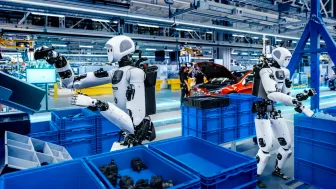
    Google DeepMind released Gemini Robotics 2.5, claiming it is the most capable vision-language-action (VLA) model to date, with a 30% to 100% increase in success rate on 200 tasks compared to previous baselines, and 20% to 30% faster task completion speed.

    Why it matters: Officially disclosed were 200 task evaluations and actual production line test data showing a 96% success rate for Mercedes-Benz, which can be used to judge the extent of VLA model deployment in real industrial scenarios.

  2. Ars Technica · AI

    DeepMind releases Gemini Robotics 2.5 and open-source security benchmark "ASIMOV-jailbreak"

    DeepMind releases Gemini Robotics 2.5, whose robotic AI has approached human level in completing 200 tasks such as gripping food and laboratory pipetting, and has achieved high-precision operations like tying bows on the Apptronik Apollo humanoid robot; this version significantly improves dexterity while launching the open-source security benchmark "ASIMOV-jailbreak".

  3. The Verge · AI

    Adobe is fully committed to AI

    Adobe announced that it will introduce chatbots and AI agents as the next-generation design assistants, even automating creative workflows and repetitive tasks. At the Adobe Max conference in Miami, Adobe introduced a feature that allows third-party AI agents to access and modify Creative Cloud projects, new features for the Firefly AI assistant, and the ability of AI agents to perform repetitive tasks in the background.

    Same story · 2 outlets

    How the accounts differ:The Verge states Adobe will automate creative workflows and repetitive tasks; TechCrunch only mentions injecting AI features into products.

  4. ITHome · AI

    Adobe Creative Cloud integrates with third-party AI agents, supporting local photo and video editing in the future

    Adobe announced new features at the MAX conference, allowing third-party AI agents to directly access and modify Creative Cloud projects via the Local Model Context Protocol (MCP), supporting AI agents from companies like OpenAI, Google, and Anthropic for background processing of regular tasks, and the Firefly AI assistant beta version adds planning mode, model selector, and Firefly Boards support.

    Same story · 2 outlets

    How the accounts differ:The Verge states Adobe will automate creative workflows and repetitive tasks; TechCrunch only mentions injecting AI features into products.

  5. The Decoder

    Anthropic's Fable 5.2 completes 41% of real freelance tasks, up 38.5% from last year

    Anthropic's Fable 5.2 completed 41.3% of real freelance tasks, an increase of 38.5% compared to last year. The model excelled in areas such as 3D modeling, audio editing, and architectural design, successfully completing nearly 50 complex projects that previous AI models could not solve. Its direct predecessor, Fable 5.1, only completed 17.8%, while Opus 5.5 and GPT 6 Astra ranked behind with 21.25% and 20.83% respectively.

  6. ITHome · AI

    Google DeepMind used AI to complete the formal verification of the Signal protocol, mathematically proving its end-to-end encryption reliability.

    Google DeepMind used AI to complete the formal verification of the Signal protocol, mathematically proving its end-to-end encryption reliability. The analysis process took about four weeks, but the specific scale of computational resources was not disclosed, and it is currently unclear about the practical feasibility of applying the technology on a larger scale.

  7. ITHome · AI

    Google Gemini launches memory summary feature, users can view/edit/delete personal information remembered by AI

    Google has introduced memory summary features for Gemini, allowing users to view, edit, and delete personal information remembered by AI. The new feature organizes personal information by category, including background, relationships, work, and interests, and supports deletion and modification. The access point is located at 'Settings' - 'Personal AI' - 'Memory Summary'. It is currently mainly targeted at American Google AI subscribers aged 18 and above, requiring English, Keep activity logging, and memory features to be enabled.