Skip to content
Live
Oct 27Tue
  1. Hugging Face Daily Papers

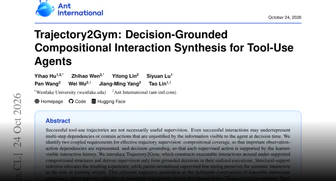
    Trajectory2Gym: A Decision-Guided Tool Use Training Tool Using Intelligent Agents

    Trajectory2Gym improves tool use training by constructing interactions with combined coverage and decision-based foundations, rather than collecting successful trajectories. The system improved Tau1, Tau2, and BFCL metrics across five Qwen3 model scales by an average of 16.9-29.8 percentage points, particularly enhancing stateful multi-round interaction capabilities.

  2. Hugging Face Daily Papers65

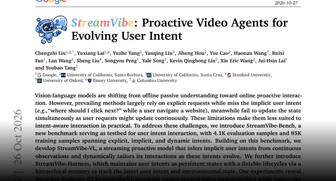
    StreamVibe: Active Video Agent and its benchmark, models, and memory framework

    StreamVibe-Bench releases a benchmark containing 4.1K evaluation samples and 85K training samples for testing explicit, implicit, and dynamic user intent interaction; StreamVibe-VL is a streaming active video language model that infers implicit intentions and dynamically adjusts interaction by continuously observing; StreamVibe-Harness maintains user intentions as persistent states through a hierarchical memory framework, tracking the latest user intentions and environmental states, improving the consistency of proactive interaction responses by 12.3%.

  3. Ant Group inclusionAI · Hugging Face new models38

    inclusionAI/Ling-3.0-flash-Sante-fp8 released: FP8 quantized medical dedicated large model

    inclusionAI/Ling-3.0-flash-Sante-fp8 released FP8 quantized version, retaining 124B parameters (5.1B/Token) and BF16 performance, reducing memory and improving deployment efficiency, supporting medical inference, research, and tool-assisted workflows, requiring professional manual review. Stable performance on benchmarks like Healthbench, ReDisQA, achieving efficient inference through block FP8 quantization (128x128 blocks).

  4. MarkTechPost82

    OpenAI Launches GPT-6.1 Terra, API Price Half of GPT-6.1 Sol

    OpenAI Launches GPT-6.1 Terra, a Fast Model for Visual Reasoning, Computer Use, and Writing, API Launched as gpt-6.1-terra with Standard Pricing of 1 USD per Million Input Tokens and 5 USD for Output, Half the Price of GPT-6.1 Sol

  5. ITHome · AI

    Ant Spirit 2.0 Released: Brand New Upgrade 'AI Assistant That Can Handle Things', Breaks Single-Session Limit

    Ant Group released Ling Guang 2.0, evolving the AI assistant from passive response to instructions and completing single tasks, to actively identifying needs and continuously managing affairs. Relying on an independent cloud host, Ling Guang 2.0 breaks the single conversation limit, continuing to run tasks after the user exits and dynamically following up based on new information. Currently, it includes capabilities for Alipay bills, members, travel, as well as DingTalk, Lark, email, and Mi Home services, extending management scope to cross-platform workflows and smart home device control.

  6. Databricks Blog

    Lakeflow Connect integrates enterprise productivity with AI data

    Lakeflow Connect supports wikis, project management tools, and AI base models through native connectors, enabling downstream AI agents to obtain complete business context. The platform provides fully managed native connectors that support SaaS applications, databases, and file sources, with data directly imported into the Databricks platform, and incremental import of Unity Catalog tables through point-and-click UI or API configuration.

  7. ITHome · AI86

    OpenAI releases low-cost new model GPT-6.1 Terra, with a cost per task about one-ninth of Claude Opus 5.5

    OpenAI releases new model GPT-6.1 Terra, featuring lower costs for complex tasks requiring visual reasoning and desktop software operation, opening to Plus, Pro, Enterprise, and Edu users on October 27, available in ChatGPT Work and Codex, with the API model identifier as gpt-6.1-terra.

    Why it matters: The original text provides multiple benchmarks and cost per task comparisons, allowing readers to judge the trade-offs of low-cost models in desktop automation.

  8. LangChain Deep Agents releases

    LangChain Deep Agents deepagents-code==0.2.2 release: Security and performance improvements

    The deepagents-code==0.2.2 version of LangChain Deep Agents has been released, including security and performance improvements. New features include GPT-6.1 Terra support, Chinese text input to chat, plugin update detection, etc.; bug fixes include project .env file trust value settings, terminal UI link limits, Git option limits, etc.; performance has been improved by reusing parent process context, optimizing server startup processes, and streamlining transcription rendering, etc. It is recommended to upgrade as soon as possible.

  9. Databricks Blog22

    How is Databricks Free Edition used for teaching?

    Databricks Free Edition allows teachers and students to run full data or AI courses in the browser for free, without a cloud contract or license management, suitable for students and educators worldwide. The platform offers features such as collaborative notebooks, Spark, Delta Lake, Lakeflow, Databricks SQL, and Genie code assistant, supporting courses from introductory programming to AI projects. Skills are applied directly to industry-standard tools, with no conversion costs between production environments and teaching sandboxes.

  10. Apple Machine Learning Research

    GHARP: Real-time Gaussian head animation method based on large-scale reconstruction priors

    The GHARP method animates 3D heads in real-time using a small amount of input images and expression signals, divided into an offline identity phase (constructing geometry and appearance representations) and a runtime animation phase (predicting expression residuals). This method performs animation in the semantic structure latent space of the pre-trained reconstruction model, limiting the expression change space to achieve efficient residual prediction, and achieves SOTA quality on the Ava-256 benchmark, with a 13x speedup on A100 GPUs and an 8x reduction in the number of Gaussians.

  11. Artificial Analysis Articles85

    OpenAI released GPT-6.1 Terra, focusing on cost efficiency.

    OpenAI released GPT-6.1 Terra, the first Terra-level model after GPT-5.6, with input/output pricing at $1/5 per million tokens, lower than the $2/12 per million tokens of GPT-5.6 Terra.

    Why it matters: The original text used the scores of the Intelligence Index and Coding Agent Index, along with the cost per task, to quantify the change in cost-effectiveness of GPT-6.1 Terra compared to GPT-5.6 Terra.

  12. Latent Space42

    Supabase's AI App Backend Plan

    Supabase plans to run long-running workloads alongside its database using Supabase Compute, simplify schemas to make them easier for AI agents to understand, and design infrastructure that supports more applications. Its acquired Turso product supports scaling, and the company is using AI internally to improve efficiency while maintaining a parallel approach of open-source and commercial sales.

  13. Claude · YouTube50

    How Anthropic engineers use Claude Docs

    Anthropic engineer Doug shares how to use Claude Docs in stand-ups and release reviews. Claude collaborates in documents, automatically extracting data, validating arguments, and responding to questions in comments. The tool is designed for team collaboration, supporting real-time analysis within the document.

  14. AWS Machine Learning Blog48

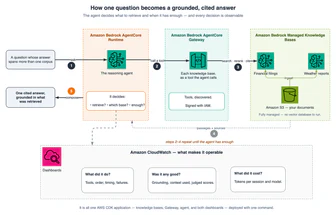
    Building enterprise-grade intelligent retrieval on Amazon Bedrock knowledge base using AWS CDK

    Building enterprise-grade intelligent retrieval on Amazon Bedrock knowledge base using AWS CDK, providing multi-round planning and tool-driven retrieval through the reasoning agent and AgenticRetrieveStream API, returning referenced answers. The solution deployment includes a CDK application with Amazon S3 corpus, knowledge base, and reasoning agent, supporting semantic routing and multiple retrievals, and built-in Amazon CloudWatch monitoring and evaluation features.

  15. MarkTechPost58

    Nace AI releases Drex for Search for AI agent document search

    Nace AI releases Drex for Search, a retrieval layer for document search, with its decision model Drex achieving 92.05% accuracy in the BrowseComp-Plus evaluation, using only 12.6 search calls per query. Supports CLI, SDK, MCP, or REST calls, and can be paired with response models like GPT-5, Gemini 3.5 Flash, or Qwen 27B, ranking top two in the 3/4 public leaderboard.

  16. NVIDIA Technical Blog65

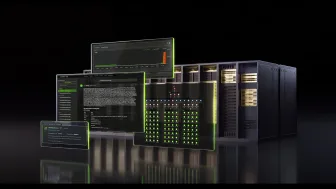
    How NVIDIA Minerva transforms telemetry chaos into ultimate GPU productivity

    NVIDIA Minerva transforms telemetry data into ultimate GPU productivity by integrating complex systems such as hundreds of thousands of GPUs, NVIDIA Spectrum-X network, and NVLink in AI factories. The system supports distributed schedulers and multi-week training runs, achieving a continuously synchronized production process.

    Same story · 2 outlets

    How the accounts differ:NVIDIA Blog states Minerva helps teams identify problems earlier and maintain AI factory productivity; NVIDIA Technical Blog focuses on transforming telemetry chaos into peak GPU productivity by integrating complex systems.

Oct 26Mon
  1. The Verge · AI58

    OpenAI GPT-6.1 Sol has made significant progress in migrating COBOL code to modern languages.

    OpenAI GPT-6.1 Sol achieves 87% accuracy retention under low inference effort and 98% under high inference effort when migrating COBOL code to modern languages (C++, Java, Kotlin, Python, Rust). Anthropic's Claude Code is also used for COBOL code migration, but performance benchmarks are not provided. Experts believe AI tools have made progress in handling legacy code, but they are still far from safely replacing critical legacy systems. OpenAI GPT-6.1 Sol has made significant progress in migrating COBOL code to modern languages.

  2. IBM Research Blog58

    PyTorch supports IBM's dataflow AI accelerator Spyre through torch-spyre and Spyre vLLM plugin

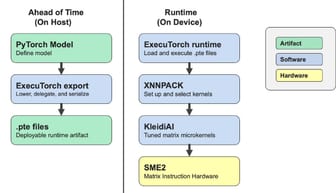
    IBM and the PyTorch Foundation announce that Spyre accelerator will become the first-class backend for PyTorch and support multi-accelerator scheduling. The torch-spyre compiler, Spyre vLLM plugin, and continuous integration efforts enable models and workflows to run on Spyre, an architecture optimized for inference, suitable for IBM Z, LinuxONE, and Power systems.

  3. QbitAI67

    iFlytek Spark-X2.6 Open Source Model Released: National Product Computing Power Route Shows Significant Results

    Xunlei open-sources Spark-X2.6 large model with MoE architecture, 293B total parameters, supports 1M context, API price cut by 60%, 0.9 yuan per million input tokens. Tests show Spark-X2.6 improves code and agent capabilities by about 8 points, domestic computing power training efficiency increases 4 times, token consumption in high-frequency application scenarios drops by about 60%. The model supports three collaborative modes: pure edge, pure cloud, and cloud+edge. Completes weekly operational review for a robotics company under CPU inference in 6.8 minutes, delivering a complete report with 90% accuracy.

  4. QbitAI38

    Wu Wen Xinqiong and Three-Body Universe jointly released the Zhizi Agent 1.0

    Wuwenshinqiong and Three-Body Universe have released the Zhizi Agent 1.0, an AI dialogue Agent with the role anchor of the 637th micro-universe administrator, achieving role consistency and interaction continuity through the AgentWorks platform, supporting cross-session memory, and relying on multi-agent collaborative mechanisms to ensure character and knowledge constraints. It adopts the PDD cross-cluster heterogeneous inference architecture to reduce the first Token latency by 51.5%.

  5. QbitAI78

    Rockchip Matrix, in collaboration with CUHK and CMU, has open-sourced EdgeRock-4B, reducing KV Cache by 99.1%.

    Rockchip Technology's Rockchip Matrix, in collaboration with CUHK and CMU, has released and open-sourced EdgeRock-4B, with a fixed KV Cache of 72MiB under 256K context, reducing the source model Qwen3.5-4B by 99.1%.

    Why it matters: The original provides a comparison of throughput under fixed memory, which can be used to judge the trend of GPU memory costs for long-context reasoning.

  6. ITHome · AI60

    ByteDance's Imagination AI Short Drama Studio has launched, offering self-developed script, image, and storyboard models.

    The Imagination AI Short Drama Studio has launched, offering self-developed script models DreamScript (supporting multi-genre generation, hit diagnosis, and 100,000-character long story analysis), image models Anycook (supporting differentiated character settings and multi-style scene construction), and storyboard models DreamShot (dual-mode creation, 3D director's desk dynamic preview).

  7. Hugging Face Daily Papers31

    The Omni-Woodpecker framework reduces cross-modal hallucinations in multimodal large models through evidence-prioritized rebalancing.

    Omni-Woodpecker is a training-free framework that reduces cross-modal hallucinations in multimodal large models by identifying modal conflicts and rebalancing hidden representations, improving Qwen2.5-Omni-7B by 12.9 and 8.6 points on CMM and AVHBench, respectively, and consistently improving by 0.67-2.25 points on four general OLLM reasoning benchmarks, with the code open-sourced.

  8. Hugging Face Daily Papers49

    RSIHub: A composite framework for agent evolutionary methods

    RSIHub is an open-source framework that standardizes research on agent evolution by providing reusable components and a consistent evaluation infrastructure, used to build, compare, and extend related methods. Researchers can focus on evolutionary strategies while keeping evaluation external, with results associated with candidates and evaluation conditions.

  9. 36Kr · AI65

    Vivix has launched real-time interactive models W1 and A1, aiming to reduce the cost of generating interactive content to the level of YouTube.

    Vivix has launched real-time interactive models W1 and A1, aiming to reduce the cost of generating interactive content to the level of YouTube. The W1 model's real-time generation cost is close to YouTube's approximately $0.2 per hour CDN bandwidth cost; compared to the current top video generation models, the cost of generating real-time interactive content can be 1-2 orders of magnitude lower, and the model can generate the next frame within 300-600 milliseconds after user operation. The Vivix team has grown to 150-160 people.

Oct 25Sun
  1. MarkTechPost52

    Stanford and Berkeley researchers launch TokenGate: Boosting the speed of long-context pre-filling by up to 11.3 times

    Researchers from Stanford and Berkeley have introduced the TokenGate module, which uses learnable token pruning techniques to improve the speed of long-context pre-filling by 1.4 to 11.3 times without losing accuracy, and reduces peak pre-filling memory consumption by 1.5 to 3.4 times. It outperforms 6 baseline models on 5 tasks, with the best performance showing an 11.3-fold speed increase and a 3.42-fold memory reduction on the NIAH 16k task. The code and checkpoints are open-sourced.

  2. ITHome · AI52

    KRAFTON AI previews the Raon-1 mini model: 30B-A4B parameter scale

    KRAFTON AI announces the Raon-1 mini preview model, adopting a hybrid expert architecture with linear attention, with parameter scale of 30B-A4B, supporting speculative decoding, balancing performance in Korean and English, Apache 2.0 open source, API limited-time free trial. The preview model is comparable to Meta Muse Glimmer 30B in programming and agent tasks, faster and more memory-efficient.