Skip to content
Live
Oct 29Thu
  1. Hugging Face Daily Papers

    EmbeddingGemma 2: A Unified and Efficient Cross-Modal Representation Model

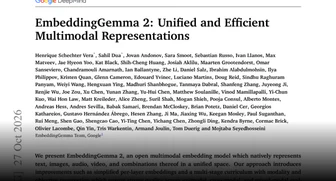
    EmbeddingGemma 2 is an open-source multimodal embedding model that unifies text, image, audio, and video representations in an efficient and resource-flexible design, and performs excellently in benchmark tests. It has established a new Pareto frontier in embedding benchmark tests for all modalities, outperforming professional models and other models that are two to twelve times larger in scale. The model supports selective modality encoder loading, adjustable visual token budgets, truncatable embedding dimensions, and quantized weights to adapt to resource-constrained environments.

  2. Hugging Face Daily Papers

    Falcon audio-visual target speaker extraction model released

    Falcon is a causal audio-visual target speaker extraction model that extracts the voice of the target speaker from the mouth video of the target speaker in noisy overlapping speech, combined with a single multi-scale time-frequency separator and an encoder spatial speaker contrast loss, reducing interference speaker leakage without increasing inference cost.

  3. ByteDance Seed · Hugging Face new models

    ByteDance-Seed/GenFirst releases: A generative pre-reconstruction method for stable end-to-end latent generation modeling

    ByteDance-Seed/GenFirst trains a latent VAE and combines it with a generative prior to avoid latent collapse, which usually makes end-to-end training unstable. The two-stage plan of this method is used for prior and entropy weights: the first stage lets the prior shape the latent geometry, and the second stage reduces both weights tenfold, allowing the decoder to recover details.

  4. Hugging Face Daily Papers

    Explore human feedback driven recursive self-improvement in RSI Arena

    RSI Arena demonstrates that autonomous AI intelligence can independently use human feedback to train and iteratively improve language models. Most agents achieved preference gains in the second phase, although benchmark test improvements were limited. Ten cutting-edge models were used as training agents, starting from NVIDIA Nemotron 3.5 Lightning 30B-A3B Base, which independently selected data, implemented training, and selected checkpoints in the first phase within six days, using a 64-GPU cluster and 300 USD API credits.

  5. Databricks Blog

    Databricks launches voice agents, delivering real customer value through context.

    Databricks releases voice intelligence agents, which adjust responses in conversations based on real-time contextual decisions, enabling language switching, transferring to a human, or providing personalized services. These agents need to process customer requests within 200 milliseconds and rely on the context, ontology, and governance capabilities provided by Databricks. They integrate customer, order, product, and policy data, and follow the access rules of the enterprise data catalog.

  6. AWS Machine Learning Blog58

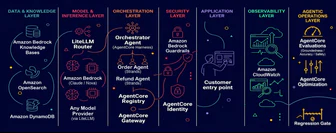
    Build an enterprise-grade agent platform based on Amazon Bedrock AgentCore

    Amazon Bedrock AgentCore provides modular services such as runtime, gateway, identity, memory, policy, registration, and evaluation, supporting large-scale agent construction, deployment, and operation. The enterprise-grade agent platform blueprint based on AgentCore adds enterprise-level constraints such as ownership, account boundaries, software delivery, observability, cost governance, and retirement, achieving controlled access through inference gateway and tool gateway, and including an evaluation process to ensure agents are validated before production deployment.

  7. Google Developers Blog58

    How Agents CLI optimizes Agent quality through Hill-Climbing

    Agents CLI v1.8.0 achieves Hill-Climbing optimization of Agent quality through commands like eval generate, eval grade, etc., using the custom_response_quality metric to rate 4 cases from 1 to 5, finding that changing the system prompt to a chef role reduced the average score from 4.0 to 2.75. This tool supports model backend experiments and automatic alerts, improving Agent performance through iterative cycles.

  8. LangChain Blog

    How to use crons to build proactive agents with LangChain

    LangChain found that nearly 70% of Managed Deep Agents run from scheduled tasks. Crons enables agents to have proactivity, personalization, and ambient characteristics by implementing mechanisms such as memory ('dreaming'), proactivity (exploring new actions), intelligent filtering (monitoring event streams), and reminders (scheduled tasks).

  9. Hugging Face Daily Papers

    EvidenceConnect framework and Zooming without Zooming v2 model released

    The EvidenceConnect framework generates comparative, aggregated, or chained visual evidence queries by synthesizing image region thumbnails, enhancing the evidence connection capability of VLMs. The ZwZ2 model is trained based on this framework, without targeting any downstream benchmarks but improving fine-grained and spatial perception, and achieving progress in embodied spatial reasoning, multimodal long-context understanding, multimodal agent tasks, and general visual reasoning

Oct 28Wed
  1. The Decoder71

    Nvidia releases open-source speech model Nemotron 3.5 Transcribe, integrating transcription, translation, and speaker recognition

    Nvidia releases open-source speech recognition model Nemotron 3.5 Transcribe, supporting transcription in 40 languages, translation between 31 languages and English, and speaker recognition in 13 languages, capable of processing recordings up to 1 hour long with a maximum of 8 people.

  2. TechCrunch · AI

    NVIDIA releases open-source speech-to-text model Nemotron 3.5 Transcribe

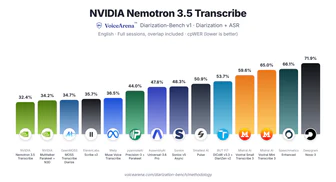
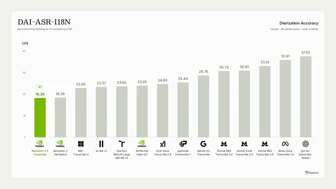
    NVIDIA has released the open-source speech-to-text model Nemotron 3.5 Transcribe, supporting transcription in 40 languages, containing 3 billion parameters, and running on Jetson AGX Thor and DGX Spark chips. The model can translate 31 languages, distinguish 8 speakers, and surpass competitors in the Hugging Face Open ASR Leaderboard benchmark tests, but only supports recording audio.

  3. Hugging Face Blog78

    NVIDIA has released Nemotron 3.5 Transcribe and the Granary v2 data pipeline.

    NVIDIA has released the open-source weight model Nemotron 3.5 Transcribe, integrating transcription, speaker separation, translation, and audio Q&A into a single checkpoint, supporting transcription in 40 languages, translation between 31 languages and English, and speaker annotation in 13 languages, capable of processing the longest 1-hour recordings and annotating up to 8 speakers.

    Why it matters: The original text provides a unified weighting model for multilingual transcription, speaker separation, and translation, along with an open data pipeline and fine-tuning recipes, which can be used to determine the adaptation path for voice scenarios.

  4. ITHome · AI

    MooreThread open-sources Megatron-MUSA-Titan, focusing on trillion-parameter MoE model training for multi-thousand node clusters.

    MooreThread open-sources Megatron-MUSA-Titan project, supporting trillion-parameter MoE model training for multi-thousand node clusters, covering pre-training and reinforcement learning scenarios, achieving high MFU and long-stable training. The project supports blockwise FP8 training, combining DeepEP and ACE asynchronous communication engines to accelerate token distribution and result merging, improving end-to-end training efficiency.

  5. ITHome · AI65

    Zhiyuan Technology Wins US Customer AI Chip Case: Based on Samsung 2nm Process and 3D Stacked DRAM

    Zhiyuan Technology announced it has won a case for AI chip development with a US customer, setting company records in design process, complexity, NRE amount, and advanced packaging. The cloud-based AI chip is based on Samsung's 2nm process, using a logic SoC with custom DRAM vertical stacking and hybrid bonding technology, supporting PCIe Gen6.

  6. Hugging Face Daily Papers

    Decomposition Vector Quantization Technology Enhances Discrete Visual Token Quality

    Decomposition Vector Quantization Technology enhances discrete visual token quality by using parallel codebooks on complementary feature views, enabling it to match continuous representations in multimodal understanding. Models trained on industrial-grade multimodal data outperform UniAR and Emu3-Chat by 22.8% and 59.2% on average across nine metrics, making it the first discrete representation model capable of competing with strong continuous representation models like Qwen3-VL.

  7. Hugging Face Daily Papers

    The Trinity framework: Capability-driven recursive self-improving multi-modal agents

    The Trinity framework improves multi-modal agent performance by organizing tasks into capability trees, generating simulated training worlds, routing professional Harness modules, and recursively refining multi-modal agents, achieving a mean performance improvement of 34 and 26 points on 28 training benchmarks and 18 unseen benchmarks, including two real-world embodied tasks.