Skip to content
Live
Oct 15Thu
  1. OpenAI Deployment Safety

    GPT-Live-1.1 System Information Card

    GPT-Live-1.1 and GPT-Live-1.1 Quip are trained on a diverse dataset including public internet information, third-party collaboration data, and user-generated content, employing advanced data filtering processes to reduce personal information and using secure classifiers to prevent harmful content. The performance metric comparison value is based on the latest version data of published models.

  2. Google Developers Blog

    How to evaluate AI agents: Beyond sensory checks.

    Evaluating AI agents cannot rely solely on perception checks, as agents may fall into retry loops or produce hallucinatory responses that still appear normal, leading to soaring cloud costs and token usage. A repeatable evaluation process should be established, starting with defining key user journeys (CUJ), using simulated user testing, and employing multiple layers of checks such as unit tests, deterministic metrics, LLMs as judges for scoring standards, and integration tests. Combining manual review tracking with automated validation can detect latent regressions early in development and expand the evaluation framework as agent capabilities grow.

  3. Apple Machine Learning Research

    MLX and RDMA implement local and distributed large language model inference on Mac Studio

    On a cluster of four Mac Studio machines, Muse Spark Open (816B parameters) generates at a speed of over 36 tokens/second. The Mac Studio M5 Ultra version offers 4.6x faster inference speed (TTFT) and 1.6x faster tokens/second compared to the M3 Ultra, benefiting from the GPU neural accelerator and 1.2 TB/s memory bandwidth.

  4. Ars Technica · AI

    A hidden recording device was found in an OpenAI top-secret meeting room.

    The FBI accused Saudi engineer Abdulrahman Alfozan of hiding recording equipment in an OpenAI confidential meeting room, intending to steal highly sensitive information involving technology, government, and business cooperation, and threatening national security. The USB device was wrapped in toilet paper by Alfozan and inserted into the back of a television. OpenAI discovered and confirmed the content was encrypted on September 30 and, after installing a camera on October 5, surveillance footage showed Alfozan attempting to retrieve the device. Alfozan was arrested after working as an OpenAI engineer for a year.

Oct 14Wed
  1. Apple Machine Learning Research27

    Whisper-small performs excellently on the Code-Switching Detection task

    Whisper-small achieved an average F1 score of 0.798 across 14 language pairs in the CS-FLEURS benchmark test, surpassing CNN's 0.776 and HuBERT's linear baseline's 0.751. The method detects language switching directly from speech by identifying the language-selective hidden state dimension in pre-trained speech encoders, and only requires a small amount of code to convert the dataset to fine-tune decision rules.

  2. OpenRouter Blog75

    OpenRouter has launched the Private Endpoints feature, supporting access to private fine-tuned models and reserved capacity.

    OpenRouter has launched the Private Endpoints feature, allowing users to access private fine-tuned models or reserved capacity through existing APIs, which are visible only within the organization and not publicly. Private endpoints need to be connected via BYOK to support OpenAI-compatible deployments, can set dedicated pricing and inherit model slug, up to a maximum of 10 endpoints, require a paid Enterprise plan subscription.

  3. IBM Research Blog38

    IBM will launch the 7-nanometer nanoscale stacking technology early research and development process design kit (PDK) in the first quarter of 2027.

    IBM announced that it will launch an early research and development process design kit (PDK) for 7-nanometer nanoscale stacking technology in the first quarter of 2027, to help semiconductor companies evaluate the technology before large-scale adoption. The kit will provide a standard cell library for logic functions and SRAM design examples, supporting layout and routing, early module-level layout, and density and power performance evaluation. Nanoscale stacking technology achieves 3D layout at the transistor level for the first time on logic wafer technology by stacking transistors vertically rather than placing them side by side, which is significantly different from current nanosheet transistor architectures.

Oct 13Tue
  1. IBM Research Blog58

    IBM Research uses an open-source agent factory to achieve 52-fold acceleration in quantum error correction chip design with a cost of $26

    IBM Research uses an open-source agent factory to optimize quantum error correction hardware, achieving 52x acceleration with a cost of about $26; with the same budget, a closed-source cutting-edge model configuration costs $299 (11.5x higher) but provides 204x acceleration, with the open-source configuration achieving hardware optimization with a smaller area; the agent factory assigns tasks to parallel working agents through a coordinator, combining code modification with hardware effect evaluation, exploring various architectural possibilities.

  2. LangChain Blog

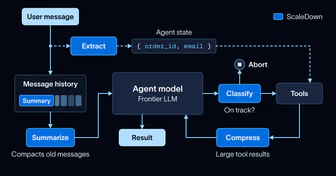
    How ScaleDown optimizes context management for long-running agents through compression and extraction techniques

    ScaleDown optimizes context management for long-running agents through compression and extraction techniques, its model is 41 times cheaper and 2.7 times faster than general models like GPT-5.5 in benchmark tests. ScaleDown provides four models: Summarize, Compress, Extract, and Classify, respectively for summarization, compression, extraction, and classification, supporting up to 1M tokens of input, and supporting image and PDF input.

  3. MIT Technology Review · AI

    Anthropic points out that Z.ai's GLM-5.3 poses a significant risk of cyberattacks.

    Anthropic released a report stating that the Z.ai model released in August, the GLM-5.3 model, poses a significant risk of cyberattacks due to its ability to be downloaded and modified arbitrarily. The model is currently open-source, but compared to closed models like ChatGPT and Claude, its capabilities are slightly inferior, but it allows users to run and retrain it locally, and supports researchers in observing its internal mechanisms in depth.

  4. Google Developers Blog

    Gemini 4 Argon optimized the performance of a 200,000-line Python codebase

    Gemini 4 Argon has been running for 11 hours without human intervention, proposing 6 optimization suggestions by analyzing the ADK Python repository with 205,000 lines of code. Ultimately, 2 of them were adopted and deployed, reducing the memory session preparation time by about 40% and increasing the cold package import speed by 21%. The model followed the repository maintainer's guidelines during the optimization process and ran all 16,892 unit tests.

  5. Amp News70

    How to use Puck in ChatGPT and Claude

    Users can interact with Puck through MCP, brainstorm tasks in ChatGPT or Claude, and then send them to Puck for implementation and management. Puck knows the user's projects in Amp and routes them to the correct module, supporting direct viewing of Amp work progress in ChatGPT. MCP provides the puck tool for Amp interaction and the orbs tool to display the interaction view of running modules.

  6. GitHub Blog · AI & ML

    GitHub Copilot Application Introduction: How to Teach Copilot to Understand Your Codebase

    GitHub Copilot can allow users to convey project rules, encapsulate repeatable processes, provide professional guidance, and connect external tools to improve collaboration efficiency through custom instructions, proxy skills, custom agents, and the Model Context Protocol (MCP) server. Custom instructions define code standards, proxy skills encapsulate repetitive tasks, custom agents handle complex work, and MCP servers extend Copilot functionality.

  7. Microsoft Research

    Microsoft Research open-sources multi-modal model StudentSim for simulating student learning behavior

    Microsoft Research has open-sourced the multimodal model StudentSim for simulating student learning behavior. It is trained on publicly anonymized learning records to create a personalized student simulator that outperforms benchmarks in areas such as chess, English writing, and mathematics. It provides early feedback signals for AI tutoring systems but is not intended to replace teachers or classroom teaching.

Oct 12Mon
  1. Microsoft Official Blog

    Microsoft expands the Azure Maia system to multi-gigawatt deployment

    Microsoft is expanding the Azure Maia system to multi-gigawatt deployment, Maia 200 has entered production, and Maia 300 will be launched in 2027. Maia 200 is serving Microsoft's production workloads, including Microsoft Copilot, and supports the MAI team in developing next-generation models. GitHub Copilot and Microsoft Foundry will be launched by the end of this year.

Oct 10Sat
  1. Sierra Blog

    The draft of the Personal Agent Protocol has been released, and 35 design partners have joined.

    The draft of the Personal Agent Protocol (Poppy) has been released, announcing the participation of 35 new design partners such as Adyen and Atomic; the protocol is based on standards such as OAuth and JWT, allowing customers to control agent permissions, and enterprises can securely collaborate across channels (website, API, proprietary agents) to achieve a variety of tasks from returns to mortgage applications.

Oct 9Fri
  1. Simon Willison65

    Simon Willison uses GPT-6 Astra High to build new blog features through voice

    Simon Willison interacted with GPT-6 Astra High via voice to build the Newsletters page of his blog, implementing a subscription list indexing feature, including weekly free Substack and monthly exclusive updates for sponsors. He used the Codex voice chat mode of the ChatGPT desktop application to complete the model, migration, view code, template, and database import functions in a local development environment and integrated the website search engine.

  2. TechCrunch · AI75

    OpenAI's dismissal of three safety researchers has sparked controversy, being accused of undermining safety culture.

    The three safety researchers fired by OpenAI denied violating company policies, stating their actions complied with safety standards, and warned that this move would undermine internal safety culture. They denied participating in the leak of new model architecture information, claiming cooperation with external security organizations was within their job responsibilities. OpenAI, however, stated that the dismissals were based on actions 'violating multiple policies,' but did not specify the exact policies.

  3. AWS Machine Learning Blog

    How BlockRun and Incarna use Amazon Bedrock AgentCore Pay to enable AI agents to pay per inference

    AgentCore Pay allows AI agents to pay as needed, Incarna uses it to enable agents to pay per request to BlockRun for model inference, BlockRun offers on-demand billing inference services for over 90 models. AgentCore Pay reduces the workload of adding x402 support from months to days through hosted wallets, native protocol handling, infrastructure layer spending governance, and auditable settlements.

  4. The Decoder75

    Some mathematicians call for a boycott of OpenAI due to the flood of AI-generated proofs in their field

    Fields Medal winner Terence Tao and others call for a boycott of OpenAI, citing controversy over its AI-generated over 700 mathematical proof documents, including methods for the Navier-Stokes Millennium Problem. OpenAI has established an AGMAI advisory group but has no decision-making power. Mathematicians criticize its failure to adopt recommendations, viewing the speed of problem-solving as the mainstay of disciplinary progress, and implying that AI training relies on the achievements of mathematicians. Experts worry that AI's rapid solutions could hinder innovation in the field and reduce collaboration and exchange brought about by traditional mathematical breakthroughs.

  5. TechCrunch · AI70

    OpenAI's mathematical solutions have not yet reached the standards of the field

    OpenAI released hundreds of solutions this week claiming to solve world-class mathematical problems, but failed to meet mathematical standards, especially in requiring human understanding of mathematical results. A new paper points out that there is a gap between the natural language solution and the formal expression solution of one of the million-dollar problems solved by OpenAI models.AGMAI points out that OpenAI only partially followed its recommendations, for example, only 10 papers publicly disclosed the model reasoning chain, 42% of the proofs were not formally processed, and did not include machine-readable metadata linking natural language to formal results.