Skip to content
Live
Nov 3Tue
  1. Hugging Face Daily Papers47

    uni-robot-agent: Open-source robot use agent unified framework achieves zero-shot operation breakthrough

    The uni-robot-agent framework enables open-source weight robots to surpass proprietary models using agents in zero-shot operation, with its onboard Qwen3.8-Flash-Next scoring 31.39 in the RoboDojo evaluation, exceeding GPT-6 Astra-RoboProbe's 28.97 score and numerous VLA/WAM baselines, and performing excellently in 19 real tasks. Analysis indicates that effective robot use requires combining four general capabilities, suggesting future training should synergistically develop these capabilities.

  2. ITHome · AI65

    Ali Zeng Xinyi: Qwen Open Source Models Have Exceeded 470, Promoting AI Popularization

    Cai Xinxin, co-founder of Alibaba Group, said at the 2026 World Internet Conference that open-source can reduce AI R&D costs and promote AI popularization, especially important for developing countries. Currently, Alibaba's Qwen has open-sourced over 470 models, with a global cumulative download volume exceeding 4 billion and derivative models exceeding 330,000.

  3. MarkTechPost

    Zyphra AI introduces Zyphra Hierarchical Attention (ZHA): The path to true sub-quadratic attention

    Zyphra AI has released Zyphra Hierarchical Attention (ZHA), a sparse attention method based on a tree indexer, designed to address the known issue in sparse attention where the indexer still needs to scan the entire context. ZHA can be distilled into a frozen pre-trained model of about 4B tokens, achieving performance close to dense attention in inference, smart encoding, and 256K retrieval benchmarks on Qwen3.6-35B-A3B.

  4. ITHome · AI

    Aisin developed the world's first 16nm STT-MRAM AI SoC, achieving a 50-fold improvement in object detection efficiency.

    Aisin and Northeastern University have collaborated to develop the world's first 16nm AI SoC integrated with STT-MRAM, using a near-memory computing design to achieve 50 times the target detection efficiency. This SoC uses an 8/16-bit mixed multiplication architecture and weight sharing technology to complete target detection using Tiny YOLOv3 within 32MB of on-chip STT-MRAM, reducing startup time by 38.59 times and increasing AI processing speed by 10.16 times.

  5. MarkTechPost

    The Letter Company has released Letterpress-1: an encoding agent designed for growth engineering

    The Letter Company releases Letterpress-1, an encoding intelligent agent that generates code changes and submits Pull Requests by reading websites and their market data. The agent runs on Letter's hosted platform, requiring no local GPU, and each change must be confirmed and previewed by the user before deployment. The basic plan is priced at $100/month, including 10,000 tokens, with overages charged at 5 times the list price.

  6. OpenAI News

    OpenAI Builds Pando: A Git-Compatible Backend Designed for Codex-Scale Development

    OpenAI has built Pando, a Git-compatible backend, specifically designed for Codex's scalable development.

    Same story · 2 outlets

    How the accounts differ:OpenAI News states Pando is designed for Codex scale development; MarkTechPost mentions it reduces median push latency by about 80% and handles nearly 1PB of Git data daily.

  7. Latent Space

    Legora CTO Jacob Lauritzen shared his experience and insights in building AI agents for lawyers.

    Legora CTO Jacob Lauritzen shared his experience in building an AI agent for lawyers, the company achieving 18,000 customers and $100 million in annual revenue within 18 months. Legora evaluates the agent by simulating the client's work environment (such as a data room due diligence involving 10,000 documents), legal engineers configure the product, and cutting-edge deployment engineers write code and integrate the system.

  8. Hugging Face Daily Papers65

    CEPO: A general prompt optimization framework for multi-agent systems

    CEPO enhances prompt optimization for multi-agent systems by separating shared coordination from agent-specific execution, continuously improving the performance of four existing prompt optimization methods across 11 cross-domain benchmark tests. The framework uses shared coordinator prompts and agent-specific execution prompts, guiding them to update based on their respective roles, allowing shared coordination rules to be consistently optimized across all agents while maintaining independent adjustment of execution instructions. Experiments show that CEPO improves optimization budget efficiency and scales performance as the number of agents increases.

  9. Sierra Blog

    Claude Code restructures Agent Studio to support Ghostwriter

    Claude Code restructures Agent Studio into the core workspace of Ghostwriter, where users can assist from analyzing problems to testing fixes within a single conversation; each work item is an independent conversation thread, supporting team collaboration and version control; Agent Studio integrates multi-agent projects, and Ghostwriter can synchronize updates across agents, all changes require team review before release.

  10. Hacker News · 300+83

    Astra can read and write neural network weights and improve Qwen3.5-0.8B

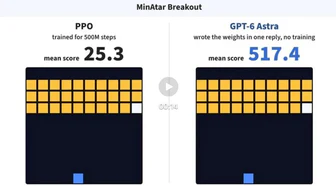
    The research team proposed Weight-Space Programming, discovering that GPT-6 Astra can directly read and write neural network weights: with only 17,253 weights, it can determine which game the network is trained on, and from scratch, write a small game network that defeats PPO trained for 100 million steps without gradients or training.

    Same story — showing the featured version《MIT experiment: GPT-6 Astra directly modifies Qwen3.5 weights, mathematical ability improves by about 6 times》

  11. PyTorch Blog34

    Ray announces the Special Interest Group (SIG) for Accelerators

    Ray announces the Special Interest Group (SIG) for Accelerators, aiming to unite hardware vendors, Ray contributors, and application developers to create a neutral accelerator support roadmap. Initial focus will be on developing test infrastructure, hardware awareness capabilities, and network transmission, prioritizing shared hardware access, reproducible development and testing environments, and broader CI coverage.

  12. Hugging Face Daily Papers65

    WeFair: Fidelity-Aware Alignment Technology Based on Human Feedback, Used for Personalized Query Rewriting in Short Video Search

    WeFair improves personalized query rewriting through a human feedback phase (demonstration, preference, and validation) based on fidelity perception, reducing intent drift and enhancing search effectiveness on short video platforms. This technology addresses the need for compact query rewriters in short video search, recovering user personalized intent from ambiguous queries under strict latency constraints. WeFair-2B outperforms strong rewriting baselines in overall accuracy and intent preservation in offline experiments, while online A/B testing shows a relative increase of 2.593% in effective video play rate and a relative decrease of 2.350% in query rewriting rate.

  13. The Decoder73

    50 AI agents spontaneously form bureaucratic collaboration in Minecraft

    The research team placed 50 GPT-6.1 Sol agents into a Minecraft survival world and ran them for three hours, only giving the instruction 'build a prosperous civilization'. The agents cut down all the trees near the spawn point in 90 seconds, exchanged about 5900 messages in total, and spontaneously elected 'Ada' as the leader in alphabetical order of the directory.

    Why it matters: The experiment placed 50 agents into Minecraft and Mindustry to observe their spontaneous organization behavior in collaboration and competition, and the test environment was open-sourced.

Nov 2Mon
  1. Import AI42

    Realtime-Bench released: Benchmark tests to evaluate the performance of LLMs on low-latency tasks

    Realtime-Bench benchmark tests evaluated the performance of LLMs on 50 real-time interactive games and web tasks, with GPT-6 Astra achieving a 36% pass rate under real-time clock conditions; this test was developed by institutions such as the University of Texas at Austin to measure the model's real-time state awareness, adaptive reasoning, and time-aware action selection capabilities.
  2. QbitAI65

    SenseNova 6.8 Flash Release: Limited-time Free to Handle Gemini 4 Carbon's Challenging Webpages and Dynamic PPTs

    SenseTime has released the multimodal intelligent agent model SenseNova 6.8 Flash, which is available for a limited time free and achieves first or second place in office automation, multi-step collaboration, and data analysis benchmarks, while tying with GPT 6 Luna for first place in long-term memory evaluations. This model can complete dynamic webpages, dynamic posters, SVG animations, and dynamic PPT designs, and has proactive interaction capabilities, able to remember and remind to update old materials.

  3. Hugging Face Daily Papers65

    HiFOR: A hierarchical predictive framework for visual language action models

    HiFOR guides action generation by hierarchically predicting future states and retrieving relevant future information, enhancing robotic manipulation capabilities. The framework jointly predicts short-term state evolution, semantic milestones, and final goal states through hierarchical dependency masks (HDM), establishing cross-temporal dependency relationships; structured perception latent world modeling organizes future potential representations along temporal, perspective, and spatial dimensions, promoting fine-grained retrieval; action-guided decomposition world retrieval adaptively retrieves relevant future information based on action representations during the denoising process, providing targeted guidance for action generation.
  4. MarkTechPost60

    NVIDIA releases Auto Ontology: An open-source semantic layer that enables AI agents to SQLize

    NVIDIA releases Auto Ontology, a semantic layer framework based on enterprise metadata, allowing AI agents to write SQL through certified business definitions. The default LLM is nvidia/nemotron-3-nano-30b-a3b, supporting Docker Compose or Kubernetes deployment. Performance tests show a 90% reduction in ontology creation time, but the text-to-SQL accuracy has not been announced.

  5. Hugging Face Daily Papers58

    Wizard: Real-time control of any world through agent control

    Wizard decouples character animation, scene control, and game logic from visual generation, allowing intelligent agents to control joint skeletons and scene geometry through structured visual agents, achieving real-time interaction at 24 FPS, zero-shot generalization to unseen scenes, characters, and actions. The team built 50.3 hours of aligned agent-video pairs, including 750 scenes and 178 characters, supporting character adaptive masking, causal adaptation, and few-step distillation techniques.