Skip to content
Live
Nov 14Sat
  1. AWS Machine Learning Blog

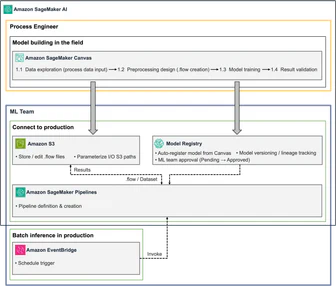
    GS Caltex uses Amazon SageMaker Canvas and Amazon SageMaker Pipelines to connect process engineer models to production workflows.

    GS Caltex enables process engineers to build and validate models without code through Amazon SageMaker Canvas, and then configure deployment and scheduled inference using Amazon SageMaker Pipelines. ML engineers can transfer SageMaker Canvas assets to Pipelines in just a few hours, with model version deployment and execution history managed by Pipelines, achieving batch processing of inference every 30 minutes and reducing inference costs.

  2. AWS Machine Learning Blog

    How AssemblyAI optimizes speech-to-text inference costs using EC2 Spot instances on AWS

    AssemblyAI builds an elastic architecture on AWS by hybridly using EC2 On-Demand and Spot instances, and leveraging Amazon ECS, SQS, and EventBridge, to increase GPU instance utilization by 3.5 times, achieve cost reduction within the European AWS region, and meet service level agreements (SLA). Its inference platform is deployed on three GPU instance families: g4dn, g5, and g6.

Nov 13Fri
  1. GitHub Blog · AI & ML58

    GitHub Blog: Build Once, Run Across Any Agent: A Practical Guide to Agent Skills

    Agent skills allow the capture of reusable instructions for users and agents, defining the timing and manner of task execution through a versioned directory centered around a SKILL.md file. Proof Agent uses an independent validator for adversarial validation of AI-generated content, while Data Forge constructs a support pipeline for table metrics through multiple collaborative skills, with each skill sharing context defined by a manifest rather than independently rediscovering it.

  2. AWS Machine Learning Blog

    Four aspects of Amazon Bedrock inference affect cost.

    Amazon Bedrock's request-level selection still changes the number of tokens processed by the service and the applicable tax rate. Cache duration, service tier, inference effort, and maxTokens can affect costs without changing the model or prompt. Each selection depends on the model and workload, and its effectiveness can be verified through response metadata, logs, and billing data.

  3. Claude · YouTube

    Claude Platform Team discusses how to build Claude API

    The Claude platform team discussed how to decide on API feature releases based on research and customer requests, as well as how to adjust controls in conversations without breaking prompt caching. Mythos and Fable use the same model weights but adopt different security measures. Claude Managed Agents and changing controls in conversations are in the testing phase. Access to Claude Mythos requires going through the Cyber Verification Program.

Nov 12Thu
  1. Claude · YouTube42

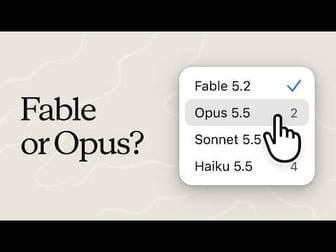
    Claude Code's use case selection between Fable 5.2 and Opus

    Claude Code released Fable 5.2, requiring users to select Opus 5.5, Fable 5.2, Sonnet 5.5, or Haiku 5.5 based on task type, or distribute tasks across models. The availability and usage restrictions of each model vary depending on the subscription plan. Guidelines suggest using the corresponding model for complex coding and knowledge work, open-ended technical tasks, and low-cost limited tasks, respectively.

  2. AWS Machine Learning Blog60

    AWS open-sources UAEF: cross-framework closed-loop evaluation AI agents

    AWS releases open-source framework UAEF, using adapters to unify the execution traces of LangGraph, LangChain, Strands Agents, Amazon Bedrock AgentCore, and Langfuse into AgentTrace, then scoring with 7 dimensions and 36 built-in metrics.

    Why it matters: The original text provides an adapter and metric design for cross-framework unified evaluation, allowing readers to judge the implementation method for comparing multi-framework agent versions.

Nov 11Wed
Nov 10Tue
  1. LangChain Blog

    How LangChain improves AI agents through Eval-Driven Development (EDD)

    LangChain improves AI agents through evaluation-driven development (EDD), defining agent behavior standards, building evaluations, adjusting code, and comparing results. EDD draws inspiration from test-driven development (TDD), targeting agents with non-deterministic outputs, measuring performance through evaluation metrics, and guiding development. Specific steps include defining agent behavior specifications, building test datasets containing inputs and reference outputs, and writing code or LLM evaluators to verify whether the behavior meets expectations.

  2. Meta Engineering38

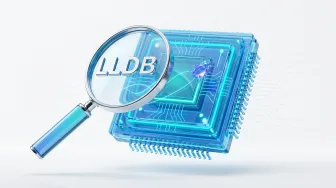
    LLDB extension architecture supports application debugging across CPU and GPU

    LLDB supports application debugging across CPU and GPU through the neutral accelerator plugin architecture of lldb-server, separating general debugging infrastructure from hardware-specific device control, presenting CPU and GPU as independent debugging processes that work together in a single debugging session. This architecture converts hardware-specific debugging APIs into concepts understood by LLDB through plugins, supporting collaborative debugging of CPUs and GPUs with different architectures, registers, memory spaces, and execution models while maintaining the neutrality of the client.

Nov 7Sat
  1. Claude · YouTube42

    How Salesforce leverages Claude Code to improve AI coding efficiency and output quality

    Salesforce expanded Claude Code to thousands of engineers, doubling effective output and reducing the number of bugs per line of code. The 'effective output' scoring system, co-built by the company's engineering leadership and Stanford researchers, measures AI coding ROI, and the intelligent agent maturity curve guides engineers from simple prompts to fully autonomous agents.

Nov 5Thu
  1. LangChain Blog

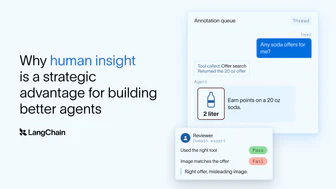
    How human insight constructs better intelligent agents - LangChain's three principles of human feedback

    LangChain explores three principles of human feedback to enhance agent development: expert judgment defines quality standards, comprehensive context evaluation, and converting feedback into reusable data; through agent trace to record user interactions and model behavior, manually labeled scoring with reasons, used to calibrate automated evaluators, improve evaluation criteria, and build golden datasets, forming reusable expert knowledge assets.

  2. IBM Research Blog38

    HRL Laboratory's MEMS inertial sensor can rival GPS

    HRL Laboratory develops an inertial measurement unit (IMU) using advanced algorithms, providing an uninterrupted GPS alternative. Its MEMS inertial sensor is the size of a can of soup, with accuracy close to GPS, and solves the long-standing problem of bias drift. Through the AutoCal automatic calibration system, it continuously corrects errors, achieving unlimited navigation support. The IMU uses ASIC and advanced packaging technology to optimize cost and size, making it suitable for light vehicles such as drones.

  3. AWS Machine Learning Blog60

    The four-layer context engineering of production-level AI agents: The practice of Deep Insight in runnable code.

    The AWS team, referencing the open-source multi-agent data analysis solution Deep Insight, has broken down the context engineering of production-level AI agents into four layers: multi-agent architecture isolation of context, using prompts to limit output, externalizing heavy content to the file system, and using a validation agent with a fallback mechanism.

    Why it matters: The AWS team has broken down the context engineering into four layers and provided specific code and token-saving data from the open-source reference implementation, which can be directly used to modify your own Agent.

Nov 4Wed
  1. NVIDIA Newsroom38

    How AI is reshaping the work of semiconductor wafer factories - engineers accelerating decision-making due to it

    AI is changing the way semiconductor wafer factories work, accelerating decision-making for engineers. NVIDIA's cuDSS library accelerates COMSOL's multiphysics simulation 10 times, Applied Materials' Ginestra platform simulation 10 times, ACE+ platform 35 times, and Siemens' Calibre lithography software simulation 17 times. NVIDIA's PhysicsNeMo framework enables Lam Research to predict plasma behavior at the millisecond level, replacing full simulations that took days.

Nov 3Tue
  1. LangChain Blog38

    LangChain points out new challenges in late 2026 for agent context engineering

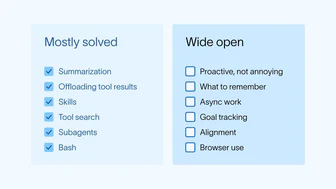
    LangChain points out new challenges for agent context engineering in late 2026, including how to proactively notify users without being annoying, agent memory management, asynchronous task processing, goal tracking and alignment, and browser usage, among other difficulties. These challenges involve how agents balance notification frequency when running in the background, decide on memory content, coordinate asynchronous tools and sub-agents, break down and iterate on goals, and prevent agents from over-optimizing goals.

Nov 1Sun
  1. Databricks Blog58

    Databricks Lakebase branching helps CI/CD: experience from 100 PR databases

    Databricks Lakebase reduces the creation time of each PR branch to seconds with its copy-on-write database branching feature, supporting up to 100 concurrent branches, with each branch having independent read/write, compatible with standard Postgres, and supports large JSONB/LOB columns, meeting Snorkel AI's needs for fast, secure, and low-cost testing of production data in CI/CD processes.

Oct 31Sat
  1. AWS Machine Learning Blog

    End-to-end method for managing Amazon Bedrock costs: playbook for FinOps and platform teams

    Amazon Bedrock cost management requires attributing every dollar spent to identity, team, and application, and monitoring, enforcing budgets, optimizing platform default settings, and then transforming data into decisions through regular reviews. Bedrock automatically attributes inference costs to IAM entities and requires CUR 2.0 and cost allocation tags to achieve this. To resolve shared role issues, user session management must be adopted to independently attribute each user request.

Oct 30Fri
  1. Google Developers Blog62

    Build generative UI applications with A2UI and CopilotKit agents

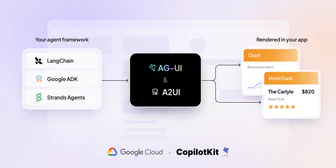
    Google introduces its framework-agnostic open standard A2UI, allowing agents to describe interfaces declaratively in JSON, rendered by applications using existing components, and integrated with the AG-UI protocol of CopilotKit to connect to agent frameworks like LangChain, Google ADK, Mastra, Strands, etc.

    Why it matters: The original text provides complete integration code and bidirectional interaction examples for A2UI and CopilotKit, which can be used to determine the implementation method for generative UIs.

Oct 29Thu
  1. AWS Machine Learning Blog58

    Build an enterprise-grade agent platform based on Amazon Bedrock AgentCore

    Amazon Bedrock AgentCore provides modular services such as runtime, gateway, identity, memory, policy, registration, and evaluation, supporting large-scale agent construction, deployment, and operation. The enterprise-grade agent platform blueprint based on AgentCore adds enterprise-level constraints such as ownership, account boundaries, software delivery, observability, cost governance, and retirement, achieving controlled access through inference gateway and tool gateway, and including an evaluation process to ensure agents are validated before production deployment.

  2. Google Developers Blog58

    How Agents CLI optimizes Agent quality through Hill-Climbing

    Agents CLI v1.8.0 achieves Hill-Climbing optimization of Agent quality through commands like eval generate, eval grade, etc., using the custom_response_quality metric to rate 4 cases from 1 to 5, finding that changing the system prompt to a chef role reduced the average score from 4.0 to 2.75. This tool supports model backend experiments and automatic alerts, improving Agent performance through iterative cycles.

  3. LangChain Blog

    How to use crons to build proactive agents with LangChain

    LangChain found that nearly 70% of Managed Deep Agents run from scheduled tasks. Crons enables agents to have proactivity, personalization, and ambient characteristics by implementing mechanisms such as memory ('dreaming'), proactivity (exploring new actions), intelligent filtering (monitoring event streams), and reminders (scheduled tasks).

Oct 28Wed