Skip to content
Live
Nov 14Sat
  1. AWS Machine Learning Blog

    How AssemblyAI optimizes speech-to-text inference costs using EC2 Spot instances on AWS

    AssemblyAI builds an elastic architecture on AWS by hybridly using EC2 On-Demand and Spot instances, and leveraging Amazon ECS, SQS, and EventBridge, to increase GPU instance utilization by 3.5 times, achieve cost reduction within the European AWS region, and meet service level agreements (SLA). Its inference platform is deployed on three GPU instance families: g4dn, g5, and g6.

Nov 12Thu
  1. AWS Machine Learning Blog

    Build autonomous AI agents using Amazon Bedrock and Spring AI

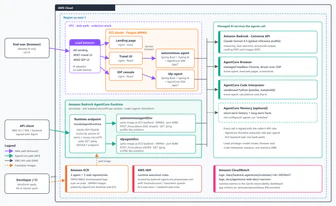
    Java teams can leverage Amazon Bedrock and Spring AI to build autonomous AI agents, addressing scalability, governance, security, and operational challenges. Spring AI brings AI capabilities to the JVM through the Spring framework (auto-configuration, dependency injection, composable advisors), while the Amazon Bedrock AgentCore platform supports framework and model-agnostic agent construction, connection, and optimization.

Nov 10Tue
  1. Google DeepMind76

    Google DeepMind releases Gemini Robotics 2.5 vision-language-action model

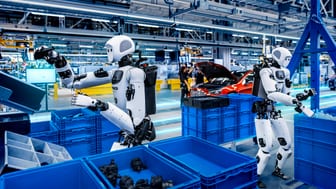
    Google DeepMind released Gemini Robotics 2.5, claiming it is the most capable vision-language-action (VLA) model to date, with a 30% to 100% increase in success rate on 200 tasks compared to previous baselines, and 20% to 30% faster task completion speed.

    Why it matters: Officially disclosed were 200 task evaluations and actual production line test data showing a 96% success rate for Mercedes-Benz, which can be used to judge the extent of VLA model deployment in real industrial scenarios.

Nov 9Mon
  1. NVIDIA Newsroom78

    NVIDIA released the GR00T 2 world action model and Isaac Lab 3.0 on CoRL.

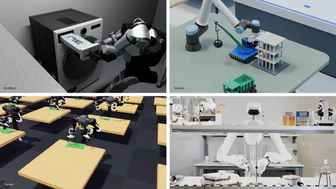
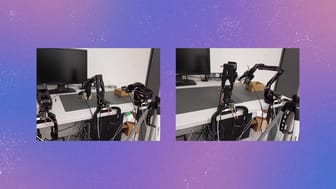
    NVIDIA released the open-source world action model GR00T 2 on CoRL, built on NVIDIA Cosmos, trained with 100,000 hours of NVIDIA open-source first-person human data, and can complete 40 out of 50 evaluation tasks without task-specific demonstrations.

    Why it matters: The original text provides the success rate of GR00T 2 on few-shot tasks and the training throughput improvement of Isaac Lab 3.0, which can be used to judge the extent to which simulation training promotes robot deployment.

Nov 6Fri
  1. Hugging Face Blog71

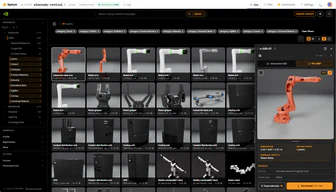
    NVIDIA has released four open-source world model checkpoints for Cosmos 3.

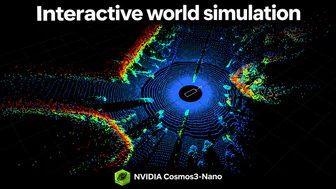
    NVIDIA has added four new open-source weight checkpoints for Cosmos 3 under the Cosmos World Model platform, all of which are post-trained versions of Cosmos 3 Nano, containing 16B trainable parameters, using the OpenMDW1.1 license, allowing commercial and non-commercial use.

    Why it matters: The original text provides four open-source weight checkpoints and a four-stage training recipe, allowing readers to judge how to adapt the world model to their own sensors and robot bodies.

Nov 2Mon
Oct 22Thu
Oct 21Wed
  1. NVIDIA Blog58

    NVIDIA European partners expand computing capabilities, building sovereign, open, and secure AI agent cloud ecosystems.

    NVIDIA European partners are expanding regional computing capabilities to support model training and inference, helping developers build agentic and physical AI applications. Nscale achieves 37% more GPUs and 50% higher inference throughput using the NVIDIA DSX platform, Crusoe develops a liquid-cooled AI factory for low-latency inference, and Nebius adopts the NVIDIA Groq 3 LPX to accelerate sensitive applications.

  2. Hugging Face Blog66

    NVIDIA has released the Cosmos3-H-Dreams surgical generative simulation model.

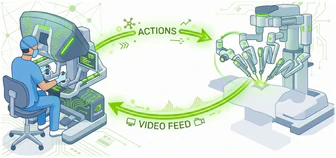
    NVIDIA has released Cosmos3-H-Dreams, extending interactive generative simulation to clinical gallbladder removal scenarios, capable of generating surgical scenes in real-time based on instrument movements.

    Why it matters: The original text explains the migration path from desktop stitching to clinical cholecystectomy scenarios, as well as the trade-off between quality and delay between four-step and two-step distillation checkpoints.

Oct 18Sun
  1. NVIDIA Blog

    NVIDIA RTX Spark laptops are officially launched, featuring Blackwell RTX GPUs and an AI platform.

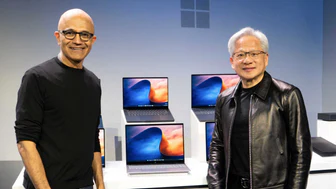
    NVIDIA RTX Spark laptops are now available, equipped with Blackwell RTX GPUs, up to 128GB unified memory, and the full NVIDIA AI platform, starting at $2399. They are launched by ASUS, Dell, HP, Lenovo, Microsoft, and MSI, bringing powerful local AI, content creation, and gaming capabilities to portable devices. NVIDIA held global launch events, including one in Berlin, where founder Jensen Huang made a surprise appearance.

Oct 16Fri
  1. Meta Engineering

    Meta How to Build Forum Applications with Native AI Engineering

    Meta uses AI agents to participate in the construction of engineering processes for Forum applications, viewing AI as a participant in the engineering process rather than an auxiliary tool. This experiment measures success by production-ready outcomes rather than lines of code, using a Human-On-The-Loop model to allow AI to autonomously execute planning, implementation, testing, and validation, with engineers responsible for setting goals, supervision, and acceptance.

Oct 15Thu
Oct 8Thu
  1. NVIDIA Blog

    NVIDIA and Microsoft team up to usher in a new era of AI agents for Windows PCs: RTX Spark and local AI calculator

    NVIDIA and Microsoft collaborate to launch RTX Spark laptops and Windows AI agent infrastructure, supporting local running of 125B parameter Qwen 3.8 Flash Next models; Microsoft releases MXC operating system-level container to ensure agent secure operation, pre-orders for RTX Spark open today, paired with Grace Blackwell chip, offering up to 20 PFLOPS inference performance.

Oct 7Wed
  1. AWS Machine Learning Blog

    AWS has launched an automated value model, redefining the business case for agent automation.

    AWS has proposed an automated value model, redefining the business case for agent automation. Traditional RPA investment return models overlook the value of agent automation in exception handling, decision quality, process adaptability, and value realization. Enterprises need to consider the redeployment value of released labor time or the reduction in cash costs, as well as the cost of exception correction, to build a credible business case.

Sep 30Wed
  1. Anthropic Research71

    Anthropic Research: What Work Can Robots Currently Complete?

    Anthropic has released a Robot Exposure Index study, using Claude to evaluate about 19,000 tasks in O*NET, finding that existing robots can complete 74% of physical tasks in the U.S. and account for 34% of all work time, but most are limited to controlled environments.

    Why it matters: Anthropic used Claude to rate O*NET tasks item by item, quantifying how much work robots can currently cover, and provided constraints on cost and regulation.

Sep 25Fri
Sep 24Thu
  1. Microsoft Research

    Microsoft Research explores the advantages of offloading physical AI reasoning to edge or cloud GPUs.

    Offloading physical AI reasoning to edge or cloud GPUs can significantly improve robot task success rates, support larger models, and extend battery life. In mobile operation tasks, offloading reasoning enhances robot response speed and accuracy, increases battery endurance, and reduces costs. Microsoft Research has developed a Kubernetes-based toolkit to support distributed reasoning deployment on robots, edge devices, and the cloud.

Jul 27Mon
  1. Meta AI Blog

    Meta AI's DINOv3 and SAM models help the University of Pittsburgh reshape assistive robots

    Meta AI's DINOv3 and SAM models achieve real-time perception in edge computing, supporting the University of Pittsburgh's RAMMP project development of assistive robots, interacting through natural language and image data to reduce user cognitive load, already integrated in prototypes with automatic door button detection, cup recognition, and navigation assistance features, and plans to add voice and touch input support.

Apr 3Fri