Skip to content
Live
Nov 14Sat
  1. AWS Machine Learning Blog

    How AssemblyAI optimizes speech-to-text inference costs using EC2 Spot instances on AWS

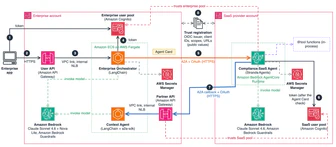
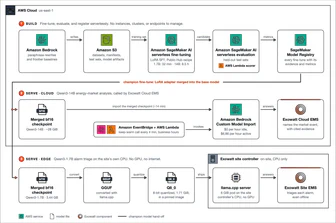
    AssemblyAI builds an elastic architecture on AWS by hybridly using EC2 On-Demand and Spot instances, and leveraging Amazon ECS, SQS, and EventBridge, to increase GPU instance utilization by 3.5 times, achieve cost reduction within the European AWS region, and meet service level agreements (SLA). Its inference platform is deployed on three GPU instance families: g4dn, g5, and g6.

Nov 13Fri
  1. Google Developers Blog

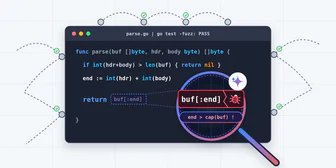
    Gemini and Z3 jointly capture bugs missed in Go code fuzz testing

    Gemini 4 Argon translates Go code panic paths into Z3 constraints, paired with Z3 to check trigger conditions, and paired with go test to replay trigger bytes, locating 3 embedded parser bugs and discovering 3 skill-lint potential bugs within 1 minute. This process is more efficient than go test -fuzz, capable of finding boundary check errors missed by fuzz testing.

Nov 12Thu
  1. Google Developers Blog78

    Google releases generative UI open protocol A2UI 1.0

    Google has released the Generative UI Open Protocol A2UI 1.0, which is the first stable version of the protocol, allowing AI agents to respond with interactive interfaces instead of plain text. Version 1.0 adds bidirectional function calls, accessibility support, and extended metadata, and provides open-source rendering SDKs for Web, Android, iOS, as well as agent SDKs for Python, TypeScript, and Dart.

    Why it matters: A2UI 1.0 extends agent output from pure text to native interactive interfaces, providing multi-platform renderers and integration scheme examples, allowing for judgment on the implementation methods of generative UI.

Nov 11Wed
  1. Databricks Blog76

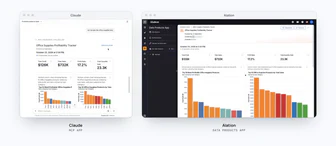
    Databricks upgrades Genie One to an enterprise AI collaboration workspace

    Databricks announces Genie One as the unified entry point for enterprise AI collaboration, consolidating search, product generation, and cross-tool operations into one place, and providing enterprise context based on Genie Ontology, governed by Unity Gateway.

    Why it matters: The original text provides specific capabilities of Genie One from Q&A to product generation, cross-tool execution, and governance, allowing for judgment on how enterprise AI workbenches can be implemented.

  2. Databricks Blog80

    Databricks releases new Genie: an autonomous AI colleague for complex enterprise work

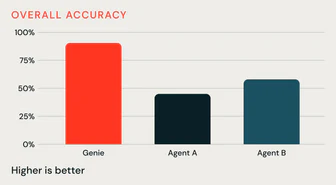
    Databricks released a new version of Genie, positioning it as an autonomous AI colleague that can continuously track progress, follow up on missing inputs, and take action when new information arrives. Users can set guards and approve critical steps. The new version is paired with Genie Ontology, which provides business definitions and organizational knowledge. Genie Search uses a hybrid search combining indexing and MCP, and continues to use Unity Catalog permissions. Unity Gateway manages access, cost, and auditing uniformly.

    Why it matters: The original text outlines the boundary of Genie's ability to shift from an assistant to autonomously performing long-term tasks and its governance methods, which can be used to determine the context and permission controls needed for enterprise agents to go live.

  3. Ant Group inclusionAI · Hugging Face new models

    inclusionAI/ZoomGain-4B released: A fine-grained visual supervision model based on global-to-local visual perception gaps

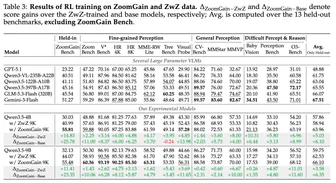
    inclusionAI has released the ZoomGain-4B large language model, achieving a score of 61.08 on ZoomGainBench and performing excellently on multiple fine-grained perception and general perception benchmark tests; the model is built with supervision based on the global-to-local visual perception gap mined from global image details, supporting English and Chinese Q&A, and can be downloaded via Hugging Face.

Nov 10Tue
  1. AWS Machine Learning Blog38

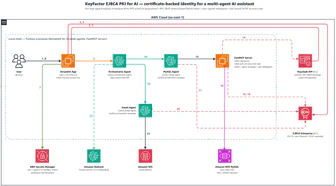
    CrossnoKaye on How to Achieve Industrial Physical AI with Amazon Bedrock AgentCore

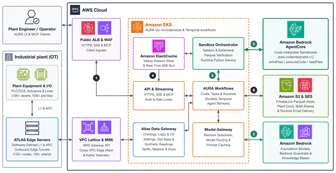
    CrossnoKaye achieves industrial physical AI on Amazon Bedrock AgentCore through its ATLAS platform and AURA agent, improving production efficiency by 11-17% and reducing energy consumption by 21%. AURA leverages AgentCore's code interpreter capabilities to run Python workloads in isolated micro VMs to verify numerical calculations, while achieving closed-loop control through edge clusters and cloud optimization systems.

  2. Google Developers Blog60

    Google AI Studio supports building Google Maps applications with prompt words

    Google AI Studio can now directly build applications driven by Google Maps Platform, where users describe their ideas and AI Studio automatically completes configuration and API key management without a credit card.

    Why it matters: The original text provides daily quotas without a credit card and a complete path from prompt words to a runnable map application, allowing readers to judge the cost of prototype construction based on this.

Nov 6Fri
  1. Mistral AI75

    Mistral releases Mistral Large 4 (Le Chonk) and expands Mistral Studio platform

    Mistral releases Mistral Large 4 (codename Le Chonk), featuring coding, defensive cybersecurity, and complex document reasoning, while expanding the enterprise platform Mistral Studio with new capabilities for hosted agents, applications, workflows, as well as enterprise context, agent observability, and evaluation features.

    Why it matters: The original text provides three types of capabilities (hosted agents, workflows, applications) and deployment options, allowing readers to judge the implementation methods of enterprise agents accordingly.

Nov 5Thu
  1. Google Research

    Agile Deliberation: How AI Assists Humans in Defining Subjective Concept Boundaries

    The Agile Deliberation framework assists humans in defining the boundaries of subjective concepts through iterative dialogue, transforming fuzzy ideas into precise AI instruction blueprints. The framework is divided into two stages: concept definition and concept iteration, which processes fuzzy images through direct feedback. In 18 user experiments of 1.5 hours each, it significantly reduces user fatigue and anxiety, making AI model performance superior to standard baselines.

Nov 4Wed
  1. Google DeepMind75

    Google Antigravity launches cheminformatics skills, completing drug discovery process in one hour

    Google DeepMind releases a set of cheminformatics skills (Cheminformatics Skills) for Google Antigravity, based on RDKit and integrated with ChEMBL and PubChem, where language models are responsible for process orchestration and scientific reasoning, and deterministic chemical tools perform molecular calculations.

    Why it matters: The original text provides a complete process of cheminformatics skills in real lung cancer drug cases, which can be used to determine the division of labor for intelligent agents in scientific research workflows.

Oct 30Fri
  1. Google Developers Blog62

    Build generative UI applications with A2UI and CopilotKit agents

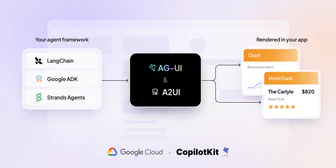
    Google introduces its framework-agnostic open standard A2UI, allowing agents to describe interfaces declaratively in JSON, rendered by applications using existing components, and integrated with the AG-UI protocol of CopilotKit to connect to agent frameworks like LangChain, Google ADK, Mastra, Strands, etc.

    Why it matters: The original text provides complete integration code and bidirectional interaction examples for A2UI and CopilotKit, which can be used to determine the implementation method for generative UIs.

Oct 29Thu
  1. Microsoft Official Blog72

    Microsoft opens the Copilot harness through Foundry, supporting the development of multi-model intelligent agents

    Microsoft opens the GitHub team's Copilot harness built by GitHub through Microsoft Foundry, providing a fully managed way to build intelligent agents that can reason, call tools, and complete long tasks.

    Why it matters: Microsoft opens the multi-model harness supporting multiple Copilot products internally to Foundry, allowing readers to judge the trade-offs of building their own orchestration layer based on this.

Oct 28Wed
Oct 27Tue
  1. AWS Machine Learning Blog48

    Building enterprise-grade intelligent retrieval on Amazon Bedrock knowledge base using AWS CDK

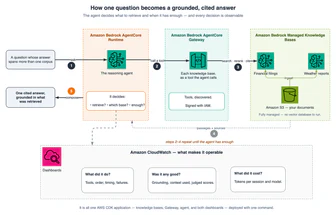
    Building enterprise-grade intelligent retrieval on Amazon Bedrock knowledge base using AWS CDK, providing multi-round planning and tool-driven retrieval through the reasoning agent and AgenticRetrieveStream API, returning referenced answers. The solution deployment includes a CDK application with Amazon S3 corpus, knowledge base, and reasoning agent, supporting semantic routing and multiple retrievals, and built-in Amazon CloudWatch monitoring and evaluation features.

Oct 22Thu
Oct 21Wed
  1. AWS Machine Learning Blog34

    Building an AI agent semantic layer on AWS using Strategy Mosaic and Amazon Bedrock AgentCore.

    Strategy Mosaic, as a semantic layer, models C360 domains on Amazon Redshift and Amazon Aurora without ETL using two linked models. Its metric syntax captures the business definition of agent reasoning and exposes the model to AgentCore-hosted Strands agents via the Mosaic MCP server, supporting user identity propagation to achieve end-to-end row-level and object-level security.

  2. AWS Machine Learning Blog40

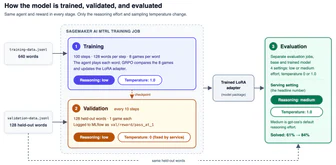
    Fine-tune GPT-OSS-20B on Amazon SageMaker HyperPod for multilingual inference

    GPT-OSS-20B is an open-source inference model that thinks in English by default, and only 22% met the target language requirements in multilingual inference tests. By using supervised fine-tuning (SFT) and reinforcement learning (GRPO) on Amazon SageMaker HyperPod, the team can improve the model's inference capabilities in French, German, Spanish, and Italian, where SFT is responsible for primary behavior teaching and GRPO optimizes when there is room for improvement.

Oct 19Mon
  1. MiniMax News

    MiniMax M3.1 Flash released: Next-generation model with improved performance and reduced cost

    MiniMax M3.1 Flash is officially launched, with nearly a threefold increase in online inference speed and a 70% reduction in cost compared to the previous generation. The model performs excellently in benchmark tests for complex intelligent tasks (cowork), computer use, software development, and network security, ranking highly in the AutomationBench-AA for automated tasks, scoring 73.7% on DeepSWE v1.1, 61.7 on OSWorld V2, 29.6 on ALE, and 82% on CyberGym.

Oct 16Fri
  1. Meta Engineering

    Meta How to Build Forum Applications with Native AI Engineering

    Meta uses AI agents to participate in the construction of engineering processes for Forum applications, viewing AI as a participant in the engineering process rather than an auxiliary tool. This experiment measures success by production-ready outcomes rather than lines of code, using a Human-On-The-Loop model to allow AI to autonomously execute planning, implementation, testing, and validation, with engineers responsible for setting goals, supervision, and acceptance.

Oct 15Thu
  1. Apple Machine Learning Research

    MLX and RDMA implement local and distributed large language model inference on Mac Studio

    On a cluster of four Mac Studio machines, Muse Spark Open (816B parameters) generates at a speed of over 36 tokens/second. The Mac Studio M5 Ultra version offers 4.6x faster inference speed (TTFT) and 1.6x faster tokens/second compared to the M3 Ultra, benefiting from the GPU neural accelerator and 1.2 TB/s memory bandwidth.

Oct 14Wed
Oct 9Fri
  1. AWS Machine Learning Blog

    Use Amazon SageMaker HyperPod to share GPU clusters between teams and achieve isolation and fairness.

    Amazon SageMaker HyperPod provides centralized authentication through AWS IAM Identity Center, uses the SageMaker AI domain to provide a customized user experience, combines Kubernetes namespaces to achieve workload isolation, and leverages HyperPod task governance for fair resource allocation, supporting multiple teams in efficiently sharing a single HyperPod EKS cluster.

Oct 7Wed
  1. AWS Machine Learning Blog

    AWS has launched an automated value model, redefining the business case for agent automation.

    AWS has proposed an automated value model, redefining the business case for agent automation. Traditional RPA investment return models overlook the value of agent automation in exception handling, decision quality, process adaptability, and value realization. Enterprises need to consider the redeployment value of released labor time or the reduction in cash costs, as well as the cost of exception correction, to build a credible business case.

Sep 24Thu
Sep 22Tue
Apr 18Fri
  1. Anthropic Research62

    Anthropic releases Claude Code best practices for intelligent agent coding

    Anthropic releases Claude Code best practices covering CLAUDE.md configuration, tool permission management, MCP access, common workflows, and multi-Claude parallelism. The article suggests exploring and planning with sub-agents before writing code and provides specific processes such as test-driven development, screenshot iteration, and headless mode automation. This article has been moved to the official documentation, and the original blog is no longer maintained.

    Why it matters: Anthropic's official system has organized the configuration, workflows, and multi-instance parallel methods of Claude Code, which can be used as a reference for setting up intelligent agent coding processes.

Mar 27Thu
  1. Anthropic Research

    Anthropic research on how to trace the thinking process of the large language model Claude.

    Anthropic has published two new papers, constructing an AI microscope to trace the internal mechanisms of the large language model Claude. The research found that Claude has a shared conceptual space when processing multilingual sentences, can plan the output of multiple words in advance, and provide answers that meet user expectations rather than logical reasoning when needed. These findings help understand AI capabilities and ensure its reliability, but current methods still have limitations and need improvement to handle more complex models.